
Zelensky's corruption problem: can he keep dodging it?
Ukraine's president has stayed silent for two weeks as his former chief of staff faces a NABU money-laundering investigation. His approval holds at around 60% — but the clock is ticking.

Two weeks have passed since Andriy Yermak‘s name surfaced as a suspect in a NABU money-laundering investigation, and Volodymyr Zelensky — Ukraine’s wartime president who addresses his nation every single evening — has not uttered a word about it. That silence, from a leader whose daily messaging is a pillar of national cohesion, is itself a political statement.
At a Glance
Andriy Yermak, Zelensky’s former chief of staff and once considered the second most powerful man in Ukraine, is named in a NABU financial investigation. The case is the latest escalation of a broader pattern of corruption revelations that began surfacing in winter 2025.
Despite the mounting allegations, Zelensky’s trust and approval ratings hover around 60% — a wartime premium driven by patriotic solidarity.
Transparency International Ukraine is calling on the president to speak publicly. Analysts warn that this popular support will not outlast the war.
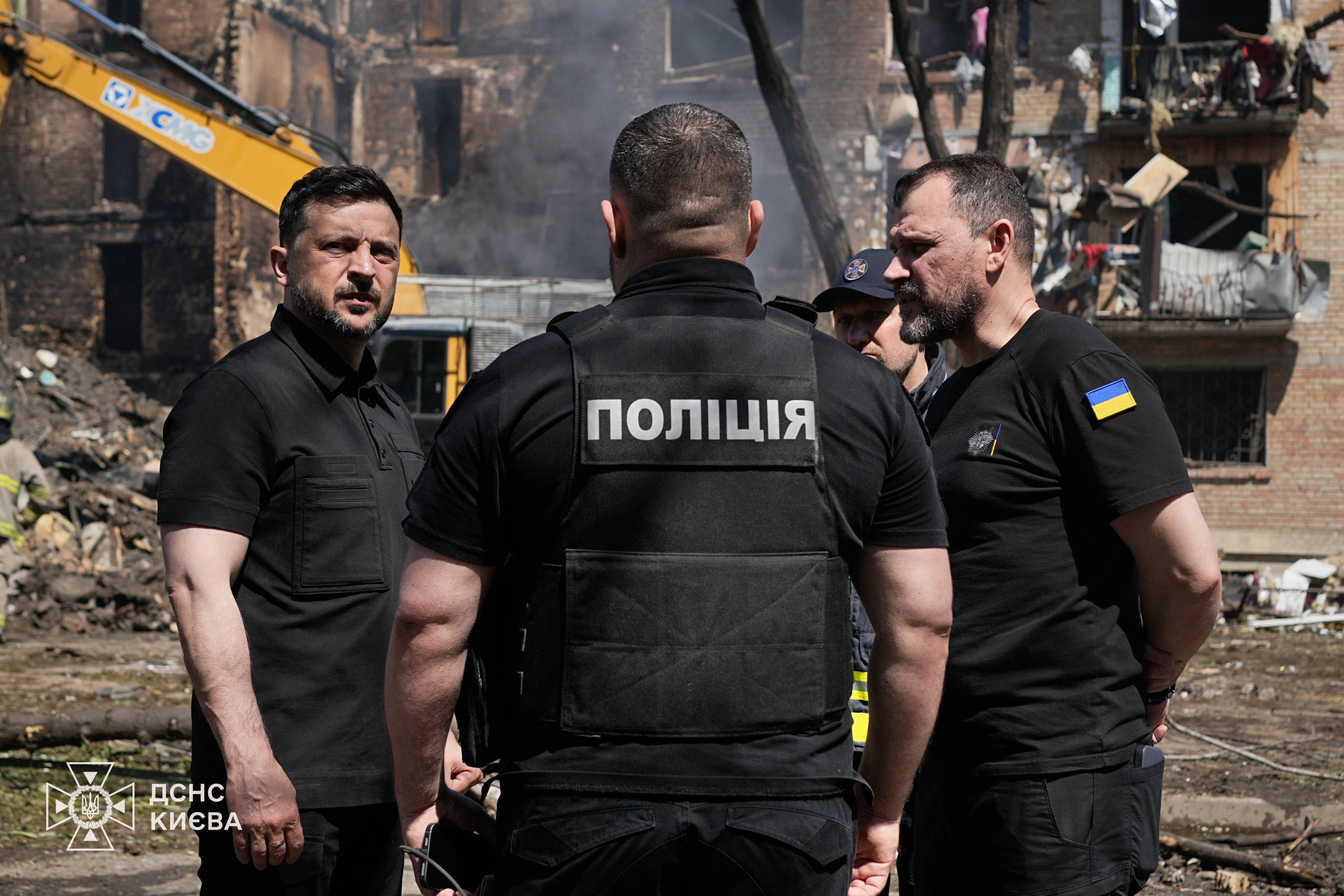
This image is used for illustrative purposes only.
Yermak: the power broker caught in the crosshairs
Andriy Yermak was no peripheral figure. Until his removal, he served as Zelensky’s chief of staff — the functional equivalent of a White House chief of staff, but with influence that observers described as exceeding that of several cabinet ministers. He was Kyiv’s chief diplomatic architect and the primary Ukrainian interlocutor for Western governments.
Ukraine’s National Anti-Corruption Bureau — known as NABU, an independent investigative body whose creation in 2014 responded to demands from Ukraine’s Western partners as a condition of continued financial support — has opened an investigation into a financial arrangement involving asset transfers of contested legality. The precise mechanics of the alleged scheme have not been made public in available sources.
What is established is the political weight of the allegation: Yermak sits at the innermost ring of Zelensky’s inner circle. His formal implication as a suspect strikes directly at the credibility of wartime governance.
The anatomy of presidential silence
Zelensky speaks every day about the war, about diplomacy, about Russian strikes. His silence on Yermak is therefore a choice, not an omission. Several explanations are plausible, though none can be established with certainty at this stage.
It could reflect a containment strategy: any comment would legitimize the story and amplify it. It could signal difficulty in crafting a response that does not further expose his inner circle. Or — a hypothesis advanced by members of Ukrainian civil society — it could indicate an implicit tolerance of practices treated as secondary to the war effort.
A civil society worker at an international NGO, identified only as Vitaly, described himself as “appalled,” adding that the accumulation of revelations left little room for the president to claim ignorance. Andriy Borovyk, executive director of Transparency International Ukraine, told Radio Svoboda — Ukraine’s public radio broadcaster — that Zelensky “won’t be able to avoid addressing” the matter and must answer the questions being raised. Borovyk stopped short of calling for the president’s resignation.
The 60% shield — and its expiration date
The most striking data point is this: despite the cascade of corruption cases, Zelensky’s trust and approval ratings hover around 60% — higher than before the full-scale Russian invasion of February 2022. War has produced the same rally-round-the-flag effect that historical precedents consistently document: a president embodying national resistance becomes politically untouchable as long as the existential threat persists.
This mechanism has a structural limitation: it is temporary. Anton Hrushets’kyi, director of the Kyiv International Institute of Sociology, frames it plainly. Ukrainians are saying, he argues, that ending the war is the priority — corruption can wait. But that very logic, he adds, “undermines Zelensky’s political future,” because “after the war, Ukrainians want to see a new generation” leading the country.
Accountability is deferred — not erased.
Seven in ten Ukrainians oppose holding elections before the end of the conflict. The reckoning is postponed, not cancelled.
Analysis — Anti-corruption: the price of Western support
Corruption in Ukraine is far more than a domestic governance problem. It is a political red line for the country’s Western backers.
Since the 2014 Maidan revolution, aid from the European Union, the International Monetary Fund, and the United States has been conditioned on measurable anti-corruption reforms: the creation of NABU itself, the establishment of asset-disclosure requirements for public officials, and the launch of a specialized anti-corruption court — the High Anti-Corruption Court, or HACC. These conditions were the political price of Ukraine’s euro-Atlantic trajectory.
The implication of a figure as central as Yermak raises a strategic question for Kyiv’s partners: can they sustain aid levels to a government whose closest aides are under active investigation for money laundering? The diplomatic answer will almost certainly be to avoid raising the question publicly while the front holds. That does not mean it is not being raised in private.
For an American or Canadian reader, a rough analogy: imagine a U.S. president’s chief of staff named a suspect in a federal money-laundering investigation during a major conflict, while the White House maintains total silence. The political pressure would be immediate. In Ukraine, it is deferred by the military context — but its intensity, when it finally arrives, may be all the greater for having been suppressed.
The bottom line
The question this affair raises is not ultimately about Yermak’s guilt or innocence — that will be determined, or not, by the courts. It is about the model of governance Ukraine intends to build when the guns fall silent. A country pursuing EU membership cannot treat corruption at the apex of its state as a matter to be addressed after the peace. Europe already knows this. And it is watching.
Sources: France Info · Radio Svoboda · Transparency International Ukraine