
Zelensky to Putin: "Enough of war"
In an unprecedented open letter, Ukraine's president calls for a full ceasefire and a direct face-to-face meeting. Moscow responds with a smirk. Europe watches. What now?

At a Glance
On June 4, 2026, Volodymyr Zelensky, Ukraine’s president, published an open letter addressed directly to Vladimir Putin, Russia’s president, proposing a bilateral meeting in a neutral third country — Switzerland, Türkiye, or the Arab world — and a full ceasefire for the duration of any negotiations.
The letter sets one firm principle: the current front line is the only starting point for any diplomacy, implicitly rejecting any pre-negotiation demand that Ukraine cede territory.
The Kremlin responded through spokesman Dmitry Peskov, who said Zelensky could come to Moscow “at any time” — a formula that deflects the proposal without engaging it. Putin, attending the St. Petersburg International Economic Forum, did not respond directly.
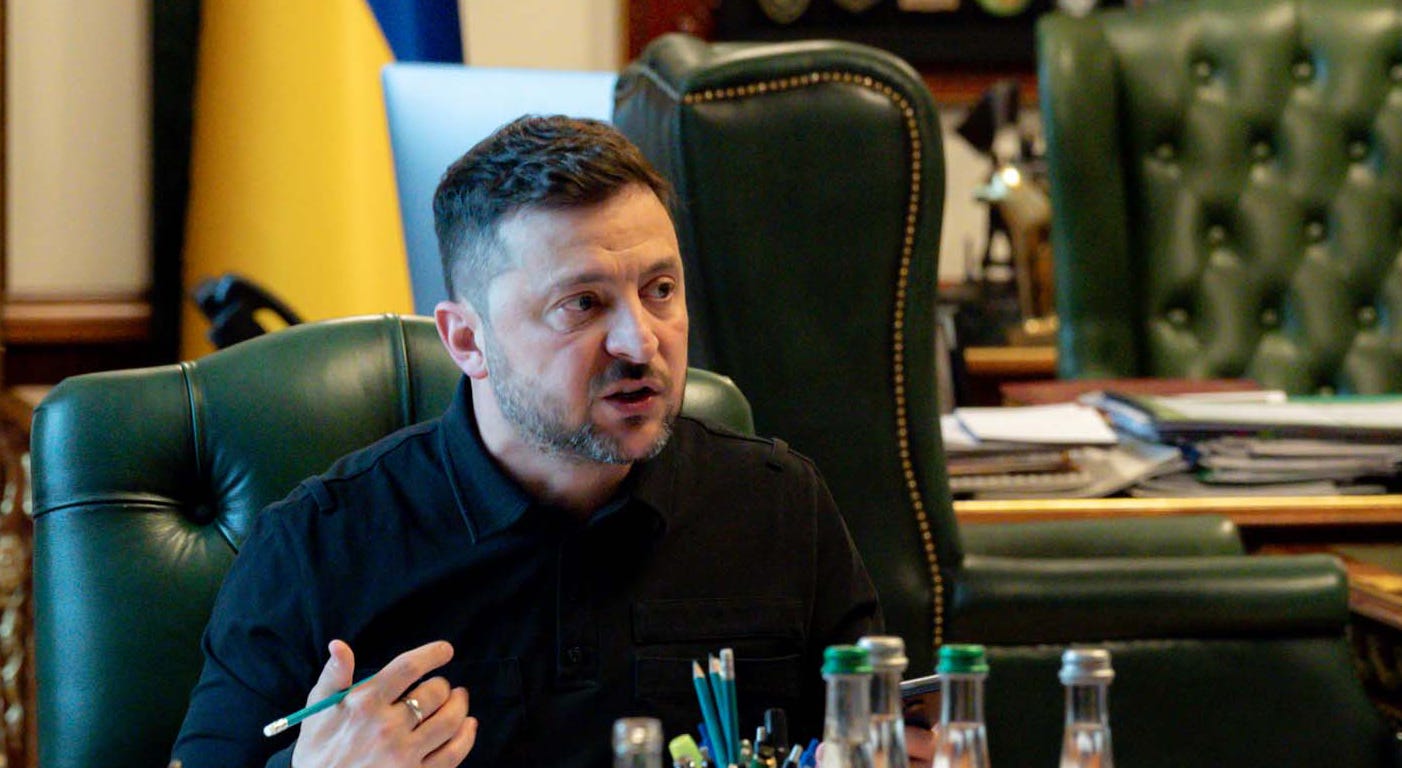
This image is used for illustrative purposes only.
Five years in, a letter as political act
On June 4, 2026, Volodymyr Zelensky published an open letter addressed to Vladimir Putin — unusual in form, deliberate in content. Posted on the official website of Ukraine’s presidency, the letter proposes a face-to-face meeting on neutral ground, a full ceasefire for the duration of talks, and a comprehensive prisoner-of-war exchange.
This is not an offer of surrender. It is also an indictment. Zelensky reminds Putin that he has spent “nearly half of his 26 years in power waging war against Ukraine” — a war he calls “a personal choice” made “without a real cause.” The letter catalogs Russian setbacks: economic deterioration, dependence on North Korea and China for military support, and mounting battlefield losses. According to figures cited by Ukraine in the letter — figures that have not been independently verified — Russian casualties exceeded 30,000 soldiers killed or seriously wounded in May 2026 alone, with a reported ratio of 63 percent killed to 37 percent wounded. Zelensky also invokes the June 2023 armed mutiny staged by Wagner Group, a Russian private military company, against Russia’s military leadership — an episode that briefly threatened Putin’s grip on power.
The ceasefire proposal and where the line is drawn
“The front line today is the line from which diplomacy must begin.”
This is a negotiating position, not a concession. It means Kyiv refuses to discuss territorial transfers before a ceasefire is in place. It also implicitly rejects Russia’s annexation of four Ukrainian regions — Donetsk, Luhansk, Zaporizhzhia, and Kherson — which Moscow declared part of Russia in September 2022 and considers non-negotiable.
The letter does not abandon Ukraine’s claim to those territories. It proposes engaging diplomacy from military reality, not from a map redrawn in Moscow.
Washington, Moscow, and the European question
Zelensky is not writing only to Putin. The letter is also a message to Western capitals.
He takes direct aim at recent American-Russian contacts in Alaska — a reference to talks held in Anchorage in early 2026 — writing that “Ukrainian and European issues are not decided in Anchorage.” It is a pointed warning against any agreement reached over Kyiv’s head.
On Europe’s role, he is explicit: it must be a party to any new security architecture, alongside the United States. He names Switzerland, Türkiye, and Arab-world nations as potential hosts for a meeting — countries that have maintained communication channels with Moscow or positioned themselves as mediators.
The Kremlin’s response, delivered by Dmitry Peskov, Putin’s longtime spokesman, was dismissive in substance while superficially conciliatory: Zelensky could come to Moscow “at any time.” The formulation rejects neutral-ground talks while maintaining a façade of openness. Putin, wrapping up a press encounter with foreign journalists at the St. Petersburg forum, did not respond directly at the time of publication.
Analysis: a letter for whom?
The dual geometry of an open letter
Addressing Putin publicly creates a documented diplomatic record. If Russia refuses any meeting on neutral ground, that refusal becomes, itself, a political act — visible to the world. The letter also speaks over Putin’s head, to Russian public opinion: Zelensky devotes several paragraphs to describing what he frames as growing Russian fatigue — fuel shortages, rising prices, a looming second wave of mobilization. This is as much a communication strategy as a diplomatic initiative.
What “full ceasefire” actually means
Russia has consistently rejected prolonged ceasefire proposals, arguing they would allow Ukraine’s military to regroup and rearm. That objection has not disappeared. But the context has shifted: according to Ukrainian-sourced data in the letter, monthly Russian losses have exceeded 30,000 for consecutive months. If accurate, the reported ratio of killed to wounded — far higher than standard military benchmarks — would suggest serious logistical and medical failures on the Russian side. Independent verification of these figures remains unavailable.
The ceasefire Ukraine proposes is not open-ended. It is explicitly tied to the existence of an active negotiating process — “for the duration of negotiations.” No talks, no freeze.
The shadow of Minsk
Zelensky explicitly acknowledges the failure of the Minsk agreements — ceasefire and political settlement deals brokered in 2014 and 2015 under French and German mediation, designed to freeze the conflict in eastern Ukraine’s Donbas region. Those agreements were never fully implemented, and Russia launched its full-scale invasion in February 2022 without honoring them. By invoking Minsk directly, Kyiv signals it will not accept another framework agreement without concrete guarantees — and that it wants direct answers to hard questions before handing anything over to technical working groups.
The bottom line
An open letter does not make peace. It asks a question that is difficult not to answer.
If Putin refuses any meeting on neutral ground, he publicly assumes responsibility for rejecting a ceasefire offer. If Zelensky gets no response, he strengthens his diplomatic standing with Western allies and global opinion. Either way, the letter of June 4, 2026 creates a documented precedent.
The real question is not whether Putin will respond — he will, one way or another. It is whether the guarantees Ukraine is seeking — European and American presence at the table, a security architecture with teeth — can be secured while Washington is consumed by the Iran file, and while Europe navigates its own internal divisions over how hard a line to hold.
Sources: France 24 · Office of the President of Ukraine (president.gov.ua)