
Zelensky to Lukashenko: remove those relay towers — or Ukraine will
Zelenskyy gives Lukashenko one week to remove Shahed drone relay systems from Belarusian towers — or Ukraine will act. Minsk's neutrality claim is no longer credible.

Ukraine’s president issued a direct ultimatum to the Belarusian strongman: one week to dismantle the radio relay systems on Belarusian communication towers that guide Russian killer drones into civilian areas. Minsk’s fiction of neutrality has just collapsed in public.
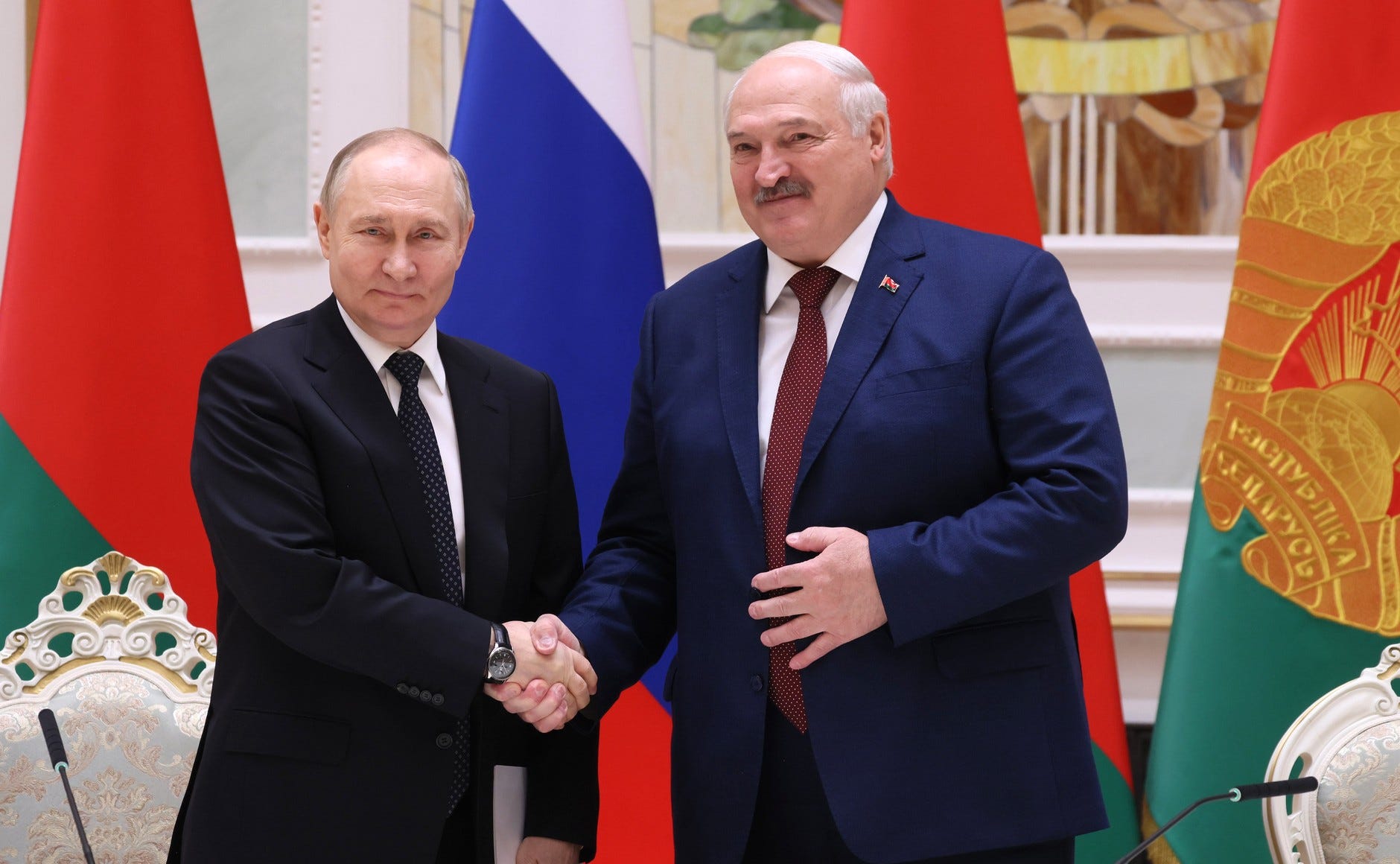
This image is used for illustrative purposes only.
At a Glance
Zelenskyy formally gave Lukashenko one week to remove signal relay equipment installed on communication towers along Belarus’s border with Ukraine — devices used to guide Iranian-made Russian Shahed drones against civilian targets.
This is not the first round: Ukraine had already destroyed a similar network in February 2026, Russia rebuilt it by spring. Lukashenko keeps allowing it.
The ultimatum reframes the Belarus file entirely: Minsk is no longer a passive Russian accomplice — it has been publicly served notice, with an explicit Ukrainian military threat against its own territory if it fails to comply.
A killing infrastructure on Belarusian soil
What Zelenskyy disclosed on June 19, 2026, was not a vague accusation. It was a description of identified, geolocated, and previously dismantled infrastructure — now rebuilt.
Since at least late 2025, mesh-network relay nodes have been installed on communication towers in Gomel and Mogilev, the two Belarusian regions bordering Ukraine — some structures standing 70 to 90 meters tall. These devices don’t launch drones. They guide them. By linking Iranian-made Shahed drones to one another via radio, they allow Russian operators to maintain control of the drone swarm even as individual units are shot down. The signal reroutes. The strike continues. The result: more precise, deadlier attacks on civilian areas in northern and western Ukraine.
In February 2026, Ukraine dismantled that network, an operation confirmed publicly by Ukrainian Defense Minister Mykhailo Fedorov and his ministry’s technology adviser Serhii Beskrestnov on February 27. Russia rebuilt a version of it by spring 2026, this time using signal-relay balloons drifting from Belarusian airspace into Ukraine. By June, new relays are back in place. Lukashenko is either allowing it — or unable to stop it. Zelenskyy has stopped distinguishing between the two.
“There are relay systems on those towers — Russian relays, Belarusian relays. What difference does it make to us?” he said at a joint press conference in Kyiv alongside Honduran President Nasry Asfura. “On his territory, along two regions bordering Ukraine, there is equipment directing fire at the Ukrainian population — civilians. There are relays on the relevant towers. Can he remove them? Why say he doesn’t want to be at war?”
The ultimatum: one week, or Ukraine acts
The timeline is not rhetorical.
“If he doesn’t do it, we will.”
Ukraine has already struck on Belarusian soil before. In December 2025, Kyiv neutralized several Shahed relay nodes in Belarus — an operation Zelenskyy confirmed in February 2026 without detailing the methods. That earlier dismantling demonstrably improved air defenses over Kyiv and central Ukraine. The June 19 ultimatum signals Kyiv is prepared to act again if Lukashenko does not comply.
Zelenskyy also accused Belarus of being “one of the main suppliers of petroleum products to the Russian army” — a charge that widens the indictment beyond relay stations and frames Minsk as an active logistics partner in Russia’s war effort, not merely a reluctant bystander.
Lukashenko caught between his apology and reality
The ultimatum lands in a singularly awkward diplomatic moment. Only days earlier, Lukashenko had apologized to Zelenskyy — publicly, in an interview with Al Arabiya — for remarks widely described as mocking and offensive, made in late May in response to Ukrainian military warnings. It was an unprecedented gesture from the autocrat, though he paired it with an instruction for Zelenskyy to “calm down.”
Those soft gestures — an apology, a proposed meeting, the release of 250 political prisoners following U.S. mediation — had been building a thin veneer of détente. Zelenskyy’s ultimatum strips it away. You cannot apologize with one hand and, with the other, maintain equipment on your towers that guides strikes killing Ukrainian children.
Zelenskyy made his read of Lukashenko’s position explicit: “Russia will continue to push him into this war. He now understands that Ukraine will respond.” The bilateral pressure logic — Moscow pushing, Kyiv threatening — leaves Lukashenko with diminishing room to maneuver.
What relay towers reveal about Belarusian “neutrality”
The Shahed relay dossier exposes something Lukashenko’s rhetorical détente had been obscuring: Belarus is not a passive Russian ally watching the war from the sidelines. It is active military infrastructure.
For a reader unfamiliar with the technical details, the parallel is direct: imagine a neighboring country permitting a hostile power to install missile-guidance antennas on its own cell towers, while publicly declaring it has no involvement in any conflict. That is no longer complicity by omission — it is participation by infrastructure.
Ukraine’s choice to issue a public ultimatum rather than strike immediately creates a sovereign accountability test for Lukashenko: can he impose anything on his own territory against Moscow’s wishes? If the relay systems are still operating in a week, the answer is no — and Kyiv will have pre-established its public justification for acting.
For the European Union, the development reinforces the rationale behind the sanctions Ukraine imposed on Lukashenko personally in February 2026, partly over this same relay network: Minsk is not a neutral party — it is a link in Russia’s strike chain.
The bottom line
Zelenskyy didn’t issue a warning. He posed a question Lukashenko cannot answer without choosing a side: dismantle the relays and defy Moscow, or leave them in place and invite Ukrainian strikes on Belarusian soil. Either way, neutrality is over. The real question is whether Lukashenko grasps that — or whether Putin won’t even allow him to think it through.
Sources: Le Monde · France Info · Euronews