
Zelensky in London: Europe draws its red lines

Europe’s three biggest military backers met with Ukrainian President Volodymyr Zelensky at Downing Street on June 7, issuing a joint statement with five binding conditions for peace — and a clear demand to be seated at the negotiating table.
Four leaders gathered in a Downing Street sitting room, a war entering its fifth year, and, for the first time in months, the outline of a shared roadmap. On June 7, 2026, Ukrainian President Volodymyr Zelensky traveled to London for bilateral talks with British Prime Minister Keir Starmer, followed by a broader E3-format meeting with Starmer, French President Emmanuel Macron, and German Chancellor Friedrich Merz. The four leaders concluded the evening by issuing a joint statement setting out five conditions for what they called a “just and lasting peace.”
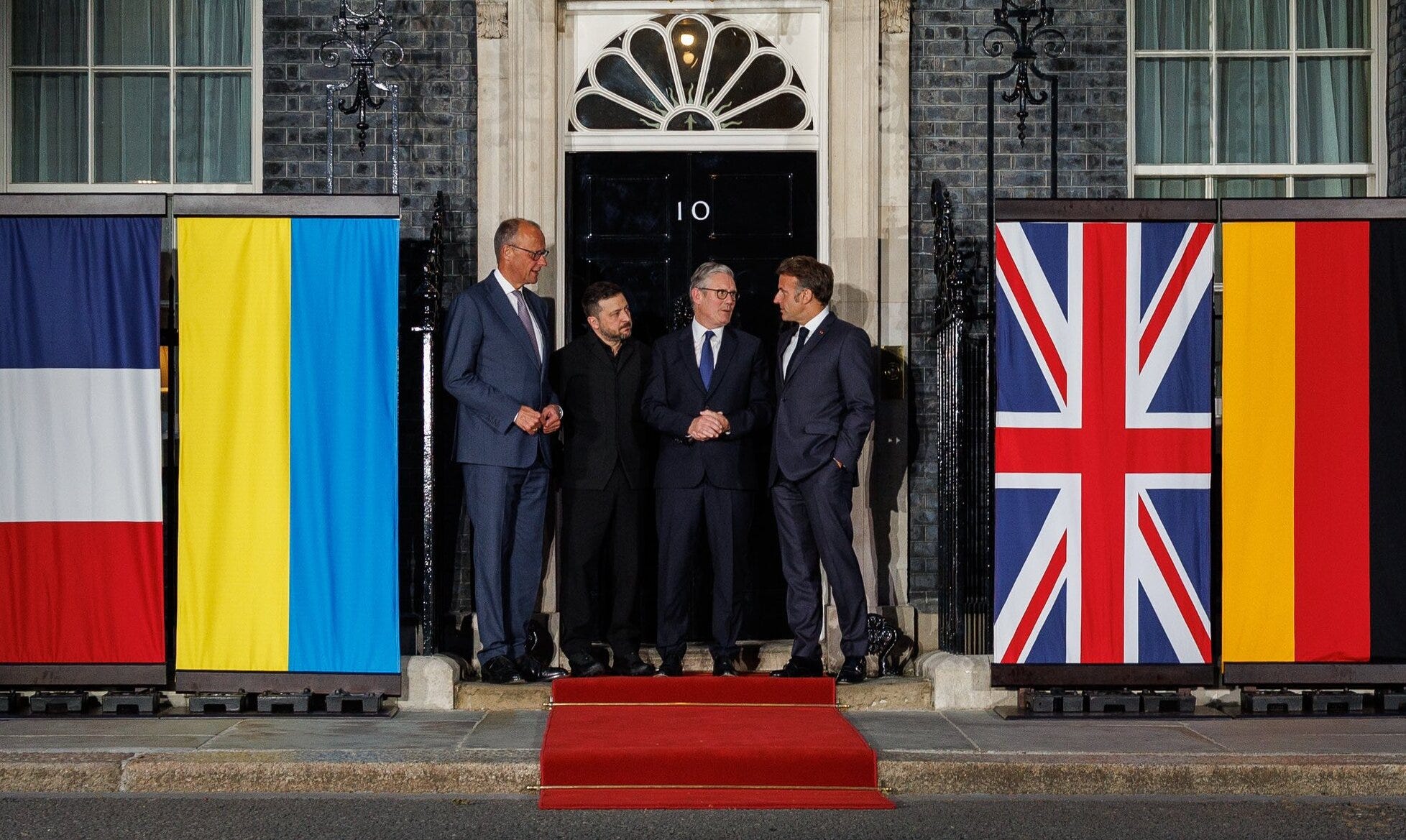
This image is used for illustrative purposes only.
At a Glance
Zelensky, Starmer, Macron, and Merz issued a joint statement on June 7 laying out five conditions for ending the war: an immediate ceasefire, negotiations based on the current front line, legally binding security guarantees for Ukraine, reparations backed by frozen Russian assets, and EU/NATO consent for any deal touching their structures.
The meeting came three days after Zelensky sent an open letter directly to Putin proposing face-to-face talks — a first since Russia’s full-scale invasion in 2022 — which Moscow effectively rejected by inviting Zelensky to come to Moscow.
Europe’s message was deliberate: “Europe should be in the negotiations and should be strong,” Zelensky said ahead of the meeting, echoing a position that Macron and other leaders have been pressing for months.
Five non-negotiable conditions
The joint statement, published on the evening of June 7 and available in full on the UK government’s official website (GOV.UK), is the most detailed policy document to emerge from the E3 format — the informal grouping of the UK, France, and Germany — in several months. It lays out five demands the signatories describe as prerequisites for any resolution: an immediate and unconditional ceasefire; negotiations starting from the current line of contact, with no pre-conceded territorial losses for Ukraine; legally binding security guarantees once a ceasefire takes hold, building on commitments already made in Berlin in December 2025 and Paris in January 2026; compensation for war damages, with Russian assets remaining frozen until Moscow both ends the war and provides restitution; and a fifth condition stipulating that any elements of a future deal touching the European Union or NATO would require the explicit consent of their respective members.
The same statement condemned Russia’s repeated use of Oreshnik hypersonic ballistic missiles against Ukrainian cities and flagged what it described as “irresponsible and dangerous” Russian drone incursions into NATO territory — a reminder that the diplomatic agenda in London was set against a backdrop of active military escalation, not a frozen conflict.
The five conditions track closely with the open letter Zelensky sent to Russian President Vladimir Putin on June 4. That letter — the first direct written communication of its kind since Russia launched its full-scale invasion in February 2022 — proposed bilateral talks in a neutral country, naming Switzerland, Turkey, or a Gulf Arab state as potential venues. It also offered a complete ceasefire for the duration of negotiations. The Kremlin responded by inviting Zelensky to come to Moscow, a formulation that functions, in practice, as a refusal: Putin knows such a request is unacceptable to Kyiv, and a trip to Moscow by Zelensky would carry connotations of surrender that no Ukrainian leader could survive politically.
Zelensky and the coalition: Europe’s search for substance
The E3 format serves as the political spine of the Coalition of the Willing, the initiative co-led by the United Kingdom and France since March 2025 that has brought together nearly 25 countries pledging to deploy a multinational peacekeeping force in Ukraine once a peace agreement is signed with Russia. The coalition is not a formal alliance in the NATO or EU sense — it has no binding legal framework and its operational mandate has yet to be activated. It functions, for now, as a political signal: a demonstration that Europe will not accept a deal imposed from the outside.
Macron argued on June 5, on the sidelines of the EU-Western Balkans Summit in Tivat, Montenegro, that Europe’s largest military contributors to Ukraine’s war effort must eventually have a seat at the negotiating table. The joint statement from June 7 does not resolve the mechanism by which that seat would be claimed. What it does do is put five precise, numbered conditions on paper — conditions that Europe can now hold up as a baseline if and when peace talks begin in earnest.
The statement also welcomed Ukraine’s recent battlefield gains, including the liberation of territory, and specifically praised the “ground-breaking use of drone technology” — an implicit endorsement of Ukraine’s medium-range strikes targeting Russian logistics well behind the front line. Eighteen months ago, several European capitals were still expressing reservations about exactly this type of operation.
When military pressure opens a diplomatic window
What happened at Downing Street on June 7 was not a routine diplomatic gathering. It was Europe’s attempt to convert a temporary military advantage into negotiating leverage before that advantage fades.
Western assessments have pointed, in recent weeks, to logistical and manpower strain across multiple segments of Russia’s front line. This context may help explain the timing of Zelensky’s open letter — and of the London summit. The underlying logic is straightforward: you negotiate from a position of relative strength while that strength holds, not after it has been squandered in months of additional fighting. Whether the window is as wide as European leaders hope, or whether Putin’s consistent refusals reflect a deeper calculation that time remains on Moscow’s side despite recent setbacks, is a question the available evidence does not resolve.
“Europe should be in the negotiations and should be strong.” — Volodymyr Zelensky, June 7, 2026 [translated]
The joint statement explicitly calls for a direct Ukraine-Russia dialogue “with active US and European participation” — framing Europe not as an alternative to Washington but as a co-guarantor alongside it. Europe is not trying to sideline the United States; it is resisting being sidelined by them. That distinction matters for what comes next. The G7 Leaders’ Summit at Évian and the NATO summit in Ankara, both due in the coming weeks, will be the first real tests of whether the E3 framework carries independent weight, or whether it remains, as critics have argued, a coordinated lobbying effort dressed up as geopolitical agency.
The bottom line
European leaders have learned since 2022 that displayed unity is not the same as actual leverage. Five precisely worded political commitments on a piece of paper do not bind Moscow or Washington. The deeper question now is not whether Europe wants to be at the negotiating table — it does, and it is saying so loudly and in public. It is whether Europe will have the standing to claim that seat when the moment arrives, or whether it will once again find itself presented with a deal already drafted and asked to sign on.
Sources: Kyiv Independent · Euronews · France Info · The New Voice of Ukraine · GOV.UK