
Zapatero investigated: Spain enters uncharted judicial territory
Spain's former PM José Luis Zapatero is under formal judicial investigation — the first time a Spanish ex-premier has faced such scrutiny in the country's democratic history.

At a Glance
José Luis Rodríguez Zapatero, Spain’s prime minister from 2004 to 2011, has been placed under formal judicial investigation on suspicion of influence peddling, money laundering, document forgery, and participation in a criminal organization — all linked to the so-called Plus Ultra affair.
According to the order issued by investigating judge José Luis Calama of Spain’s National Court, Zapatero allegedly led “a stable, hierarchical influence-peddling structure” designed to secure favorable treatment from the Spanish administration.
This marks the first time in the history of Spanish democracy that a former head of government has been formally investigated on corruption-related charges.
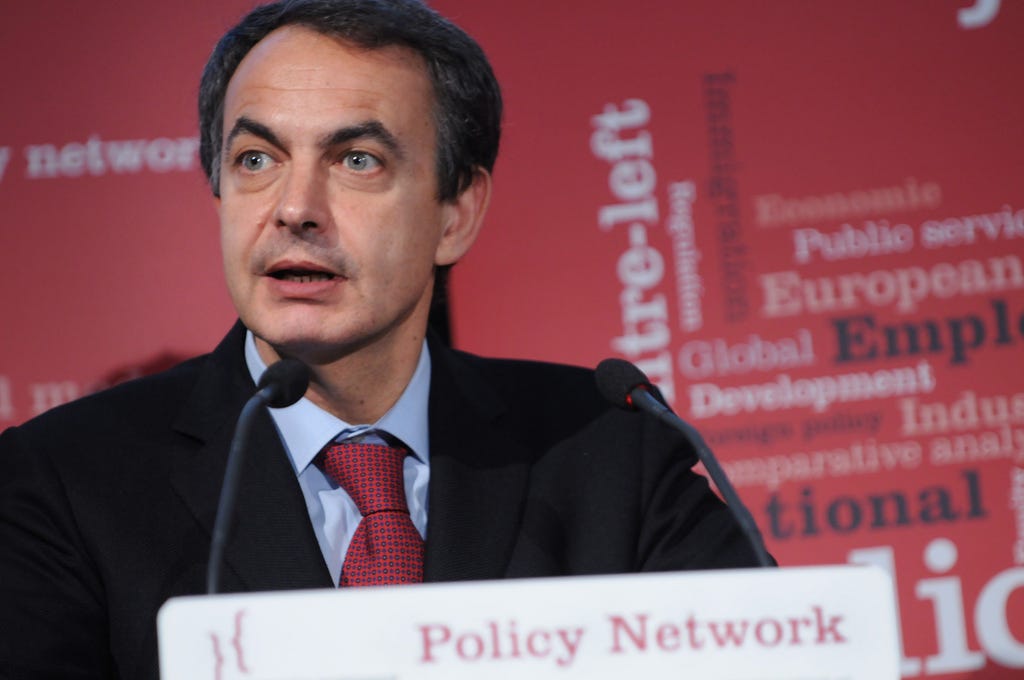
This image is used for illustrative purposes only.
An airline bailout, a sprawling investigation
At the center of the case: €53 million (approximately $58 million) in public aid granted in March 2021 by Prime Minister Pedro Sánchez’s government to Plus Ultra Líneas Aéreas, a small Spanish airline, as part of pandemic-era economic relief measures. The funds were disbursed through SEPI, Spain’s state holding company, which manages public stakes in strategic industries. The bailout drew scrutiny almost immediately, given the alleged financial ties between the airline’s leadership and opaque Venezuelan networks.
The investigation has been led by the UDEF — Spain’s Economic and Fiscal Crime Unit, a specialized financial crimes division of the national police force, roughly equivalent to the FBI’s financial crimes unit. Over months of work, investigators reconstructed exchanges, meetings, and financial structures that, according to the presiding judge, may have served to launder funds originating from embezzlement in Venezuela — specifically from subsidized food distribution programs and gold sales by Venezuela’s central bank.
What the judge unsealed from the confidential record is striking in its detail. According to information that has filtered through the Spanish press, investigators uncovered conversations in which Plus Ultra executives discussed, as early as spring 2020, the need to “build a bridge to ZP” — Zapatero’s initials — in order to secure public aid. Alleged payments of nearly €2 million are said to have been routed through consulting firms, some linked to Julio Martínez Martínez, a close associate of the former prime minister. The UDEF raided Zapatero’s office on Madrid’s Calle Ferraz — directly across from the Socialist Party headquarters — along with several commercial entities, including Soft Gestor, Inteligencia Prospectiva, and Whathefav SL.
Zapatero denies any wrongdoing. In a filmed statement, the former head of government said all his private activities had “always complied with the law,” denied ever owning an offshore structure, and stated he had “never” taken any steps to facilitate the Plus Ultra bailout.
Zapatero: a constitutional as much as a judicial precedent
Zapatero’s placement under formal judicial investigation — he served as prime minister from 2004 to 2011 — represents a historic break. No former Spanish head of government had ever been formally implicated in criminal proceedings for alleged corruption since the restoration of democracy in 1978.
For a North American reader, the closest analogy would be a former U.S. president being summoned before an independent federal tribunal — a situation that, even in the American constitutional tradition, carries enormous symbolic weight, however different the legal systems may be. In Spain, the Audiencia Nacional — the National Court — functions similarly to a specialized federal court, handling major criminal cases, terrorism, and crimes with international dimensions. It is before this body that Zapatero has been ordered to appear on June 2.
This judicial first arrives in an already turbulent moment for the Sánchez government, which has been navigating a succession of scandals involving figures close to the Socialist administration — including the so-called Koldo affair (a separate corruption case involving a former Socialist transportation minister) and the legal troubles of former minister José Luis Ábalos.
Analysis: when alleged corruption crosses party lines
The shockwave from Zapatero’s investigation extends well beyond the courtroom. It strikes at the heart of a structurally weakened PSOE — Spain’s Socialist Workers’ Party, currently in government — and of a coalition whose parliamentary survival rests on fragile alliances.
Pedro Sánchez, Spain’s current prime minister and leader of the PSOE, chose a posture of frontal defense: he publicly backed Zapatero, invoked the presumption of innocence, and went on the offensive against the conservative opposition, citing the Popular Party’s own judicial record — the PP has faced multiple convictions in illegal party financing cases. This counter-strategy of political-legal deflection is consistent with the Spanish government’s defensive posture since 2023, but it carries growing reputational risk as legal troubles mount.
The lawfare argument — a term borrowed from the American legal debate to describe the alleged weaponization of the judiciary against political opponents — was immediately deployed by government allies. Several figures from the Catalan left, including leaders of ERC (Esquerra Republicana de Catalunya, a left-wing Catalan independence party and a key coalition partner keeping the Sánchez government afloat), suggested a coordinated judicial offensive against the progressive bloc.
This reading is not without political grounding — Spain has a long history of judicial cases used as instruments of partisan destabilization. But it risks obscuring a more structurally troubling reality: if Judge Calama’s inferences about Zapatero’s role were to be confirmed, it would suggest that the porosity between Socialist influence networks and opaque foreign financial circuits — in this case, Venezuelan — runs deeper than the party has so far acknowledged.
The Venezuelan connection deserves context. Zapatero cultivated close ties with figures in the Chavista orbit during his years as an informal mediator in Venezuela’s political crisis. Those ties, long regarded as a diplomatic asset, have now become a potential legal liability — which could indicate that the line between informal diplomatic influence and financial self-interest remained, at best, blurred.
Spain’s Popular Party has called for immediate general elections. Sánchez responded that the next vote would take place as scheduled in 2027 and called on his allies to defend Zapatero’s “honor.” Between those two positions lies an open judicial process whose outcome is uncertain — but whose political consequences are already being felt.
The Bottom Line
An investigation is not a conviction — and Zapatero, like any defendant, is entitled to the presumption of innocence. But this case raises a question larger than one man’s legal fate:
How far are European democracies genuinely capable of subjecting former leaders to the rule of law, without that process being instantly reframed as a political attack by those it targets?
Spain’s answer, in the weeks ahead, will say a great deal about the institutional solidity of a country that has long held itself up as a model of democratic transition.
Sources: Euronews · AP News