
Zapatero charged: Sánchez bets his political survival
Spain's ex-PM Zapatero faces formal charges for influence peddling. Sánchez doubles down as his coalition fractures.

Spain’s prime minister is standing by his predecessor as a sweeping corruption probe threatens the most consequential socialist figure in a generation — and with him, the fragile parliamentary majority holding the government together.
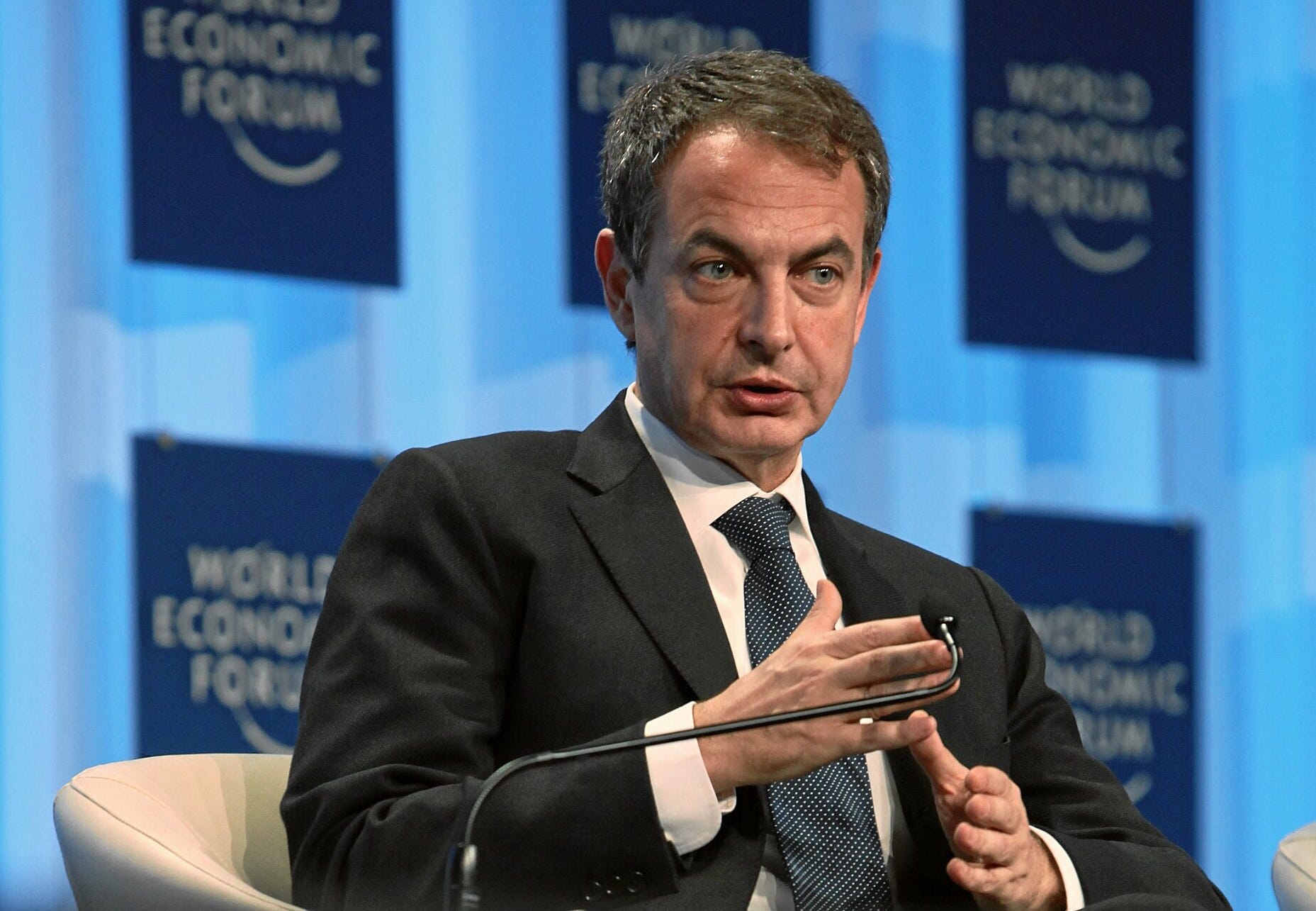
This image is used for illustrative purposes only.
At a Glance
José Luis Rodríguez Zapatero, Spain’s prime minister from 2004 to 2011, was formally placed under judicial investigation on May 19, 2026, on charges including criminal conspiracy, influence peddling, document forgery, and money laundering — all linked to a controversial pandemic-era bailout of a small airline.
Prime Minister Pedro Sánchez, the current head of government and leader of Spain’s ruling Socialist Party (PSOE), is publicly defending his predecessor and categorically ruling out early elections, promising a vote in 2027 at the end of his mandate.
New details released this week — including the discovery of luxury jewelry and watches in a safe belonging to Zapatero, whose associates attribute them to family inheritance — have deepened the crisis and unsettled the coalition’s indispensable parliamentary allies.
The Plus Ultra affair: a bailout that won’t go away
During the Covid-19 pandemic, Spain’s government approved roughly 53 million euros in public funds to rescue Plus Ultra, a small airline operating routes between Spain and Latin America with a fleet of four aircraft. Even before the pandemic, the company’s finances were precarious. The decision immediately drew scrutiny over how and why it was made.
Five years later, Spain’s investigating judge Calama believes he has reconstructed a far murkier chain of events. According to the judicial inquiry, Zapatero allegedly used his influence with several cabinet ministers, through a consulting firm he controlled, to shape the conditions of the public rescue. Investigators are also examining the possible use of shell companies and cross-border financial transactions to route funds that may have been improperly obtained.
Zapatero faces four counts: criminal conspiracy, influence peddling, document forgery, and money laundering. He is expected to appear before the judge in the coming weeks. He has denied all accusations — both following the May 19 indictment and in earlier parliamentary hearings — insisting he never intervened in the granting of the bailout and never received a commission tied to Plus Ultra.
A development this week added new weight to the case: during a search operation, investigators found a large quantity of luxury jewelry and watches inside a safe belonging to the former prime minister. The value of the items has not been determined. People close to Zapatero have said the objects are family heirlooms.
Sánchez and the accumulation of scandals
To understand why this case carries potentially fatal political weight, it is necessary to see it in the context of a government already navigating multiple simultaneous judicial proceedings against people in Sánchez’s immediate orbit. His wife, Begoña Gómez, was formally charged with corruption in April 2026. Santos Cerdán, a senior PSOE official, resigned after audio recordings surfaced suggesting the improper award of public contracts in exchange for commissions. Sánchez’s brother, David Sánchez, faces trial on separate influence-peddling charges.
Within this landscape, Zapatero is not just another defendant. He is the moral figurehead of Spanish socialism, a discreet but influential mentor to Sánchez for years, and one of the few historical pillars of the PSOE to have continued openly supporting the prime minister throughout a turbulent governing period. His judicial entanglement removes a precious symbolic shield at the precise moment when the parliamentary majority depends on increasingly tenuous alliances.
On Wednesday, May 27, returning from an audience with Pope Leo XIV at the Vatican, Sánchez reaffirmed his support at a press conference, saying there was no sufficient reason to change his position. He also flatly rejected early elections, promising a vote in 2027 as scheduled.
The coalition under strain
The real political fault line does not run through the opposition. Alberto Núñez Feijóo, leader of the Partido Popular — Spain’s main conservative party — called for Sánchez’s resignation in parliament and sarcastically framed Zapatero as the prime minister’s “moral compass.” The rhetoric is pointed, but its practical leverage is limited as long as the governing coalition holds together.
The vulnerability lies elsewhere. The Basque nationalist PNV and Catalan independence parties, whose votes are mathematically necessary for the government’s survival, are watching developments with mounting anxiety. Their support is transactional, built around continuous negotiation over territorial and budgetary arrangements. Should the perception of systemic corruption within the PSOE become too politically costly, the calculus for these parties could shift.
Gabriel Rufián, the floor leader for Esquerra Republicana de Catalunya (ERC) — a Catalan independence party whose votes are decisive in Madrid — gave public voice to that discomfort during parliamentary questions. He acknowledged the case “breaks the heart of many people on the left” while withholding any definitive judgment. Within the government’s coalition partner Sumar and the left-wing Podemos party, initial statements also declined to offer unconditional cover for Zapatero should the facts prove out.
This sequence of events — the accumulation of judicial proceedings touching figures from the prime minister’s inner circle, the dissonant voices within the progressive camp itself — could indicate that the Sánchez government is entering a phase of slow erosion, even if no formal dissolution of parliament appears imminent at this stage.
When justice becomes the arena for politics
The Zapatero affair exposes a structural tension that extends well beyond Spain. Across several European democracies, the judicialization of political life has become a primary instrument for destabilizing governments in office — whether through France’s cascading judicial proceedings against senior figures, Italy’s recurring investigations into governing coalitions, or prosecutions of national officials in Romania and Slovakia. This is not in itself evidence of an instrumentalized judiciary, nor of established guilt: it reflects both a genuine strengthening of judicial institutions and heightened public sensitivity to elite conduct.
What is distinctively Spanish is the temporal concentration of proceedings around a single political network. When an active prime minister simultaneously navigates inquiries touching his wife, his brother, his party’s secretary-general, and his former mentor, the question is no longer purely legal. It raises questions about the internal governance of a party that has held power without interruption since 2018 — and that, under pressure, appears to struggle to produce a credible institutional response.
The presumption of innocence protects individuals before the courts. It does not exempt a government from explaining how public decisions were made and in whose interest.
The bottom line
The question the Zapatero affair actually poses is not whether one former prime minister is guilty. It is whether there is a threshold beyond which the accumulation of judicial proceedings stops being a political management problem and becomes a legitimacy crisis. Sánchez has survived every individual storm to date. The storms may no longer be individual.
Sources: Euronews · AFP