
Why France is becoming Europe's AI power hub
At VivaTech, Foxconn and Nvidia are betting on France's cheap, stable nuclear power to anchor Europe's AI infrastructure buildout.

France’s nuclear-heavy power grid is becoming one of the most decisive arguments in the global race to build artificial intelligence infrastructure, and the world’s biggest tech companies are taking notice.
At a Glance
Foxconn and Bull, the French computing arm of Eviden, have announced a €120 million partnership to manufacture AI servers for the European market, with final assembly in Angers, France
France’s stable, relatively cheap nuclear-generated electricity has become a decisive factor in attracting global computing giants
Nvidia is betting on France’s AI ecosystem — led by Mistral AI — to build out a sovereign European AI computing offering
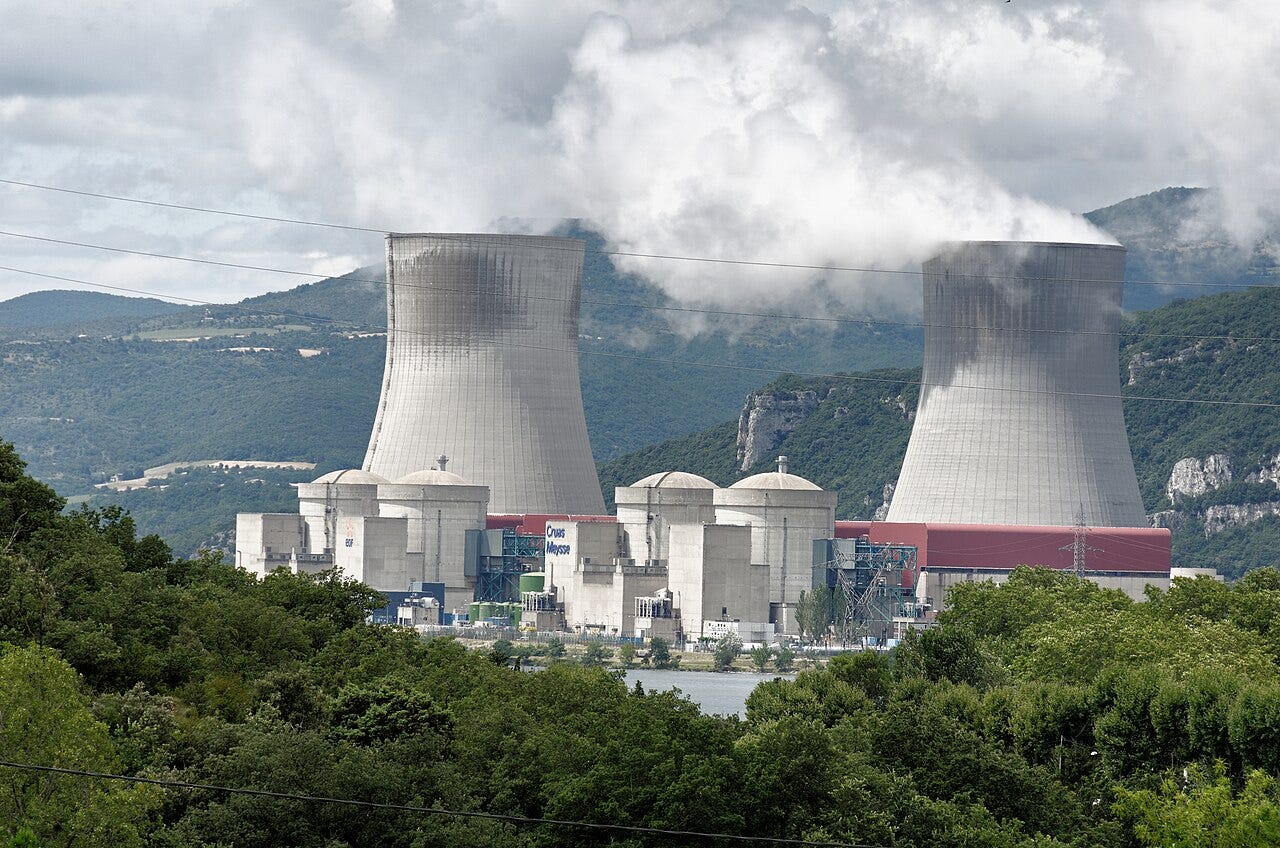
This image is used for illustrative purposes only.
VivaTech, the Paris technology conference marking its 10th anniversary this year and drawing roughly 180,000 attendees, became this year’s showcase for a deeper geopolitical shift: the battle to build artificial intelligence infrastructure is increasingly a battle over energy.
Foxconn — the Taiwanese manufacturing giant best known for assembling iPhones — and Bull, the French computing division of Eviden, announced a partnership backed by an investment exceeding €120 million to build powerful AI computers in Europe, designed to power the continent’s growing network of so-called “AI factories”: the large-scale computing centers that form the backbone of artificial intelligence infrastructure. Components will be manufactured and tested in the Czech Republic, before final assembly and validation at Bull’s facility in Angers, France.
For Foxconn, attending VivaTech for the first time, the choice of France was no accident. James Wu, the company’s vice president and spokesperson, pointed to an advantage few European countries can match: abundant, stable nuclear-generated electricity — an increasingly decisive factor for hosting computing centers whose energy consumption keeps climbing.
Why France is attracting AI giants
Under President Emmanuel Macron, France has positioned itself as a “startup nation” and a leading player in Europe’s AI buildout. But it’s a more structural advantage that appears to be tipping the scales for investors: the cost and stability of energy.
The unusually high share of nuclear power in France’s electricity mix sets the country apart from most of its neighbors, more reliant on natural gas or intermittent renewables — a contrast widely noted in European energy analysis. For data center operators that need to guarantee continuous power supply over the long term, that stability matters as much as the price tag.
Foxconn isn’t just bringing server racks to France: the company says it aims to energize the broader French AI-linked industrial ecosystem, from electric vehicles to smartphones to PCs that increasingly run AI features.
The Foxconn-Bull deal is part of a broader wave of investment, with Nvidia among its principal architects in Europe. At last year’s VivaTech, Nvidia CEO Jensen Huang pledged to build more than 20 “AI factories” across the continent and named Mistral AI as Europe’s champion for sovereign computing. This year, Nvidia and Mistral AI announced the creation of Mistral Compute, a GPU cloud platform project designed specifically to meet Europe’s digital sovereignty needs.
The power-chips-sovereignty equation
Jensen Huang likes to describe AI as a “five-layer cake”: energy, chips, infrastructure, data center servers, and finally AI models and applications. That framework helps explain why France, rather than another European market, is capturing an outsized share of recent investment announcements.
Nat Ives, Nvidia’s enterprise director for Benelux, France and the Nordics, pointed out that France brings together the state-owned utility EDF (Électricité de France), a mature nuclear power sector, and a growing share of renewables — all at once. That combination lets data center operators point to sustainability and carbon-footprint credentials that increasingly factor into site-selection decisions.
This environmental pressure isn’t merely a marketing talking point. Nvidia says it powers all of its offices and data centers worldwide with renewable electricity, and its newest Blackwell chip architecture is designed to cut energy consumption per AI task by up to 25 times compared with the previous generation — an efficiency gain that, in turn, eases pressure on national power grids already straining to meet AI-driven demand.
Beyond raw energy supply, another factor helps explain the rush toward France: in just a few years, the country has produced a cluster of generative AI champions — Mistral AI foremost among them, alongside AMI and H Company — drawing on a university tradition steeped in mathematics and computer science. For Nvidia, that pool of talent and open-source companies represents a second, distinct pillar of attractiveness, separate from the energy question. This talent pipeline also gives France leverage that energy infrastructure alone cannot provide: a domestic AI industry capable of putting that computing power to use, rather than merely hosting servers built and consumed by others.
The real question: sovereignty, or relocated dependency?
The stakes go beyond competition among European cities for data center investment. Building Europe’s sovereign AI infrastructure on chips designed by an American company and assembled by a Taiwanese contract manufacturer could appear to undercut the very goal of digital sovereignty it’s meant to serve.
This reliance on Nvidia chips — the company holds a dominant position in the global market for AI semiconductors — isn’t unique to France; it runs through every sovereign computing project underway in Europe, including those led by champions like Mistral AI. The real question, then, isn’t whether Europe can do without Nvidia in the near term. It’s whether stacking computing capacity on European soil — even when built from foreign components — amounts to genuine sovereignty, or simply shifts dependency from one layer (data hosted elsewhere) to another (the chips that run it).
The Bottom Line
France has turned a decades-old energy choice — its nuclear power fleet — into a decisive competitive edge in the AI economy.
It’s whether stacking computing capacity on European soil amounts to genuine sovereignty, or simply shifts dependency from one layer to another.
What remains unclear is whether that edge is enough to keep AI’s economic value on European soil — or whether the continent ends up hosting the hardware while the intellectual property and the profits stay elsewhere.
Sources: Euronews · Usine Nouvelle · Le Monde Informatique