
Vučić in Beijing: Serbia caught between two fires

A state visit to China, tens of thousands of protesters in the streets at home, and a veiled mention of resignation — Serbia’s president is running out of room to maneuver, and the EU is watching closely.
Aleksandar Vučić, Serbia’s president and leader of the populist right-wing Serbian Progressive Party (SNS), shook hands with Xi Jinping at the Great Hall of the People in Beijing on May 25, 2026 — while riot police fired tear gas at protesters back home in Belgrade. The timing was no coincidence. It was a clear foreign policy statement.
At a Glance
Vučić is on a five-day state visit to China (May 24–28), Serbia’s largest foreign investor, just days after a major anti-government rally in Belgrade ended in clashes between police and demonstrators.
Speaking to reporters in Beijing, Vučić floated the possibility of an early resignation — while simultaneously dismissing the protests as “empty” and “without substance.” His security services put turnout at 34,300 — a figure independent observers estimated at up to 180,000–190,000.
The visit further strains relations with Brussels: Serbia has been an EU membership candidate since 2009, but its deepening ties with China and Russia have become a major obstacle in a process already slowed by concerns over democratic backsliding.
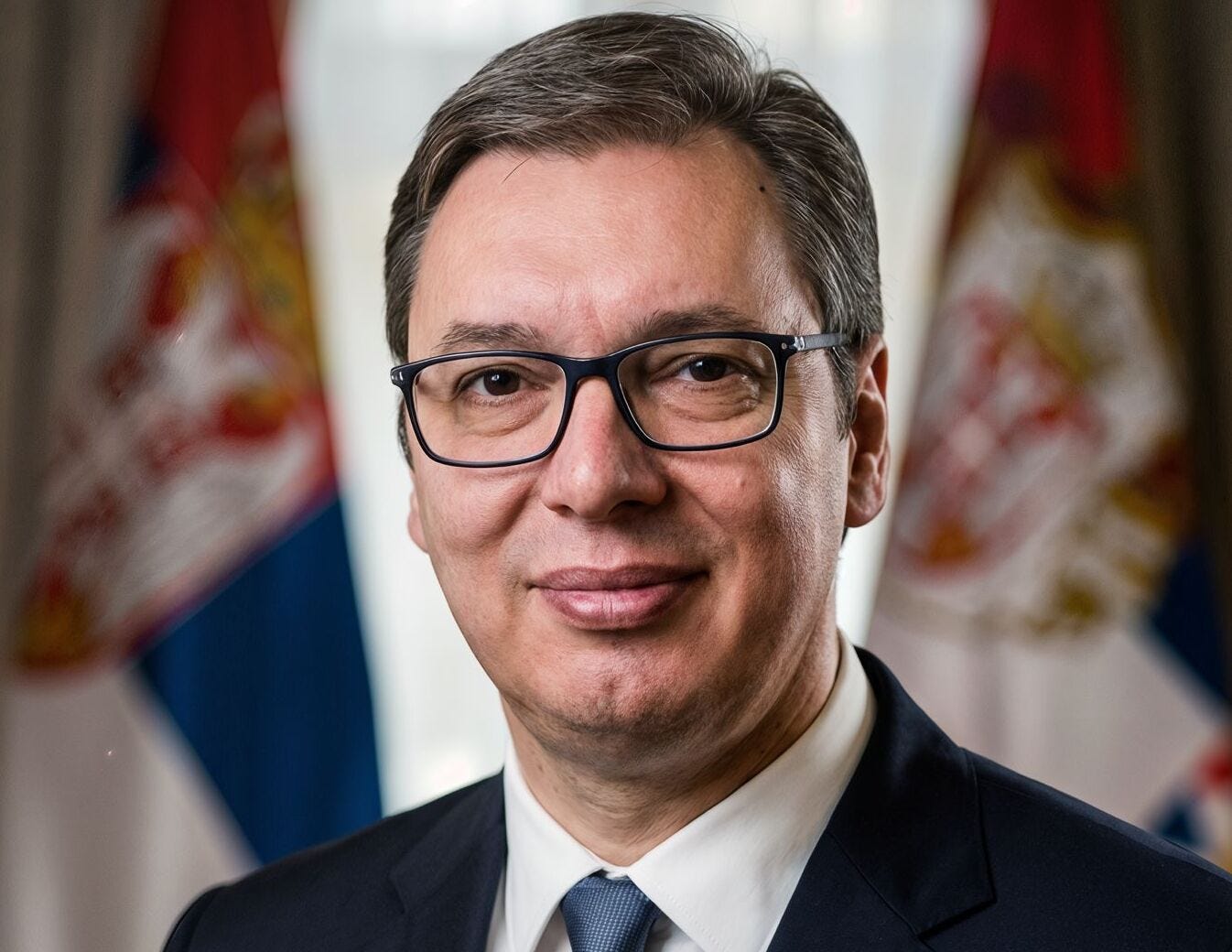
This image is used for illustrative purposes only.
A trip timed for maximum friction
Belgrade’s Slavija Square — one of the capital’s main junctions — had already hosted a massive anti-government rally in March 2025 that ended in controversy after independent experts alleged the possible use of a long-range acoustic device against peaceful demonstrators, a claim the government denied.
The May 23, 2026 rally confirmed that the protest movement retains strong momentum: tens of thousands of students and citizens took to the streets to demand early elections and an end to Vučić’s more than decade-long grip on power. Serbia’s Interior Ministry estimated the crowd at 34,300; the Archive of Public Gatherings, an independent NGO, put attendance at between 180,000 and 190,000.
The movement traces back to November 1, 2024, when a renovated concrete canopy collapsed at the railway station in Novi Sad, Serbia’s second-largest city, killing 16 people. The disaster ignited widespread protests against what demonstrators describe as endemic state corruption and negligence. Former Prime Minister Miloš Vučević, who had been in office since May 2024, announced his resignation on January 28, 2025 — a significant concession that failed to quell the movement.
It was against this backdrop that Vučić flew to Beijing at the invitation of Chinese President Xi Jinping.
Defiance toward Brussels, in China’s capital
On arrival in Beijing, Vučić adopted a combative tone toward the European Union. He accused Brussels of attempting to dictate Serbian foreign policy — particularly by pressuring him to limit contacts with the Kremlin. He mocked the EU’s stance, suggesting they might as well hand him “a wish list” of approved interlocutors.
The visit follows high-profile trips to Beijing by both Donald Trump and Vladimir Putin. By aligning himself in the same diplomatic orbit, Vučić sent a deliberate signal — to his domestic base and to European capitals alike.
The China dependency: structural and deepening
Sino-Serbian ties have accelerated dramatically over the past decade. Chinese interests now dominate key sectors of Serbia’s mining and steel industries. A bilateral free trade agreement, signed on October 17, 2023 and in force since July 1, 2024, has further cemented commercial links — even as the EU was simultaneously tightening restrictions on Chinese industrial imports into its own market.
Serbia has also acquired Chinese CM-400AKG supersonic air-launched ballistic missiles, making it the only country west of Belarus to operate such advanced Chinese-made weaponry. Last month, the EU’s top enlargement official warned that continued democratic backsliding could cost Serbia around €1.5 billion ($1.7 billion at current exchange rates) in EU funding.
For a North American audience, the parallel is instructive: imagine a NATO membership candidate signing major arms deals with China. The EU is not NATO, but the logic of strategic incompatibility is structurally similar.
Resignation: tactical move or political theater?
Speaking to journalists in Beijing, Vučić made a remark that immediately fueled speculation: he suggested he might resign soon, noting that his presidential term is approaching its end. He was careful to rule out repeating the move of former President Boris Tadić — who resigned early in 2012 to trigger simultaneous elections — calling such a step pointless. Vučić has indicated that elections could be held between September and November 2026.
Whether this was a genuine signal or a calculated attempt to regain control of the narrative from a protest movement that has dominated the agenda for over 18 months remains unclear. What is certain is that the statement was made from Beijing — more than 7,000 kilometers from a capital still under heavy police deployment.
Vučić also downplayed the Slavija Square rally, calling it “empty” and “without substance” — his security services’ estimate of 34,300 attendees standing in stark contrast to independent tallies nearly six times higher.
Analysis: the impossible geometry
The balancing act Vučić has maintained for years — advancing EU membership talks on one side while deepening ties with Beijing and keeping channels open to Moscow on the other — is becoming increasingly unsustainable. The margins for maneuver are narrowing.
Serbia is the first and only European country to formally commit to building a “community with a shared future” with China — language drawn directly from Beijing’s strategic vocabulary, implying deeper long-term political alignment. Were Serbia to join the EU while maintaining this commitment, it would not simply be another pro-China member state. It would set a structural precedent with no equivalent in the Union’s history.
The Bottom Line
The EU has yet to decide whether it prefers a destabilized Serbia on its doorstep, or a stable one that increasingly faces east.
If Vučić calls early elections or steps down, the question that will outlast his presidency is not merely who governs Serbia — but which geopolitical orbit the country ultimately chooses. The student-led movement has succeeded in making that choice unavoidable.
Sources: Euronews · Reuters · Al Jazeera · European Western Balkans · CBS News