
U.S. troop withdrawal from Germany: a strategic opportunity in disguise?
The announced reduction of American forces in Germany upends a postwar security guarantee — and may be the catalyst Berlin needed.

At a Glance
On May 1, the Pentagon, directed by the Trump administration, ordered the withdrawal of 5,000 U.S. troops from Germany, part of sustained pressure on European allies to shoulder more of their own defense costs.
The announcement has generated a surprising cross-party consensus in Germany, from the far-right AfD to the far-left BSW and Die Linke, together representing roughly a third of the electorate.
Berlin sees the pullback as a potential accelerant for building what Chancellor Friedrich Merz has called “the most powerful conventional army in Europe” — a major strategic repositioning for the continent.
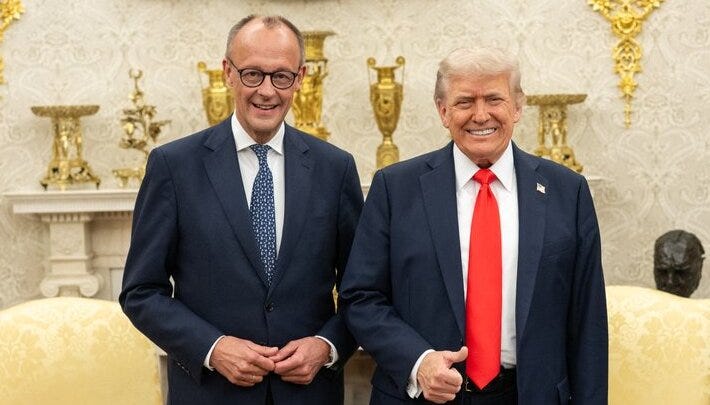
This image is used for illustrative purposes only.
A near-permanent guarantee, suddenly in question
Since 1945, the U.S. military presence in Germany has been more than a security arrangement. It was the symbolic guarantee of the country’s democratic reconstruction under Western stewardship. With more than 35,000 active-duty soldiers, Germany hosts the largest American military contingent on the continent — not merely a fighting force, but the living legacy of a foundational postwar compact.
The Pentagon’s May 1 order, directed by the Trump administration, fits a consistent pattern: forcing NATO allies to meet — or exceed — their defense spending commitments, a dynamic roughly analogous to shareholder activism applied to a military alliance. Germany’s Defense Minister Boris Pistorius acknowledged the move was not unexpected, noting it had long been “anticipated that the U.S. could withdraw troops from Europe, including Germany.” Relations between Trump and German Chancellor Friedrich Merz — leader of the center-right CDU/CSU bloc and head of government since early 2025 — have grown strained specifically after Merz publicly criticized U.S. military strikes against Iran — a rupture that lends the timing of this order a diplomatic edge, even if its operational rationale stands on its own.
A cross-party consensus that defies expectations
What is striking is not the withdrawal itself, but the reception it has received in Berlin. The AfD — Alternative für Deutschland, Germany’s far-right party and one of the largest forces in the Bundestag — had long called for the departure of all allied troops, nuclear weapons included. Its platform for last year’s federal elections explicitly demanded the “withdrawal of all allied troops stationed on German soil.”
The convergence with the far left is less expected. Sevim Dagdelen, a member of parliament for the BSW (Bündnis Sahra Wagenknecht, a left-wing sovereignist movement), expressed gratitude for American help in defeating Nazism while arguing that, 81 years on, “it is time for American soldiers to come home.” Soren Pellmann, co-chair of Die Linke’s (The Left party’s) parliamentary group, adds a geopolitical argument: withdrawing long-range U.S. missiles from German territory could reduce Berlin’s exposure to potential Russian retaliation, signaling to Moscow that Germany is not seeking military escalation.
Combined with backing from elements of the SPD (the center-left Social Democratic Party), parties favoring U.S. disengagement account for roughly a third of German voters. Public opinion is moving in the same direction: a survey by the Bertelsmann Foundation, a respected German policy think tank, found that 76% of Germans now believe Europe should “follow its own path” after half a century of transatlantic cooperation.
The power mechanics behind the pullback
Three distinct logics are converging here.
The first is American: the Trump administration is applying coherent pressure across NATO to force allies to finance their own security, a debate that resonates with longstanding U.S. domestic frustration over what critics call “free-riding” by European partners.
The second is German: Chancellor Merz has openly stated his ambition to make the Bundeswehr — Germany’s armed forces — the strongest conventional military in Europe.
A U.S. withdrawal could accelerate that agenda by making strategic autonomy not optional, but unavoidable.
The third is European: at a moment when Atlantic solidarity can no longer be taken for granted, Germany is being called upon to lead within NATO and in the construction of a collective European defense. That role, historically constrained by the memory of World War II and the deliberate modesty it imposed on German power, this sequence may have done more to accelerate it than any diplomatic summit could have.
Analysis — What this withdrawal really reveals
The pullback of 5,000 troops is not, in itself, a decisive military event. It is a political signal whose implications reach far beyond the order of battle.
For Germany, it forces a long-deferred choice between two identities: the protected power, whose strategic restraint was guaranteed from outside, and the responsible European heavyweight, expected to secure its own neighborhood. That tension, dormant since the end of the Cold War, is now fully exposed.
For Europe, it sharpens a question that continental leaders have avoided for too long: how sustainable is European security when it rests on an American guarantee whose continuity depends on a four-year electoral cycle? Pellmann’s argument about de-escalation toward Russia deserves engagement — even if the proposition that reducing a defensive posture lowers Russian aggression risk remains contested among most European security experts.
What is not in dispute: Germany in 2025 is not Germany in 2015. The rearmament debate, once taboo, has become mainstream. And a U.S. withdrawal framed as a blow in Washington is being absorbed in Berlin as something closer to an invitation — to step up.
The Bottom Line
The real question is not whether 5,000 fewer American soldiers weaken Europe’s defenses. It is whether Europe is ready to take on what Washington appears determined to hand over. For Germany, this pullback could be the catalyst for a strategic transformation it has been postponing for decades. For NATO, it poses a harder question: can an alliance endure when one of its founding members treats it as a policy option rather than an unconditional commitment?
Sources: L’Express · Bertelsmann Foundation