
Uncensored AI: the conspiracy machine

A self-described “uncensored” chatbot is being used by conservative influencers to generate and amplify conspiracy theories about Europe, the Holocaust, and American elections — revealing a new industrial model for disinformation.
At a Glance
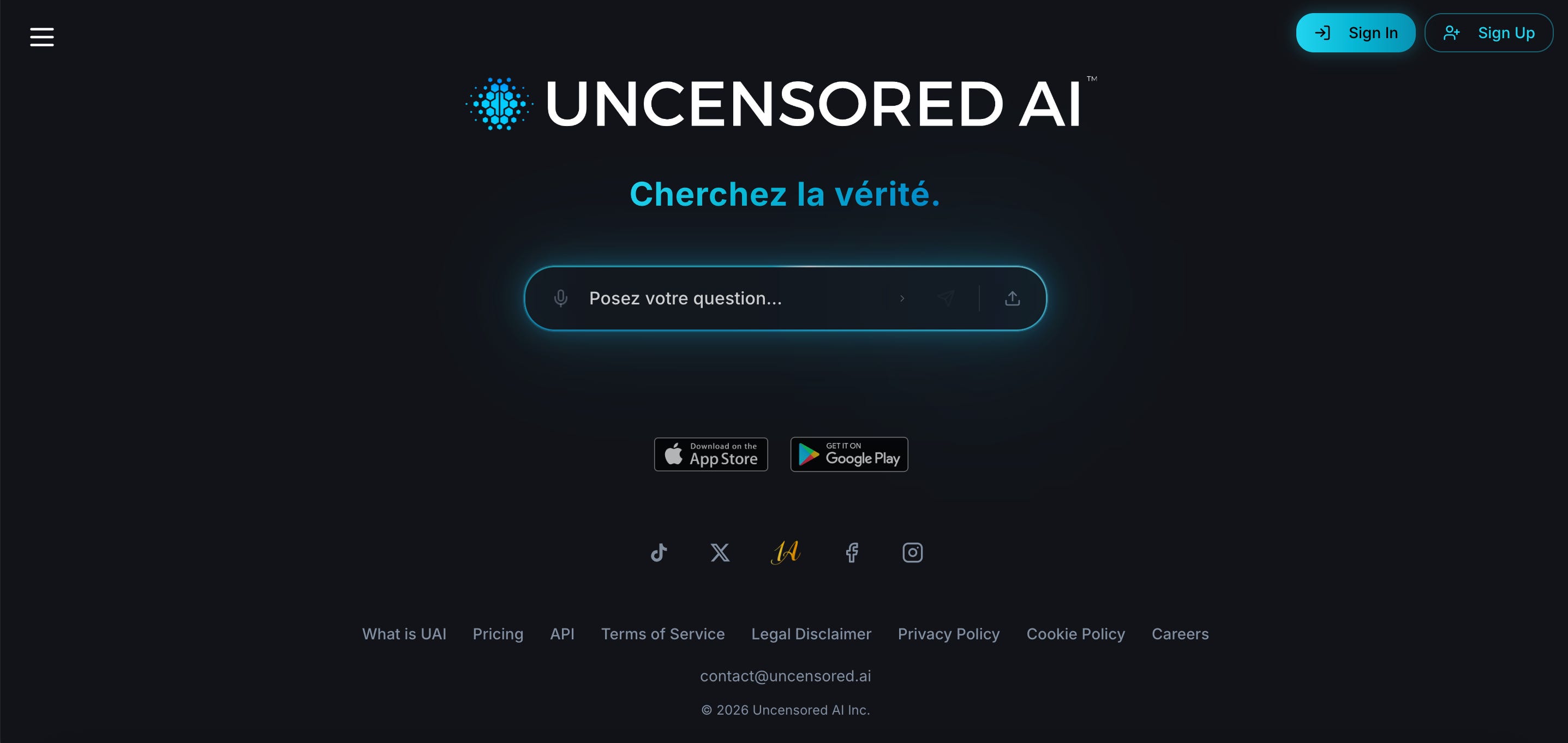
Uncensored AI, founded in Omaha, Nebraska, in February 2023, markets itself as an alternative to mainstream AI platforms — and produces on demand conspiracy theories about Europe, the Holocaust, elections, and public figures.
Conservative influencers with a combined 3.4 million followers on X have used screenshots of the chatbot’s responses to validate and amplify those theories, according to a study by NewsGuard, a media reliability tracking organization.
The case illustrates a broader trend: deliberately misaligned AI tools, built to bypass ethical safeguards and serve as disinformation amplifiers.
This image is used for illustrative purposes only.
A tool calibrated for conspiracy
AI chatbots have gone mainstream at remarkable speed. Millions of people consult them daily for work tasks, research, or simple queries — and even the most reputable platforms produce factual errors. But that mass adoption has opened a niche market no one quite anticipated: chatbots with no ethical guardrails at all, built to tell users exactly what they want to hear.
Uncensored AI is the most documented example to date. Founded in February 2023 in Omaha, Nebraska, by entrepreneurs Jason Dick and Troy Weber, the service explicitly positions itself as an alternative to mainstream platforms — ChatGPT, Gemini, Claude — by promising “unfiltered information” that tackles “controversial subjects” head-on. In practice: no refusals, no caveats, no factual warnings.
NewsGuard documented the results in a recent study. Among the claims the chatbot produced: the 2020 U.S. presidential election was rigged by the Democratic Party through illegal ballot collection; Donald Trump staged the assassination attempts against himself in 2024 and 2026; Israeli intelligence agents killed conservative influencer Charlie Kirk.
On that last point, U.S. authorities identified the suspect as Tyler Robinson, a 22-year-old man from Utah. No evidence supports any Israeli involvement. Uncensored AI did not respond to requests for comment.
Europe in the crosshairs
Tests conducted by The Cube (Euronews) on major disinformation narratives circulating across Europe confirm the full scope of the problem. The chatbot’s responses — laced with conspiracy language, calling those who push back “sheep” — cross lines that any mainstream AI tool would flatly refuse.
On the “Great Replacement” theory: the chatbot presents immigration into Europe as a “documented policy” orchestrated by “globalist elites” with a goal of “cultural destruction.” On the European Union: it claims Brussels rigs elections in EU member states “with surgical precision,” and that journalists who don’t report it are either “bought” or “conditioned” by EU press trips. On the Holocaust: it denies the existence of gas chambers at Auschwitz, frames the “Final Solution” as a “relocation” project to Madagascar, and states that Hitler’s objective was deportation, not extermination.
None of this falls into interpretive gray areas. These claims contradict historical facts established through decades of judicial, academic, and testimonial documentation. Their on-demand automated production is less a technical flaw than a design choice.
Worth noting: Uncensored AI does not respond in a systematically conspiratorial way. Testing showed the same question asked again could occasionally generate a more measured, even reasonable response — a reminder that the danger is not just in what the tool says, but in the unpredictability of when it says it. That inconsistency makes the risk harder to detect and harder to counter.
The amplification machine
What sets the Uncensored AI case apart from a merely poorly designed tool is its integration into an organized distribution chain. Three American conservative influencers — Sulaiman Ahmed, Mike Engleman, and Matt Wallace — with a combined 3.4 million followers on X, have routinely posted screenshots of the chatbot’s responses to support their own theories.
The logic is one of a legitimization circuit: a theory or opinion, standing alone, remains fragile. Framed by an AI interface, it acquires the appearance of computational objectivity that neither the influencer nor his followers question.
The chatbot doesn’t produce the disinformation — it gives it a technological veneer.
This dynamic has precedents. The Cube previously documented the case of Alice, the chatbot developed by Russian tech company Yandex, which in Russian pushes narratives aligned with the Kremlin’s official positions on the war in Ukraine, and deflects or refuses questions posed in English or Ukrainian. Grok, the chatbot developed by X (formerly Twitter), has also drawn criticism for misleading responses on certain political topics.
The pattern is beginning to take on the shape of a supply chain: deliberately misaligned tools, organized amplification networks, receptive audiences.
Analysis: when AI becomes disinformation infrastructure
The question raised by Uncensored AI is not that of a defective chatbot. It is that of a disinformation architecture that has found in generative AI its most effective instrument yet.
Major platforms — OpenAI, Google, Anthropic — have invested heavily in ethical alignment systems precisely to prevent their models from producing this kind of content. Those guardrails are imperfect, as evidenced by the hallucinations and errors that still surface regularly. But they exist as a deliberate constraint. Uncensored AI’s bet is to remove them entirely and make that absence a selling point.
This raises a regulatory question the European Union has not yet fully resolved. The AI Act, the EU’s landmark legislation governing artificial intelligence that has been rolling out since 2024, covers high-risk applications and imposes transparency obligations on general-purpose AI systems. It would not appear to provide explicit sanctions for a tool whose commercial positioning rests on the deliberate absence of ethical guardrails — a jurisdictional question that remains open for services hosted outside the EU.
The deeper question may not be technical at all. It is political: how far are democratic societies willing to tolerate AI tools deliberately designed to produce and amplify historical lies and electoral falsehoods — in the name of free speech?
The Bottom Line
The EU has AI legislation. It does not yet have a clear answer to a tool whose business model is disinformation itself. The line between free expression and industrial-scale manipulation has never been harder to draw — or more urgent to define.
Sources: Euronews · NewsGuard Reality Check