
Ukrainian drone hits NATO port of Constanta
Russian electronic warfare derailed a Ukrainian drone into Romania's Constanta port. The second NATO-soil incident in a week raises Article 5 questions.

At a Glance
A Ukrainian maritime drone exploded on June 5, 2026, in the port of Constanta, Romania, with no casualties. Kyiv admitted it had lost control of the vessel due to Russian electronic jamming.
It was the second such incident in one week on Romanian soil: seven days earlier, a Russian-designed drone had crashed into an apartment building in Galati, lightly wounding two people.
Romania is a NATO member state. Each incident raises a question that has yet to receive a clear institutional answer: where does the war in Ukraine end?
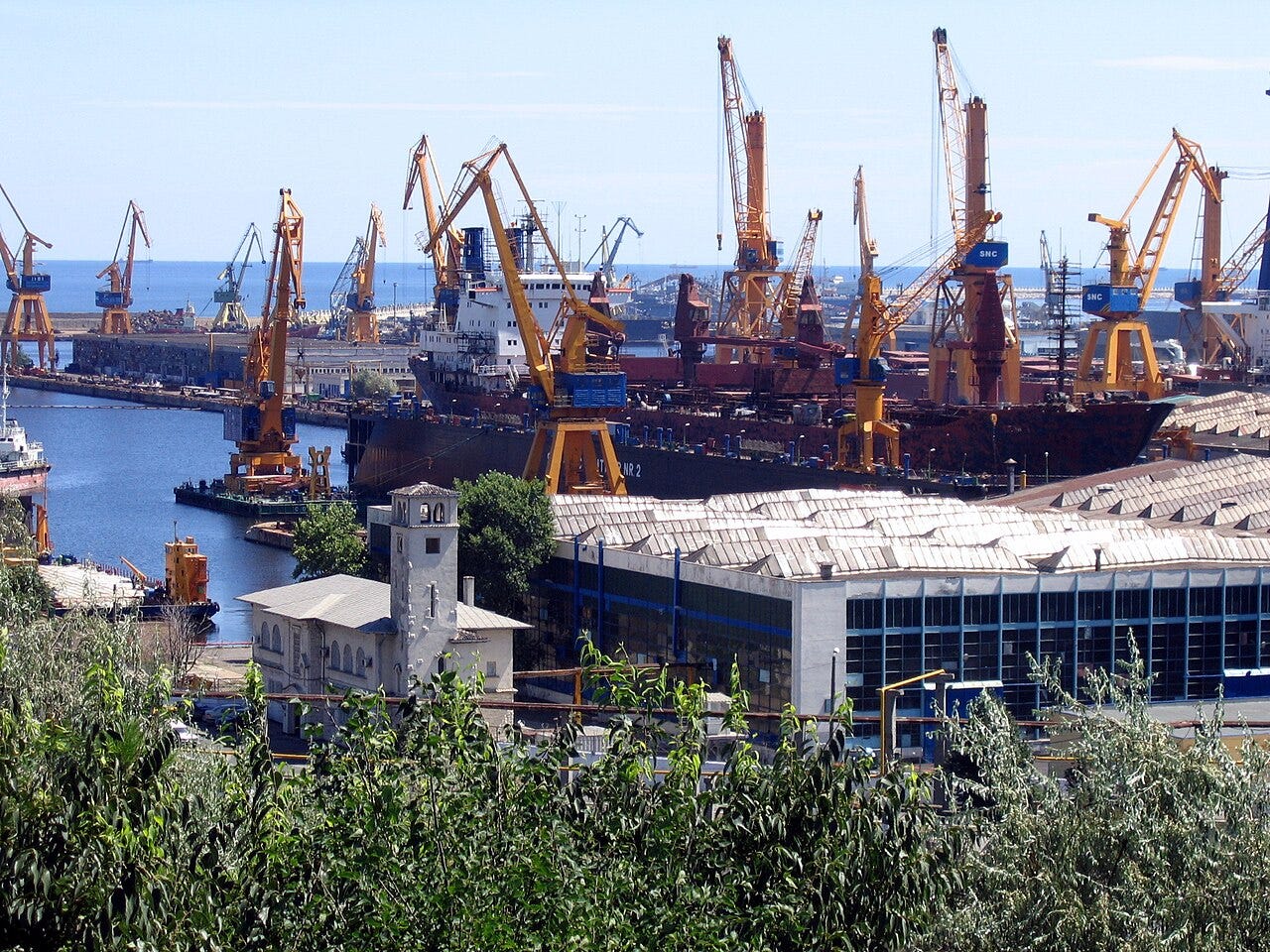
This image is used for illustrative purposes only.
What happened on June 5 in Constanta
The drone — a surface vessel of the type deployed by Ukraine’s navy to strike Russian ships in the Black Sea — was detected in the port of Constanta around 6 a.m. It did not explode, or rather “self-destructed,” in the words of Raed Arafat, head of Romania’s Department for Emergency Situations, until around 10:30 a.m. No injuries were reported.
For several hours, the origin of the vessel remained undetermined. Arafat had noted only that the drone was “of the type used in the war in Ukraine” and was not part of Romania’s military inventory or any recent NATO exercise in the Black Sea area. Ukraine’s navy then put the matter to rest: the drone was theirs, “disrupted by the enemy’s electronic warfare systems,” causing it to “lose control and end up near the Romanian coast.” [translated from Ukrainian]
A high-risk week for Romania
This was not an isolated event. One week earlier, a Russian-designed aerial drone — a Geran-2 — had crashed into a residential building in Galati, a Romanian city near the Ukrainian border. Two people were lightly injured: a 14-year-old boy and his 53-year-old mother. Nicusor Dan, Romania’s president, had explicitly blamed Russia.
Two incidents in seven days. Two different weapons — one Ukrainian, one Russian. The same result: damage on the soil of a NATO member state.
Electronic warfare and its blind spots
Electronic jamming — the disruption of drone guidance signals through hostile radio emissions — has become one of the most heavily used tools in the Russia-Ukraine conflict. Both sides reportedly deploy it on a large scale, and the Black Sea has emerged as a primary battleground, particularly following a series of Ukrainian strikes against Russia’s Black Sea Fleet.
What the June 5 incident reveals is that a Ukrainian surface drone deployed offensively against Russian naval targets could, if its guidance systems are compromised by enemy countermeasures, end up anywhere in the region — including the territory of a non-belligerent state. The question of legal responsibility in this scenario remains unresolved under international humanitarian law. It seems plausible that NATO’s legal experts are examining precisely this kind of contingency.
Article 5’s unanswered question
Article 5 of the North Atlantic Treaty — the mutual defense clause that forms the bedrock of NATO, the 32-nation Western military alliance — holds that an attack on one member is considered an attack on all. But Article 5 was designed with deliberate attacks in mind, not incidents triggered by electronic warfare in a conflict to which the affected state is not a party.
Romania is not at war. It hosts NATO military bases, monitors the Black Sea, and sits on the conflict’s geographic front line. What the Constanta incident suggests — without it being possible to establish this formally — is that a new category of risk is taking shape: not a deliberate strike on an ally, but a series of repeated collateral incidents that, with enough accumulation, could one day breach the threshold of political tolerance.
So far, Bucharest has handled these incidents with calculated restraint. Nicusor Dan named Russia when the drone was Russian. Romania did not invoke Article 5. But every uncontested incident, by accumulation, quietly redefines what counts as “acceptable” on NATO soil.
The Bottom Line
The war in Ukraine is not being fought only between the Dnipro River and the Sea of Azov. It is also unfolding, diffusely and without deliberate intent, across miles of coastlines and borders that NATO’s legal architecture never envisioned in this form.
The real question Constanta raises is not “who sent the drone?” It is: how many of these incidents does it take before an institutional response becomes unavoidable — and who gets to write the rules?
Sources: France Info · AP