
Ukraine's Patriot crisis: Zelensky's appeal to Trump
Ukraine's president asks Washington for Patriot PAC-3s as U.S. disengagement deepens — while Moscow deploys a nuclear-capable missile over Kyiv for the first time since November.

The weekend of May 24, 2026, will be remembered. Russia launched 90 missiles and 600 drones against Ukraine in a single night — including an Oreshnik, the intermediate-range ballistic missile capable of carrying a nuclear warhead. At least four people were killed in Kyiv and the surrounding region; more than a hundred were wounded. The Ukrainian office of the World Health Organization sustained damage. The Kyiv studio of Germany’s public broadcaster ARD was partially destroyed.
Against this backdrop, Volodymyr Zelensky, Ukraine’s president, sent a letter to Donald Trump on May 27, 2026, requesting additional Patriot PAC-3 missiles — “this vital protection tool against Russian terror,” in his own words. The request is not a sudden alarm: it marks the latest escalation of a months-long air defense supply crisis that Washington, consumed by the Iranian theater, is deepening through inaction.
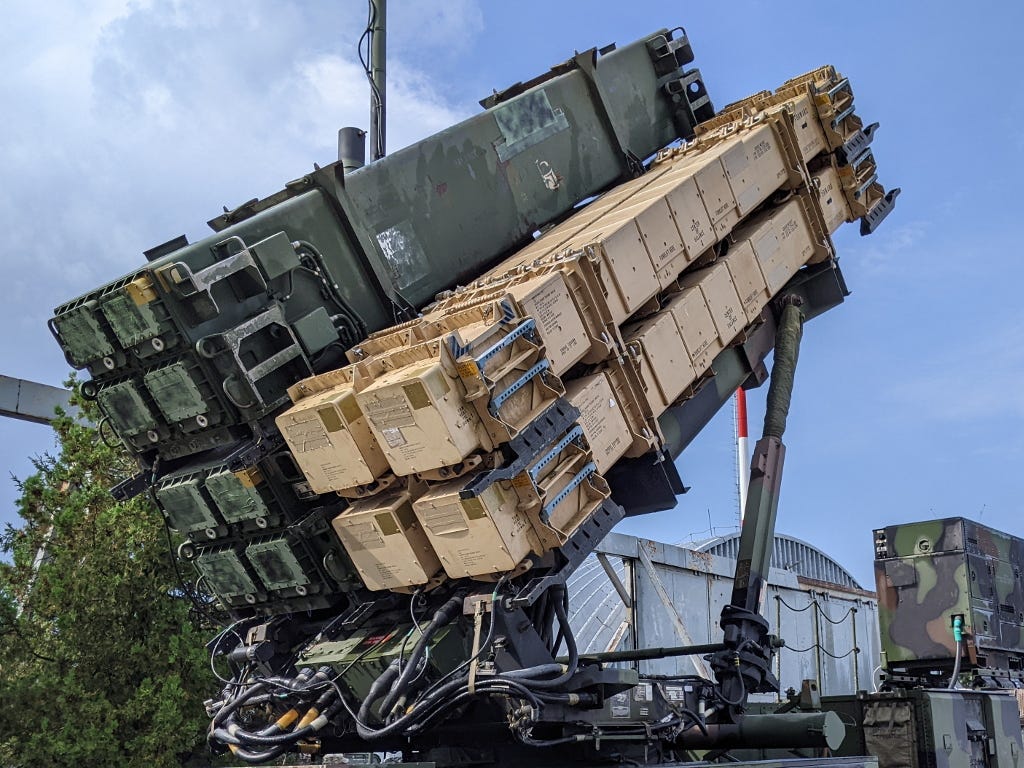
This image is used for illustrative purposes only.
At a glance
On May 27, 2026, Zelensky wrote to Trump requesting Patriot PAC-3 missiles after a night of mass Russian strikes that killed at least four people in Kyiv, with confirmed use of an Oreshnik missile capable of carrying a nuclear warhead.
Ukraine’s PAC-3 shortage is structural: in January 2026, some Ukrainian launchers ran out of interceptors entirely; testimonies from unit commanders suggest crews have been loading just one missile at a time instead of the standard two to four.
The Trump administration formally suspended all direct military aid to Ukraine in March 2025 — Vice President JD Vance publicly celebrated the decision, deepening a dilemma for Europe: how to finance American-made weapons when Washington refuses to supply them.
A chronic shortage, not a one-time alert
The Patriot system — roughly equivalent to a long-range ground-based missile shield, analogous in strategic importance to defending Washington against ballistic strikes — is Ukraine’s only proven defense against Russian ballistic missiles. Its interceptors, the PAC-3, are manufactured exclusively in the United States by Raytheon Technologies.
By January 2026, the situation had reached a breaking point: Ukrainian launchers were reportedly running out of ammunition during Russian strikes on energy infrastructure. In April, Zelensky himself told ZDF, Germany’s main public television channel, that the shortage “could not be any worse” [translated from French]. Unit commanders, according to accounts relayed by specialized defense outlets, have reportedly been loading just one interceptor per launch rather than the standard two to four — a rationing practice that mechanically reduces interception success rates.
What the May 27 letter makes clear is that the situation has not stabilized. A strike of the scale seen on the night of May 24-25 — with 55 missiles intercepted out of 90, and 549 drones out of 600 neutralized — exhausts stockpiles that are not being replenished.
The impossible triangle: Washington, Europe, and industrial capacity
The power dynamics behind this crisis are as much political as military. The Trump administration froze all direct military aid to Ukraine in March 2025. Vice President JD Vance, speaking at a Turning Point USA event in Athens, Georgia, in April 2026, explicitly called the decision “one of the things I’m most proud of in this administration.” That statement effectively closes the door on a swift resumption of direct deliveries, whatever Zelensky’s letter may say.
Europe has partially filled the gap. Throughout 2025, European partners financed the purchase of PAC-3 interceptors through indirect acquisition channels — buying American to deliver Ukrainian. Germany, during Zelensky’s visit to Berlin in April 2026, committed to financing “several hundred” additional missiles. But without a precise timeline. And there is a structural constraint that no diplomatic workaround fully resolves: the PAC-3 is produced at a rate calibrated for peacetime demand, inadequate to simultaneously cover Ukrainian needs, NATO stockpiles, and the consumption generated by the ongoing Middle East conflict.
This suggests — though no formal production decision has been announced — that even a partial resumption of U.S. aid would run into an industrial bottleneck at least as constraining as the political one.
The Oreshnik signal and what Moscow says
The confirmed use of the Oreshnik missile on the night of May 24 marks both a symbolic and operational threshold. This intermediate-range ballistic missile — a category regulated by Cold War-era bilateral disarmament treaties between Washington and Moscow — is designed to carry a nuclear warhead. In the May 24 attack, it struck Bila Tserkva, a city roughly 60 kilometers south of Kyiv.
The Russian Defense Ministry stated it had targeted only military objectives. The facts on the ground — a water supply infrastructure damaged, a shopping center destroyed, dozens of residential buildings affected — do not straightforwardly support that claim. These details remain contested; an independent full accounting is not yet available.
Kaja Kallas, the EU’s High Representative for Foreign Affairs and Security Policy — roughly comparable to a secretary of state for the 27-nation bloc — described the Oreshnik’s use as “a political intimidation tactic and a reckless form of nuclear blackmail.” French President Emmanuel Macron called it a “headlong rush.” These convergent formulations suggest Kremlin strategists may be testing Western resolve in the face of symbolic nuclear escalation — a hypothesis that is analytically plausible but not confirmed in official statements.
Separately, Russia advised foreign diplomats to evacuate Kyiv. Around fifty countries, along with the European Union, summoned Russian representatives to protest.
What the letter doesn’t say
Zelensky’s appeal to Trump has a rhetorical function: it keeps the bilateral channel alive at a moment when the American administration is simultaneously pressuring Kyiv toward a ceasefire and rejecting any direct military engagement. Trump himself, at a summit in mid-2025, urged Zelensky to “find a deal” and called on both sides to “stop where they are.”
What the letter does not address — and what defense analysts are raising with growing urgency — is a harder structural question: even an adequate supply of Patriot PAC-3s cannot intercept a coordinated volley of 690 projectiles. The system was not designed for that. Russia’s deliberate saturation of air defenses is a documented tactic. The Patriot remains indispensable against high-value ballistic missiles. But the deeper issue is whether a defense architecture essentially dependent on Western supply chains — and ultimately on a single American manufacturer and a single American administration — is sustainable.
Ukraine is developing its own anti-ballistic system through domestic arms producer Fire Point, with an operational target reportedly set for 2027. That development track is worth watching, even if its operational viability remains unconfirmed at this stage.
The bottom line
Will Washington allow Kyiv’s missile shield to run dry while Moscow deploys nuclear-capable ballistic missiles against civilian targets?
The answer, or the absence of one, will say as much about the state of Western alliances as about the outcome of the war itself.
Sources: AFP · Euronews · Le Temps