
Ukraine's EU door opens — the bombs don't stop
Budapest's veto is gone. All 27 EU states agreed to open accession talks with Ukraine — as Russian drones hit eleven regions in a single week.

At a Glance
All 27 EU member states agreed on June 12 to open the first thematic cluster of accession negotiations with Ukraine and Moldova, ending a two-year blockade that had been engineered by Hungary’s previous government.
The first formal intergovernmental conference is set for Monday, June 15, in Luxembourg; Kyiv wants all six negotiating clusters open by summer to show a war-weary population that EU membership is within reach.
Meanwhile, Russia struck eleven Ukrainian regions in a single week — roughly 530 drones and two air-launched guided missiles — as Ukraine escalates long-range strikes on Russian energy and military infrastructure.
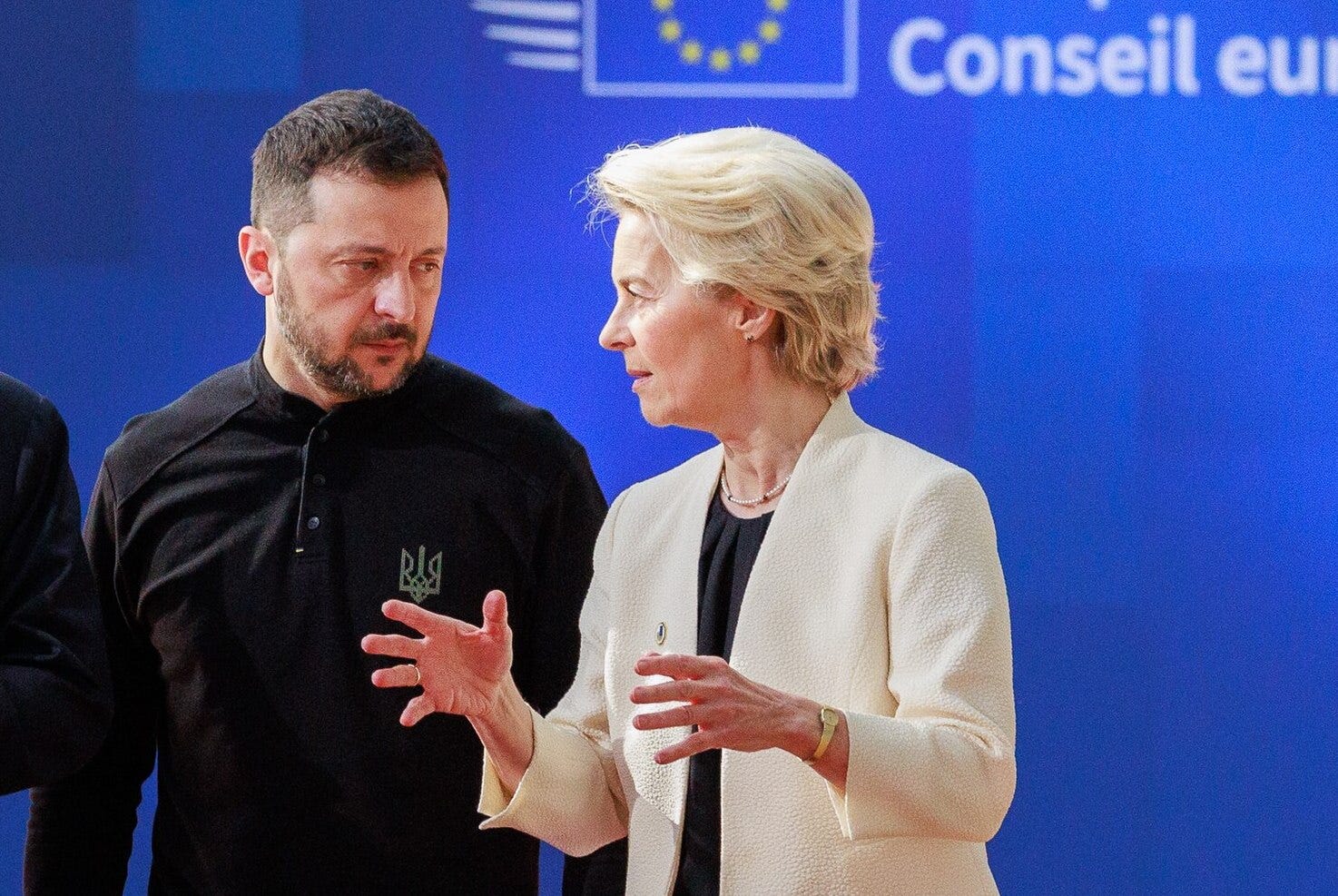
This image is used for illustrative purposes only.
After Budapest, the lock breaks
For two years, one country was enough to paralyze the European future of two nations. Hungary, then under Prime Minister Viktor Orbán, had blocked the continuation of accession talks with Ukraine — and by extension with Moldova, whose negotiations had been joined to Kyiv’s. Budapest’s stance shifted following Hungary’s change of government: Péter Magyar, the country’s new prime minister, lifted the veto in early June. On June 12, the ambassadors of the 27 EU member states in Brussels endorsed a common position to move to the next stage.
This first thematic cluster, known as “fundamentals,” covers the rule of law, human rights, and the judicial system — the backbone of the entire accession process. Without it, nothing else can move forward. The formal intergovernmental conference is scheduled for Monday, June 15, in Luxembourg.
Hungary’s reversal did not come without conditions. The agreement is accompanied by a rule-of-law roadmap and a minority rights action plan, revised to reflect the results of consultations between Budapest and Kyiv — addressing one of the two countries’ deepest bilateral friction points.
What “opening a cluster” actually means
The EU accession process is structured around six thematic clusters and 33 individual chapters. Opening a cluster does not mean joining the union — it marks the start of a lengthy technical negotiation, at the end of which each chapter must be “opened” and then “closed” by unanimous agreement among all member states. Full membership can take years or even decades.
Ukraine wants all six clusters open by summer. That ambition is shared by the European Commission, the EU’s executive arm, and several member states. Cyprus, which currently holds the rotating presidency of the Council of the European Union — the body representing member governments — is targeting the opening of at least one additional cluster before the end of June.
“The faster we open the other clusters, the better.”
— a senior EU diplomat
Taras Kachka, Ukraine’s deputy prime minister for European integration, expressed gratitude for “the support and unity of all EU members” and said Ukraine “expects to open the remaining clusters soon.”
But member states want to preserve the integrity and credibility of the process — which is supposed to be merit-based, not driven by geopolitical sympathy. A proposal recently floated by Germany’s chancellor for an “associate member” status to fast-track Ukraine’s path was pushed back.
530 drones and two missiles in a single week
While diplomats were endorsing common positions in Brussels, Russian drones were combing the Ukrainian sky. Volodymyr Zelensky, Ukraine’s president, said Wednesday that eleven regions of the country had been targeted since the beginning of the week — roughly 530 Shahed attack drones (an Iranian-designed model used extensively by Russian forces) and two air-launched guided missiles. Ukraine’s air force said it intercepted 110 drones in the single night of Friday to Saturday.
In the Dnipro region (officially Dnipropetrovsk) in southeastern Ukraine, nine people were wounded in more than twenty strikes combining drones and aerial bombs. A 40-year-old man was hospitalized in critical condition, according to the regional administration.
Ukraine is striking back. Its forces hit the Kuibyshev oil refinery in Russia’s Samara region, as well as two other energy facilities in the Vladimir region. Ukrainian FP-5 Flamingo cruise missiles also struck a military plant in Cheboksary that had been supplying Russian forces with drones and missiles. In the district of Temryuk in Russia’s Krasnodar region, a Ukrainian drone killed one person and wounded three others, setting fire to a maritime terminal that required the mobilization of 96 firefighters.
Ukraine’s strategy of targeting Russian energy infrastructure has intensified over recent weeks, aimed at degrading Moscow’s logistical and industrial capacity.
Analysis: two wars at once
Ukraine is fighting two wars simultaneously — one kinetic, against Russian drones and missiles; one institutional, against time and EU bureaucracy. The two fronts are not independent. They condition each other.
The war on the ground fuels the urgency of EU accession from Kyiv’s perspective: membership would be a security anchor, a signal that Ukraine belongs to the West regardless of what happens on the battlefield. Moscow understood this long ago. The Kremlin has repeatedly cited Ukraine’s European and NATO aspirations as partial justification for its full-scale invasion in February 2022. Kremlin spokesman Dmitry Peskov warned Moldova in October that its rapprochement with Brussels was a “grave mistake” and a “rather confrontational line toward our country” [translated from French]. Russia’s threat on Europe’s eastern flank is, in Moscow’s own framing, inseparable from the accession process.
On the European side, opening this first cluster sends a strong political signal to a Ukrainian population exhausted by over four years of war. But it does not compensate for the two years lost under the Hungarian veto. Member states have made that clear: technical acceleration will not substitute for the genuine progress of reforms.
The question no one is yet asking openly: can a rigorous, rule-of-law-based accession process actually be completed for a country at war, with part of its territory under occupation, running its national administration under air-raid sirens and power cuts? The honest answer is: perhaps — but it has never been tried.
The Bottom Line
Ukraine is entering a process without precedent: negotiating EU accession while fighting an existential war on its own soil. The EU, for its part, is embarking on an enlargement for which it has no established playbook in conditions of active conflict. The Hungarian veto is gone — but the real question is not whether talks will move quickly. It is whether they will produce actual membership, or simply a permanent horizon that keeps Ukraine in Europe’s waiting room indefinitely.
Sources: Euronews · France Info · AFP