
Ukraine's drone war reaches Moscow's suburbs

Russia is escalating its strikes on Ukrainian energy infrastructure — but the 600 Ukrainian drones that targeted the Moscow suburbs on May 16–17 are forcing a question the Kremlin can no longer sidestep: who is actually absorbing the shock of this war?
Russia pounded Ukraine’s power grid on May 18. But 600 Ukrainian drones over Moscow are raising a harder question: who’s absorbing this war?
At a Glance:
Between May 16 and 17, 600 Ukrainian drones targeted Russian territory, with 80 striking the Moscow region; at least one woman was killed in the suburbs and three others died elsewhere in Russia
Russia has intensified its strikes on Ukrainian energy infrastructure in what may constitute a response to Kyiv’s offensive — but Western analysts estimate Moscow lost roughly 120 square miles on the eastern front in April, the first such retreat since 2023
Vladimir Putin’s approval ratings have weakened according to internal Russian polling, as oil and gas revenues collapsed 47% in the first two months of 2026
The night that changed the scale of the conflict
Between 3 a.m. and 9 a.m. on Sunday, May 17, residents of Moscow’s suburbs recorded footage of drones falling — and the detonations that followed as Russian air defenses moved to intercept them. Of the 600 drones launched toward Russia, 80 targeted the Moscow region. One woman was killed. Two oil storage facilities near the capital were hit, including a fuel depot whose fires spread across social media. Three additional fatalities were confirmed elsewhere in Russia.
Russia claims to have intercepted the vast majority of the incoming drones. But the political context surrounding the attack matters as much as its physical impact.
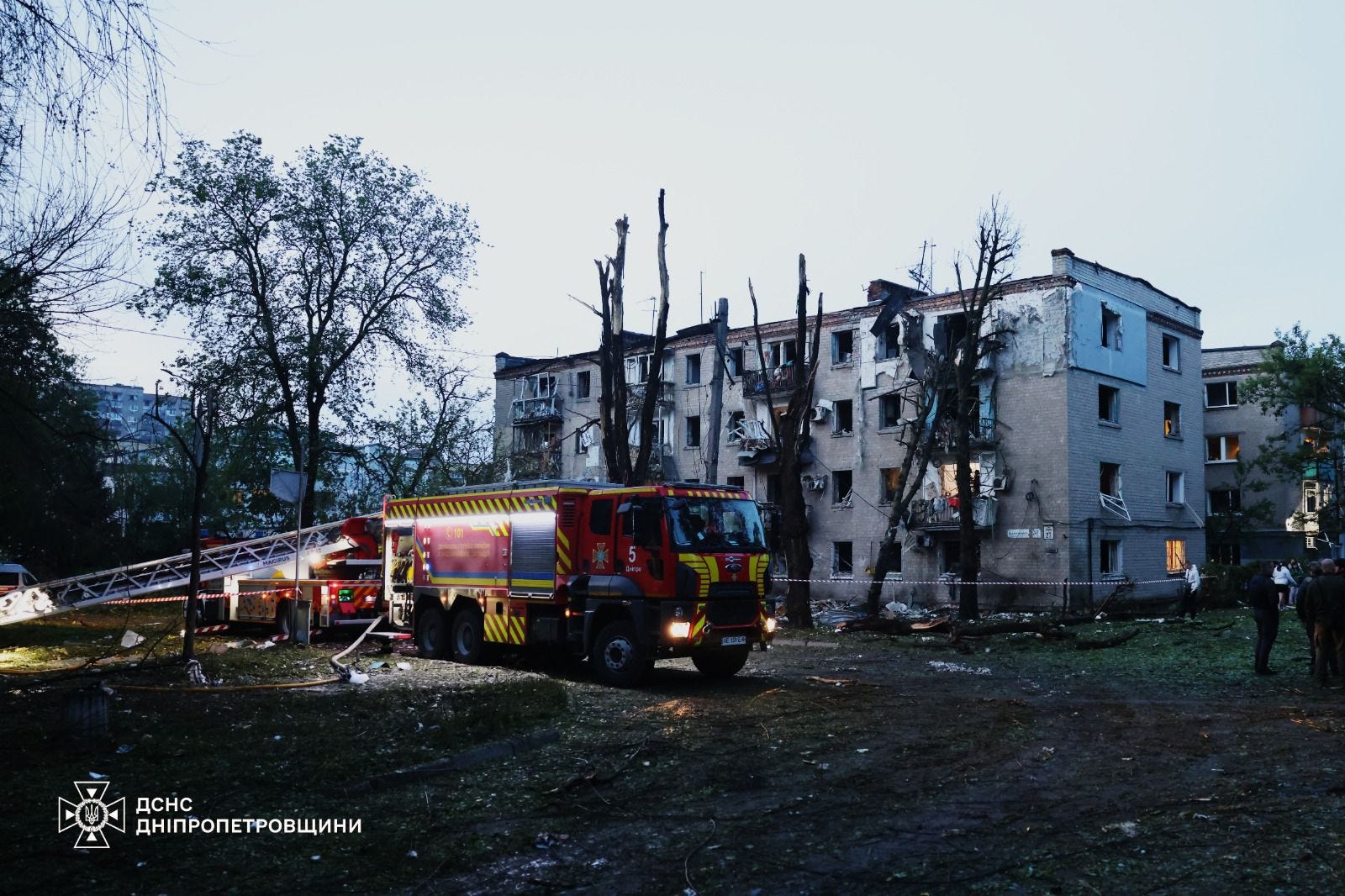
Four days earlier, Russia had launched what Ukrainian officials called the largest aerial assault since the start of the war — 1,560 drones and roughly 50 missiles struck Ukraine between May 14 and 15, killing at least 24 people, including nine in the capital, Kyiv. The barrage came after a 72-hour ceasefire brokered at the request of U.S. President Donald Trump. When it expired, Kremlin spokesman Dmitry Peskov confirmed the resumption of operations without ambiguity: “The humanitarian ceasefire ended. The special military operation is continuing.” [translated from Russian]
Moscow escalates — but on a shifting front
Russia’s May 18 strikes against Ukrainian energy infrastructure follow a well-established operational logic: cut power and heat to break public support for the war effort. Since the early weeks of the conflict in 2022, Moscow has systematically targeted Ukraine’s electricity grid, thermal plants and fuel depots — a campaign the Council of the European Union, the body where EU member states’ ministers meet to adopt legislation and coordinate policy, described in March 2026 as “systematic and deliberate targeting of civilian and energy infrastructure.”
Yet this aerial offensive is unfolding in a less favorable military environment for Moscow than Kremlin messaging suggests. Western analysts estimate that Russian forces lost approximately 120 square kilometers on the eastern front in April — a retreat that Putin publicly contradicts, insisting his troops are advancing. The gap between these two accounts cannot be independently resolved from open sources, and both should be treated accordingly.
Putin in the turbulence zone
Several converging indicators point to a difficult moment for the Russian president. The May 9 Victory Day parade — Russia’s annual showcase of military power, roughly equivalent to a combined Memorial Day and Fourth of July in terms of national symbolism — was scaled back, with Moscow choosing to keep troops at the front rather than recall them for the ceremonies.
The economic picture is equally strained. Russian oil and gas revenues fell 47% in the first two months of 2026, squeezed by Western sanctions and repeated Ukrainian drone strikes on export infrastructure. The Black Sea port of Tuapse, a key oil export hub, was struck four separate times between late April and early May. Ukrainian long-range drones can now reach targets more than 620 miles from the Ukrainian border — putting over 70% of the Russian population within range, a figure drawn from Bloomberg’s analysis of Ukrainian military capabilities. Ukraine’s domestic drone industry, which has expanded rapidly since 2022, is the primary driver of this shift.
Internal Russian polling suggests Putin’s approval ratings softened at the start of the year — a figure that must be treated with caution in a country where public opinion surveys operate under significant political constraint.
Ukraine has resisted Western pressure — including signals from Washington and several European capitals — to scale back strikes on Russian energy infrastructure, citing concerns about their impact on global oil markets. Zelensky has held firm.
Analysis: the war of attrition is changing shape
For three years, the dominant logic of this conflict ran in one direction: Russia strikes deep into Ukraine, Ukraine holds, Europe supports. That asymmetry is beginning to shift — not in raw military terms, where Russia retains significant advantages in manpower and munitions, but in the strategic logic of economic exhaustion and psychological pressure on the Russian home front.
Think of it as the drone-era equivalent of the strategic bombing campaigns that defined the later stages of World War II — not a knockout blow, but a sustained effort to erode industrial capacity, logistics networks and public morale from the inside out.
Ukraine is not trying to conquer Russia; it is trying to make the cost of this war tangible to Russian citizens in a way that four years of casualty lists have failed to achieve.
The EU is compounding that pressure on a parallel track. The 20th package of sanctions, adopted by the Council of the European Union on April 23, 2026, directly targets Russian energy revenues. And the €90 billion loan granted to Ukraine — broadly comparable in scale to major U.S. emergency spending packages — includes €60 billion earmarked for defense and is to be repaid using Russian war reparations.
The bottom line
Russia is striking Ukraine. Ukraine is striking Russia. And Moscow now faces a two-front challenge: the military front in eastern Ukraine, and a domestic front where residents of the capital’s suburbs are filming drones at dawn and asking whether they’re heading their way.
The central uncertainty is not military. It is political: how long can the Putin regime absorb this combination of economic pressure and psychological attrition before its internal foundations begin to shift? That question — unanswerable today — will likely determine the trajectory of this conflict far more than any square-kilometer accounting of territorial control.
Sources: France Info · Euronews · Atlantic Council · Council of the European Union · Al Jazeera