
Ukraine: Washington offers mediation as Moscow bombs Kyiv
Rubio pledges U.S. readiness to broker peace after deadly Russian strikes near Kyiv — but Moscow is already targeting embassies and sharpening its threats.

At least four dead. Buildings gutted. And at the same moment, U.S. Secretary of State Marco Rubio declaring from New Delhi that Washington stands “ready and willing” to help end the war in Ukraine. American diplomacy stepped forward precisely as Russia escalated its bombardment of the Ukrainian capital — a sequence that raises as many questions as it answers.
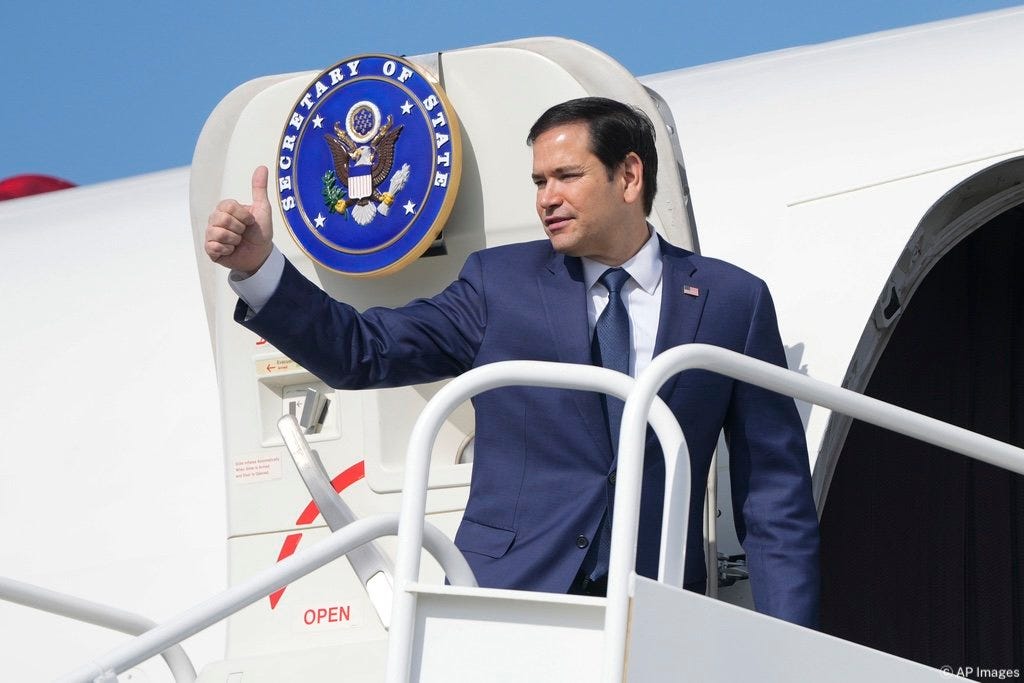
This image is used for illustrative purposes only.
At a Glance
Russia launched a barrage of drones and missiles targeting Kyiv and surrounding areas during the night of May 23-24 and throughout the weekend, killing at least four people and causing significant damage. Among the weapons used was the Oreshnik hypersonic missile, which Moscow claims can travel at ten times the speed of sound.
At the same time, Moscow warned foreign diplomats — including Americans — to leave Kyiv, citing imminent “systematic” strikes against “decision-making centers.” Western missions rejected the warning outright.
Marco Rubio, the U.S. Secretary of State, reaffirmed Washington’s willingness to serve as mediator from New Delhi, the day after a phone call with Russian Foreign Minister Sergei Lavrov.
The mechanics of a calculated escalation
The strikes on the night of May 23-24 were not a routine operation. The deployment of the Oreshnik missile — presented by Moscow as capable of carrying nuclear warheads — marked a significant step up in the means being employed. One Oreshnik strike hit Bila Tserkva, a city of roughly 200,000 people located some 80 kilometers south of Kyiv, illustrating that the Russian targeting envelope now extends well beyond the capital’s center. The assault followed Russia’s accusation that Ukraine had hit a vocational school in the Luhansk region, held by Russian forces, killing 21 people. Russian President Vladimir Putin ordered retaliation. The Russian Foreign Ministry then announced “systematic” strikes against Ukraine’s military-industrial infrastructure in Kyiv, targeting “command posts” — a formulation broad enough to encompass government buildings or diplomatic facilities.
The warning issued to foreign diplomatic missions, including the U.S. embassy, constitutes the political component of this escalation. Moscow had already used this form of intimidation in early May, when Ukraine threatened to disrupt the Kremlin’s military parade on Red Square. Western embassies rejected both warnings without hesitation: a spokesperson for France’s foreign ministry stated that Paris had no intention of evacuating, while the European Union’s ambassador to Kyiv publicly announced he was staying. Ukrainian Foreign Minister Andrii Sybiha dismissed the threats as “blackmail.”
Rubio in New Delhi: the right offer at the wrong moment?
Rubio’s statement came in a complex diplomatic setting. The U.S. Secretary of State was attending a ministerial meeting of the Quad — the strategic forum bringing together the United States, India, Japan and Australia, designed to coordinate Indo-Pacific security policy — at Hyderabad House in New Delhi. It was from that venue that he commented on the Russian strikes and reaffirmed Washington’s readiness to mediate.
The statement followed a phone call Monday with Lavrov, during which the Russian foreign minister relayed the evacuation warning to his American counterpart. Rubio told reporters that Russia had sent a note to all embassies, not just the American mission.
Washington’s readiness to mediate is not new: U.S.-led peace talks had already stalled in recent months, partly due to the Iran crisis consuming much of the Trump administration’s bandwidth. This succession of competing foreign-policy priorities could suggest that Washington’s actual room for maneuver is narrower than it appears — though that assessment remains an analytical hypothesis rather than an established fact.
What this sequence reveals about the state of the conflict
The Russia-Ukraine war, triggered by Russia’s full-scale invasion in February 2022, has now lasted longer than World War II — a comparison Rubio himself made. That chronological reference is not incidental: it signals a form of diplomatic fatigue running through Washington and European capitals alike.
For American readers, the conflict’s dynamics could bring to mind other prolonged engagements in which U.S. power sought a way out without direct military involvement. That parallel should not be pushed too far — the geopolitical contexts differ substantially — but the underlying logic of the offer Rubio is making is recognizable: neither withdrawal nor escalation, but a mediator’s posture that conditions on the ground — mass strikes, threats against embassies, deployment of hypersonic weapons — are making increasingly difficult to sustain.
The unified European resistance to Russian pressure is also worth noting. The coordinated refusal to evacuate by the French, EU and Ukrainian missions points to a degree of Western cohesion that, on this specific point, is holding.
The Bottom Line
Washington says it is ready to mediate. Moscow bombs and threatens. Kyiv holds firm and calls it blackmail. Europe stays put.
Whether this standoff is quietly moving toward the conditions for a ceasefire, or simply hardening into a conflict with no exit in sight, is the question that no declaration from New Delhi — however well-intentioned — can answer on its own.
Sources: Euronews · AFP