
Ukraine strikes St. Petersburg on Russia's economic showcase day
Drones hit a civilian bus in occupied Donetsk and a fuel terminal in Russia's second city — simultaneously.

At a Glance
A Ukrainian drone strike killed seven civilians and wounded eleven on June 3, 2026, when it hit a passenger bus traveling through Russian-occupied Donetsk, in eastern Ukraine.
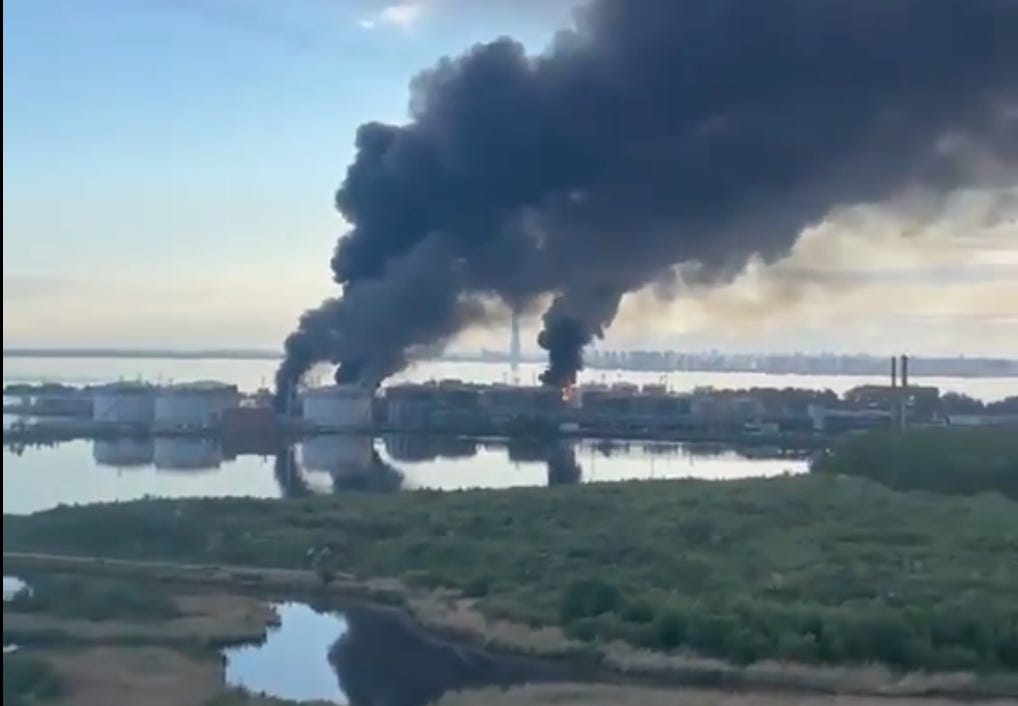
On the same night, Ukrainian drones struck the fuel terminal at the port of St. Petersburg, roughly 700 miles from the Ukrainian border, triggering a visible fire with no reported deaths.
The dual strike landed on the opening day of Russia’s flagship St. Petersburg International Economic Forum (SPIEF), the Kremlin’s annual showpiece for attracting global investment.
This image is used for illustrative purposes only.
A night of two strikes, one signal
In the early hours of Wednesday, June 3, 2026, a passenger bus traveling from Moscow to Simferopol — the administrative capital of Russian-annexed Crimea — was struck by a Ukrainian drone near Yenakiieve, a city in the Russian-occupied section of Ukraine’s Donetsk region. Seven civilians were killed and eleven wounded, according to Denis Pushilin, the Moscow-installed head of the occupied part of Donetsk. The victims were civilians, by his own account.
Simultaneously, more than 1,100 kilometers (roughly 700 miles) from Ukraine’s border, drones were hitting St. Petersburg. The port’s fuel terminal — described by Ukrainian President Volodymyr Zelensky as used “for military purposes” — caught fire. Injuries were reported across several city districts by Governor Alexander Beglov. No deaths were reported in the city. Russia’s Defense Ministry said 354 Ukrainian drones were shot down throughout the night.
The timing: deliberate provocation or operational coincidence?
The strikes unfolded on the opening day of the St. Petersburg International Economic Forum (SPIEF), the Kremlin’s annual prestige gathering where Vladimir Putin hosts foreign delegations, business leaders, and handpicked commercial partners. The black smoke rising over the harbor offered an image starkly at odds with the message Moscow seeks to project: a Russia that is stable, open for business, and in control.
Kyiv’s stated doctrine does not target civilians. But the bus strike, in territory Moscow formally claims as its own, complicates the picture. Russian authorities immediately presented the victims as civilians. Ukraine did not specifically comment on the incident.
This double blow — symbolic in St. Petersburg, lethal in occupied territory — could signal a deliberate intensification of Ukraine’s strategy: hit where Russian propaganda is most exposed, and demonstrate that Russia’s own territory no longer offers a safe rear. That assessment remains an inference; the operational intent behind the simultaneous timing has not been confirmed by Ukrainian officials.
The spiral: 23 Ukrainians killed the day before
Ukraine’s escalation was a direct response to a massive Russian strike launched overnight on June 1–2. More than 70 missiles and 650 drones had targeted Ukraine, hitting Kyiv and other cities. At least 23 people were killed and 138 wounded, with 16 of the dead in Dnipro alone. Zelensky warned that Moscow was already preparing the next salvo.
The Ukrainian president renewed his calls for tighter sanctions against the countries and companies supplying Russia with components used in missile production. He also pressed allies for additional interceptor missiles for Patriot air defense batteries — the only system in Ukraine’s arsenal capable of countering Russian ballistic missiles.
The urgency is compounded by an acute shortage. The joint U.S.-Israeli war against Iran has consumed roughly a third of available Patriot interceptor stockpiles. Countries across the Gulf depend heavily on the same system. Competing demands for scarce hardware are now a strategic reality Kyiv cannot afford to ignore.
Analysis: the war of symbols goes deeper
The strike on St. Petersburg marks a geographic rupture. This is not the first time Ukrainian drones have reached targets at this range — but the image of black smoke over Russia’s second-largest city, on the opening morning of its most high-profile economic event, is unlikely to be coincidental. It reads as a political message as much as a military operation.
For Putin, the showcase must hold. SPIEF is one of the few remaining forums where the Kremlin can still project a semblance of economic normalcy toward a world that has largely sanctioned Russia. A visible strike — visible, literally, from the forum’s surroundings — attacks that image as surely as a battlefield loss.
For Kyiv, the relationship with its allies runs partly through demonstrations of capability. Each deep strike is an argument in the ongoing negotiation with Washington and Brussels for more equipment and fewer restrictions on how Western-supplied weapons may be used.
The question is no longer whether Ukraine can reach St. Petersburg — the answer is clearly yes. It is whether Ukraine can hold the line against Russia’s next barrage, without the Patriot interceptors the geopolitics of the Middle East are holding at a distance.
The Bottom Line
The war in Ukraine now plays out on three boards simultaneously: the military front, the battle of symbols, and the global competition for finite weapons stockpiles. Every Ukrainian deep strike reinforces the case for long-range weapons; every Russian missile on Kyiv resets the urgency for Patriot batteries. The question that remains open is this: how far are Western allies willing to prioritize Ukraine in a defense calculus that is now global — with fronts multiplying faster than inventories?
Sources: France Info · Euronews · AFP