
Ukraine hits Moscow's main oil refinery — twice in one week
In a record drone attack overnight June 17–18, Ukraine struck Moscow's largest oil refinery for the second time in a week, disrupting airports and raising the military and diplomatic stakes of the war

Ukraine launched its largest drone attack on Moscow in at least two years overnight on June 17–18, 2026, striking the city’s main oil refinery for the second time in a week and forcing evacuations at Russia’s busiest airport. Kyiv framed the operation as a direct response to relentless Russian bombardment — and as a deliberate escalation at a pivotal diplomatic moment.
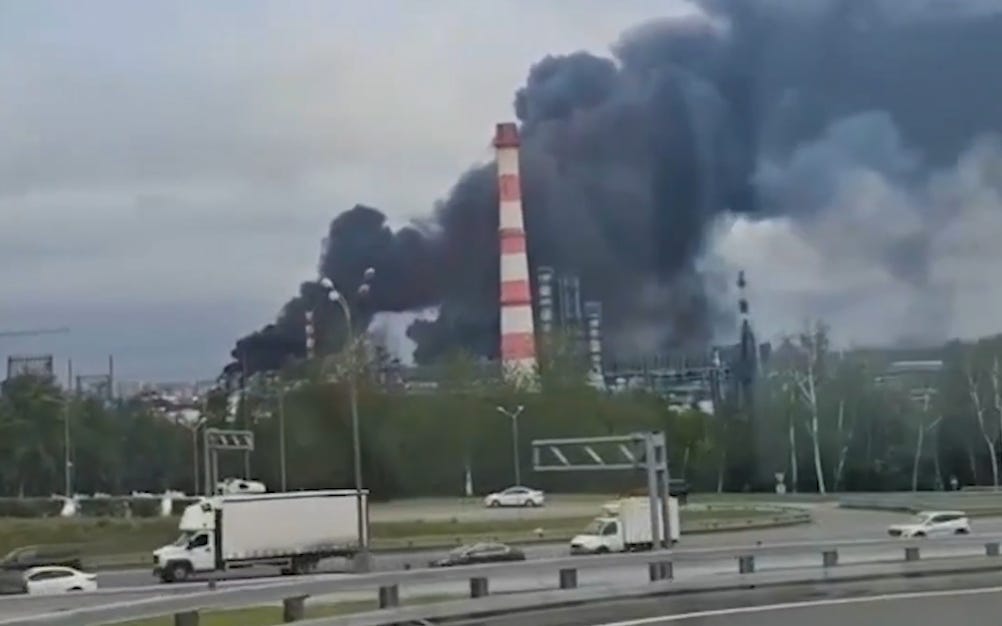
This image is used for illustrative purposes only.
At a Glance
Record scale: Moscow Mayor Sergei Sobyanin said 194 drones were intercepted in the Moscow region alone overnight. Russia’s Defense Ministry claimed its air defenses shot down more than 500 Ukrainian drones across the country during the same night — the largest such attack on the capital in at least two years, according to the Russian state-run news agency Tass.
Strategic target: The MNPZ (Moscow Oil Refinery), owned by Gazprom Neft — a subsidiary of the Russian state energy giant Gazprom — sits in the Kapotnya district, between nine and ten miles (roughly 15 km) from the Kremlin. It supplies an estimated 40% of Moscow’s fuel market, including fuel for the capital’s airports.
Diplomatic timing: The attack came hours after Ukrainian President Volodymyr Zelensky held what he described as a pivotal coordination call with U.S. President Donald Trump and French President Emmanuel Macron, following the conclusion of the G7 summit in Évian, France.
A deliberate campaign against Russia’s fuel supply
Ukraine did not formally claim responsibility in the initial hours — consistent with its standard practice on deep-strike operations. By the morning of June 18, Zelensky confirmed the strike on social media, saying his forces had hit the Moscow refinery “for the second time this week” [translated from French]. He called it “a fully justified response” to Russian attacks on Ukrainian cities.
The MNPZ, located in Moscow’s southeastern Kapotnya district, is one of Russia’s largest oil refining facilities. Owned by Gazprom Neft, it processes approximately 11 to 12 million tons of crude oil per year and supplies between one-third and 40% of the capital’s fuel needs — including jet fuel for Moscow’s airports. The first strike on the refinery had occurred on Tuesday, June 16.
Hitting the same strategic target twice in under 72 hours reflects a broader Ukrainian tactic: overwhelming Russian air defense systems through sheer volume while degrading the hydrocarbon infrastructure that helps fund Moscow’s war machine. Ukraine has spent months launching long-range drone strikes against oil depots, refineries, and logistics hubs deep inside Russian territory — sometimes hitting targets more than 300 miles from the Ukrainian border. Overnight, a separate oil depot in Gukovo, in Russia’s Rostov region near the Ukrainian border, was also struck.
Moscow under alert: airports grounded, suburbs damaged
Beyond the refinery, the scale of the attack generated cascading disruptions across the capital. Sheremetyevo Airport — Russia’s busiest — announced it had evacuated passengers to “secure locations” and suspended flights during the barrage. Russian carriers Aeroflot and Rossiya canceled more than 170 flights to and from Moscow. Several major roads near the refinery were temporarily closed.
In the greater Moscow region, Governor Andrei Vorobyov reported damage to a residential building in the Zhukovsky district, whose residents were evacuated, as well as a fire at a shopping center in Lyubertsy. Damage was also reported in the towns of Chekhov and Pavlovsky Posad. One woman sustained a minor shoulder injury in Elektrostal. No serious casualties were reported in the capital itself. As is standard in this conflict, Russian and Ukrainian accounts of the damage diverged significantly — Russian officials tended to emphasize successful interceptions while providing limited detail on infrastructure damage, a pattern that independent verification from inside Russia remains difficult to challenge.
The bigger picture: hitting the wallet, not just the morale
Ukraine’s long-range drone campaign is not designed to capture territory. It is designed to degrade Russia’s capacity to finance and supply its war effort.
The logic operates on two levels. First, direct economic pressure: damaging refining infrastructure forces Russia to import or ration fuels needed for civil and military aviation, transportation logistics, and the state’s oil industry. Second, a demonstration of reach: striking Moscow twice in one week — at a facility roughly 15 kilometers from the Kremlin — signals a growing sophistication and density in Ukraine’s drone arsenal that Moscow cannot easily dismiss. The full extent of the damage to the MNPZ remained unconfirmed at time of publication, with Russian authorities acknowledging the hit while minimizing its consequences — a pattern consistent with Moscow’s public communication throughout the war.
This dual escalation — deeper and more frequent Ukrainian strikes, near-daily Russian bombardment of Ukrainian cities — is unfolding more than four years into Russia’s full-scale invasion, with no military resolution in sight.
It would be premature to draw a direct causal link between the intensification of Ukrainian strikes and the current diplomatic dynamics. But the timing is striking. The overnight attack on Moscow came just hours after Zelensky called his joint call with Trump and Macron a conversation that “could change a lot.” That proximity in time may signal a Ukrainian intent to maintain maximum military pressure precisely as negotiating positions are being crystallized — though this remains an inference, not an established fact.
The bottom line
Vladimir Putin was in Kazan — roughly 500 miles east of Moscow — hosting a two-day summit with leaders of Southeast Asian nations when his capital came under its heaviest drone assault in years. Russia managing its Asian partnerships while its energy infrastructure burns fifteen kilometers from the Kremlin is not a coincidence — it is the face of a war that refuses to stay contained.
If Ukraine can strike Moscow’s main oil refinery twice in a single week, the question is no longer whether Kyiv has the capability to inflict real costs deep inside Russia. The question is whether those costs — economic, symbolic, logistical — will eventually change the Kremlin’s calculus about continuing a war that Moscow still publicly frames as proceeding on its own terms.
Sources: France Info · Radio-Canada · AFP · Kyiv Independent