
UK defense secretary resigns over spending shortfall
Britain's defense minister quits, calling Starmer's military investment plan inadequate amid growing security threats.

At a Glance
John Healey, the United Kingdom’s Secretary of State for Defense, resigned on June 11, 2026, objecting to the government’s forthcoming Defence Investment Plan (DIP) — a ten-year military spending roadmap — which he considers chronically underfunded.
The resignation lands one week before the Makerfield by-election, a critical political test for Prime Minister Keir Starmer, who has already faced months of internal Labour Party pressure.
The British government must publish its long-delayed DIP before the NATO summit on July 7–8 — a deadline that now arrives with no defense secretary in place.
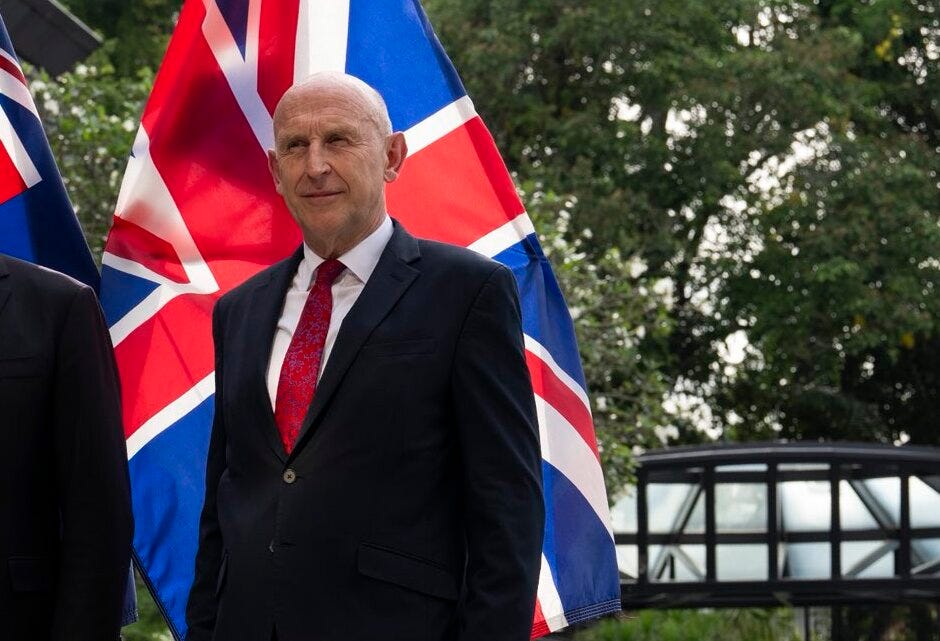
This image is used for illustrative purposes only.
A budget dispute at the cabinet’s core
John Healey, who served as Secretary of State for Defense since the Labour Party came to power, submitted his resignation to Prime Minister Keir Starmer on June 11, 2026. In a letter he published on X, he delivered a blunt verdict: the government — and specifically the Treasury — had failed to mobilize the resources the country needs to defend itself “in this period of growing threats.”
The dispute centers on the Defence Investment Plan (DIP), originally expected at the end of 2025 and repeatedly delayed. Healey said he had made clear in advance that he could not sign off on any deal that would leave the armed forces underfunded. When that line was not moved, he chose to walk.
The Prime Minister’s office did not immediately issue a public response.
A resignation timed to cause maximum damage
The resignation could hardly have come at a worse moment for Starmer. The Labour prime minister has faced months of internal party opposition, compounded by a string of damaging controversies. The Makerfield parliamentary by-election, widely viewed as a political bellwether for the government’s standing, is set for next week.
The broader context makes the timing more acute. The war in Iran has made visible, for a wider public, the cumulative effects of years of defense underinvestment — most notably the diminished operational capacity of the Royal Navy in the region. That backdrop sharpens the political charge in Healey’s letter, even if the DIP dispute is its direct cause.
Analysis: NATO commitments vs. fiscal reality
The numbers in dispute
The Starmer government has committed to raising defense spending to 2.5% of GDP by 2027, 3% after 2029, and 3.5% by 2035 — targets aligned with NATO requirements. These commitments were presented as a clean break from the underfunding of previous years.
Yet Healey’s resignation suggests the gap between announced trajectories and what the Ministry of Defense actually needs may be wider than the public figures imply — or that the Treasury declined to provide the credits required to meet those commitments on schedule. NATO Secretary General Mark Rutte, questioned at a press conference in Brussels on the same day and unaware of the resignation at the time, acknowledged that increasing military spending was “not easy.”
The deeper question: who decides how much risk is acceptable?
Healey’s departure exposes a structural tension that runs through every government facing hard budget constraints: who, ultimately, arbitrates between security imperatives and fiscal sustainability? By resigning rather than acquiescing, Healey is making a political bet — that a British public increasingly aware of its military vulnerabilities will side with him over a prime minister seen as timid on defense.
That bet may prove right. It may also be read, by European and North American allies, as a signal that the United Kingdom is struggling to translate its security ambitions into concrete budget choices — at precisely the moment NATO is demanding more from every member.
The Bottom Line
The question Healey’s resignation puts on the table is whether the political will to fund defense at the level democracies publicly commit to can survive the pressure of competing budget priorities — or whether the gap between promise and delivery is simply structural, and the next crisis will find Europe, once again, catching up.
Sources: France Info · AFP