
Turnberry on hold: EU strikes a deal under Trump's ultimatum

Under mounting pressure from Washington, the European Union reached a provisional agreement Wednesday to implement the Turnberry trade framework — with a deadline of July 4 and the threat of higher tariffs hanging over every word.
At a Glance
European Parliament and Council negotiators struck a provisional deal overnight May 19–20, unblocking a legislative process that had been paralyzed for months over the implementation of the EU-U.S. Turnberry trade framework.
Parliament dropped its demand that the U.S. first eliminate steel surcharges before the deal kicks in, instead granting Washington until the end of 2026 to comply — its most significant concession.
President Trump had set July 4 — the 250th anniversary of American independence — as a hard deadline for EU ratification, threatening to raise tariffs on European cars and trucks from 15% to 25% if Brussels failed to deliver.
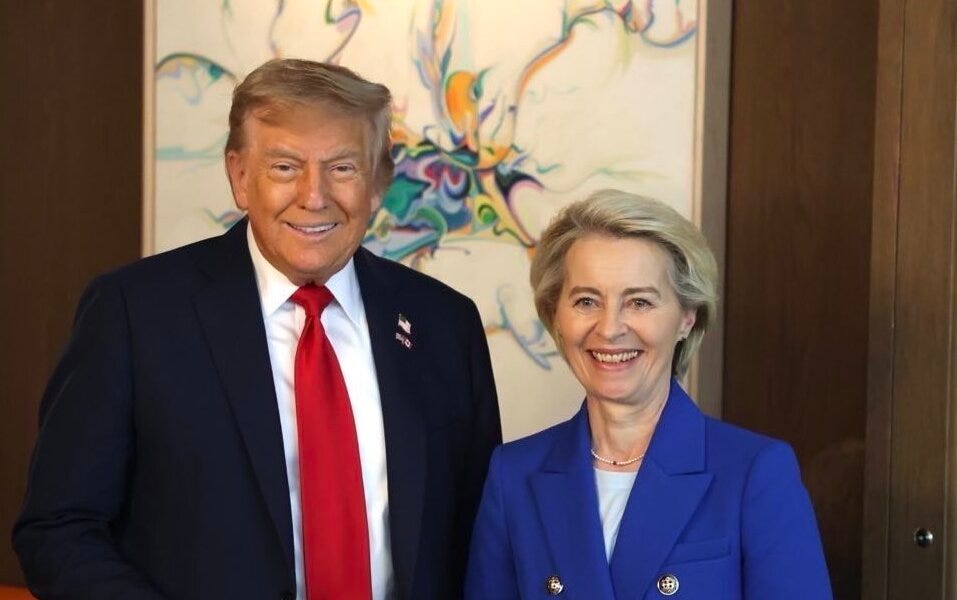
This image is used for illustrative purposes only.
A deal that almost never was
Ten months after it was concluded at Trump’s Turnberry resort in Scotland, the EU-U.S. trade agreement remains, as of May 20, 2026, a political commitment without full legal force. The framework signed July 27, 2025, by Donald Trump and Ursula von der Leyen — president of the European Commission, the EU’s executive arm — had seemed to draw a clear line: the EU would eliminate tariffs on most American industrial goods, and in exchange Washington would cap its own tariffs on European exports at 15%.
The balance looked settled. It wasn’t. On the American side, the 15% mechanism moved quickly — a retroactive decision dated September 25, 2025, even erased the 25% tariff that had briefly applied to European vehicles. On the European side, the legislative translation of the deal ran into a resistant Parliament, geopolitical turbulence triggered by Washington’s ambitions over Greenland, and a shock from the U.S. Supreme Court: on February 20, 2026, the court ruled Trump’s tariffs unlawful — a decision whose full practical effects remain suspended pending further legal proceedings, but one that froze European momentum.
Then came the political complications. Several European countries drew Washington’s ire in January 2026 by opposing or criticizing U.S. designs on Greenland — with eight EU member states reportedly threatened with additional tariffs as a result. Weeks of tension over the U.S.-led military campaign against Iran added new friction to an already strained relationship.
The Strasbourg night that unlocked everything
It was in a closed-door negotiating room at the European Parliament in Strasbourg that this saga provisionally resolved itself. After a failed attempt in early May, representatives of the Parliament and the 27 EU member states reconvened on the evening of May 19. By early morning, the Cypriot presidency of the EU Council — Cyprus holds the rotating, six-month chairmanship of the Council of the EU, the body that coordinates EU governments and drives internal legislative negotiations — announced a “provisional agreement.”
The EU Council should not be confused with the European Council (the summit of heads of state) or the Council of Europe (a separate, non-EU institution). In practical terms, the Council presidency sets the legislative agenda and brokers deals between member states — the equivalent, roughly, of a rotating committee chairmanship managing 27 co-equal governments.
The compromise rests on a major concession by Parliament: the steel question was taken off the table as a precondition. Lawmakers had initially demanded that the U.S. eliminate its surcharges on steel-containing components before any EU tariff reductions took effect. The final text instead gives Washington until the end of 2026 to comply. Steel and aluminum remain outside the 15% framework, still subject to 50% U.S. tariffs — a contentious chapter left to future negotiations.
In return, Parliament secured several safeguards. A suspension clause allows Brussels to withdraw preferential treatment for American exporters if Washington exceeds the agreed tariff ceiling, discriminates against EU operators, or engages in economic coercion. A sunset clause sets a firm expiration date for the deal: March 2028.
For European businesses and workers, the stakes are concrete. The EU and the U.S. trade roughly €900 billion in goods and services annually, supporting millions of jobs on both sides of the Atlantic. The automobile sector alone employs around 14 million Europeans directly and indirectly — and it was the sector most directly targeted by Trump’s threat to raise tariffs from 15% to 25%. A deal that holds those tariffs at 15% represents measurable relief for exporters from Germany’s auto manufacturing corridor to northern Italy’s industrial belt.
The mechanics of Trump’s pressure
This resolution was not spontaneous. It is the direct product of an ultimatum. On May 7, following a phone call with von der Leyen, Trump announced on Truth Social that he was giving the EU until July 4 — the 250th anniversary of American independence — to ratify the deal. If Brussels missed that date, tariffs on European cars and trucks would jump well beyond 15%, he warned. Von der Leyen described the call as “very good” and confirmed that “significant progress” had been made toward a reduction in tariffs by early July.
This deadline-as-leverage tactic is a hallmark of Trump’s negotiating style: impose an asymmetric time pressure, let the other side scramble, then frame any concession as a victory. Whether it works as reliably against European institutions — with their procedural complexity and consensus requirements — is a different question.
Parliament had to navigate two conflicting demands. Green and left-leaning groups insisted on robust safeguards against a partner whose reliability had been repeatedly questioned. Anna Cavazzini, a German Green MEP — a Member of the European Parliament — argued that recent events had demonstrated that Washington’s commitments could not simply be taken at face value, making strong protective clauses essential. On the other side, the center-right European People’s Party (EPP), the Parliament’s largest political group, pressed for rapid ratification to protect transatlantic trade worth millions of jobs.
Bernd Lange, a German Social Democratic MEP who served as the Parliament’s lead negotiator, played down the concessions, arguing that the final text preserved Parliament’s core demands: a suspension mechanism, an impact monitoring system, provisions on unjustified tariffs, an expiration clause, and meaningful parliamentary oversight. The steel compromise, from his vantage point, was a matter of timing — not principle.
What the deal says — and what it leaves open
The Turnberry agreement is not a trade treaty in the conventional sense. Neither the U.S. Congress nor EU member state parliaments have formally ratified it. It is a joint political declaration, fleshed out in August 2025 and implemented through separate legal instruments on each side. For American readers, the closest analogy would be an executive agreement — a deal signed by the White House without Senate ratification, given effect through delegated legislative authority. That structure gives the arrangement inherent fragility.
France’s reaction at the time of signing illustrated that ambivalence. Benjamin Haddad, France’s minister for European affairs, called the deal unbalanced, even as he acknowledged it would provide temporary stability. Prime Minister François Bayrou was blunter on X, suggesting the EU was “resigning itself to submission.” Neither position altered the outcome — but both signal the unease with which Paris entered this new tariff equilibrium.
Entire sectors remain outside the deal’s perimeter. Steel and aluminum, taxed at 50%, are pending separate negotiations. Potential U.S. pharmaceutical tariffs, signaled by Trump separately, are not covered by the Turnberry framework. And Washington has not formally withdrawn its threats against the eight EU member states that reportedly drew its anger during the Greenland crisis.
The bottom line
Wednesday’s provisional agreement is a calendar win — not necessarily a substantive one. The EU has met its deadline, six weeks ahead of July 4. But the structural question remains unanswered: can a durable transatlantic trade relationship be built on biannual ultimatums, suspension clauses as scaffolding, and a power asymmetry that neither sunrise nor sunset provisions truly address?
What the Strasbourg night resolved was a procedural problem. Whether Europe is negotiating with a partner or accommodating a power imbalance — that question stays open.
Sources: France Info · RTS · Le Temps · Touteleurope.eu · European Parliament · Vie-publique.fr · French Directorate General of Customs