
Trump sidelines Europe at Ormuz
At the G7 in Évian, Trump reduced Europe's Hormuz initiative to "a boat or two" — a cordial sidelining that reveals the limits of European influence in its own neighborhood.

At a Glance
Trump arrived at the G7 in Évian, France, on Monday, June 15, fresh off a preliminary deal reached Sunday, June 14 with Iran — a memorandum of understanding, not a final agreement — setting a framework to reopen the Strait of Hormuz by Friday’s formal signing in Geneva.
In front of French President Emmanuel Macron, Trump reduced the proposed multinational naval force to “a boat or two,” while praising France as “a special friend” — a formulation warm in tone and dismissive in substance. But U.S. officials had signaled before the summit that allied demining support would in fact be welcome.
Macron maintained his “offer to help” while conceding it might not be “wanted” or “necessary” — though six G7 members, excluding the U.S., jointly proposed a defensive demining mission hours later, suggesting Europe has no intention of standing down.
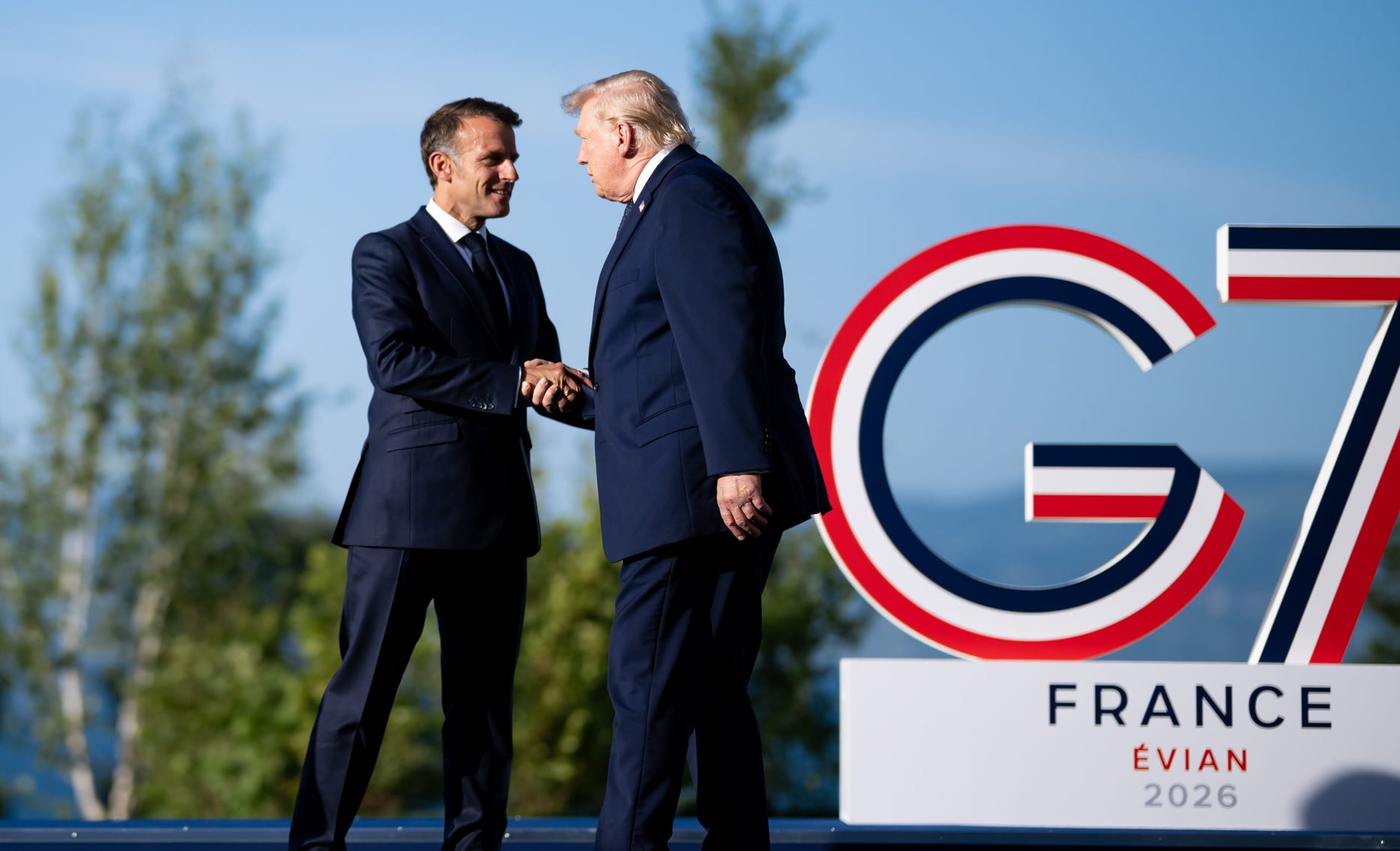
This image is used for illustrative purposes only.
A preliminary deal before the summit even opened
Before Air Force One touched down in Évian, Donald Trump had already reshaped the G7’s agenda. The agreement reached Sunday with Iran — a memorandum of understanding, described by Vice President JD Vance as “about a page and a half” and explicitly framed as a broad framework leaving many details to future technical negotiations — was presented by Trump as a personal diplomatic triumph. The formal signing is scheduled for Friday, June 19, in Geneva. Iranian President Masoud Pezeshkian welcomed the framework as “an important step” but stressed that a final agreement had not yet been completed.
The deal’s scope matters for understanding what happened next. When Trump told Macron on Monday that the Strait would be “completely open” by Friday, he was describing the legal trigger — the signing ceremony — not the physical reality. Pentagon officials have estimated that mine-clearance operations could take up to six months, even with dedicated minesweeping vessels already in the region. Analysts suggest normal shipping flows may not return to pre-war levels until 2027.
That context made the exchange with Macron particularly pointed. Where the French president had hoped to present a multinational initiative — a Franco-British force to demine the strait and secure its reopening — Trump responded with a phrase polite in form and more ambiguous in substance than it first appeared:
“I don’t think we’re going to need a lot of help.”
He added that he saw no problem with a few countries sending “a boat or two” to the area, noting that France “would be very good for that.” He wrapped up the exchange with a warm word for “Emmanuel,” whom he called “a special friend.”
Not a rejection — but a reframing
Trump’s comment should be read alongside what U.S. officials had said before the summit. A senior administration official stated last week that the U.S. would be “very involved in demining” and that G7 allies contributing to the effort would be “a helpful thing to get things back to normal as quickly as possible.” The UK and France had coordinated a mine-clearing plan with military planners from more than 15 countries, operationally ready and awaiting political endorsement.
What Trump appeared to reject at Évian was not Europe’s operational role, but its political framing — the idea that the Franco-British initiative represented an autonomous European contribution rather than a supporting role in a U.S.-led resolution. The distinction is subtle but consequential: Europe is welcome at the minesweeper, less so at the negotiating table.
France, the United Kingdom, Germany, Japan, Italy, and Canada responded by jointly proposing “a strictly defensive and independent mission to reassure commercial shipping and conduct mine clearance operations” — a formulation that conspicuously asserts Europe’s independence from U.S. authorization.
Macron’s exposed position
Macron’s response to Trump was telling. Rather than contest the framing, he reiterated his “offer to help,” while acknowledging it might not be “wanted” or “necessary.” Hours earlier, speaking on the French private broadcaster TF1, he had said the aircraft carrier Charles de Gaulle — already deployed to the Arabian Sea since March — could be “within two or three days” of the zone. That positioning, contingent on American and Iranian approval, captures Europe’s structural dilemma in this crisis: militarily ready, politically subordinate.
A further complication hangs over the deal itself. Israel sharply criticized the U.S.-Iran framework, and exchanges of strikes between Israel and Lebanon continued as of Monday — raising questions about the regional ceasefire’s durability and, with it, the conditions under which any demining mission would operate.
Europe outside the room — but not absent
The Strait of Hormuz is one of the world’s most critical maritime chokepoints, a narrow passage between Iran and Oman linking the Persian Gulf to the Gulf of Oman. Roughly 20 to 25 percent of global seaborne oil trade passes through it. Its effective closure since late February 2026 — when Iran’s mining campaign began amid escalating U.S.-Israeli strikes — had cut crude tanker transits by an estimated 95 percent and caused severe disruption to global energy and logistics networks.
That Europe sought a role in stabilizing the waterway was both politically coherent and economically self-interested. Both France and the United Kingdom have naval capacity in or near the region, direct stakes in stable energy flows, and a shared interest in demonstrating strategic relevance to Washington after months of being criticized for not backing the Iran campaign.
The question is whether Trump’s comment at Évian represented a definitive verdict or an opening gambit. The demining problem is real, large, and time-sensitive — and the U.S. does not have unlimited minesweeping capacity. Europe may yet find its “boat or two” becomes indispensable.
The bottom line
The exchange in Évian was less a rejection of Europe than a reminder of the hierarchy. Washington and Tehran concluded a framework deal — incomplete, fragile, with Israel still firing and details still unresolved — and then invited their allies to help with the cleanup. Whether that turns into genuine partnership or remains cordial marginalization will depend less on Trump’s rhetoric than on the mine count in the strait and the durability of a one-and-a-half-page document that neither side has fully committed to yet.
Sources: France Info · AFP · ABC News · CNN · NPR · Türkiye Today · TradingKey