
The Northolt Treaty reshapes Europe's defense
The UK and Poland signed the Northolt Treaty on May 27, 2026: joint weapons, cybersecurity, and Russia named as Europe's greatest long-term threat.

On May 27, 2026, Keir Starmer and Donald Tusk signed a new defense and security treaty at a site freighted with history — the Battle of Britain Bunker, yards from the RAF base where Polish pilots flew sorties in 1940. Eighty-six years on, their two countries committed to a new pact — this time against a threat that, unlike Nazi bombers, often strikes invisibly: cyberattacks, sabotage, coordinated disinformation.
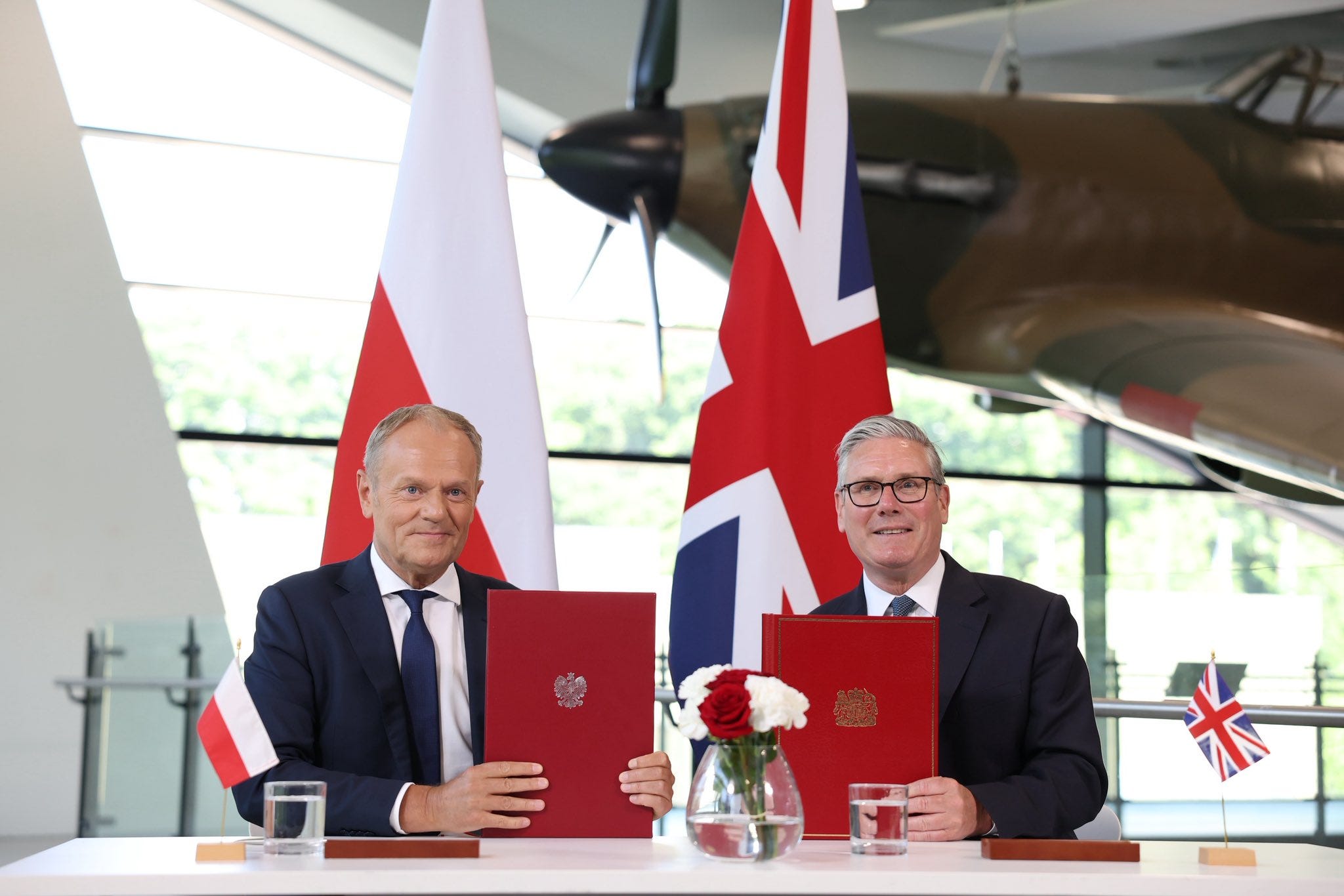
This image is used for illustrative purposes only.
At a glance
The UK and Poland signed the Northolt Treaty on May 27, 2026, covering joint weapons development, cybersecurity, intelligence-sharing, and the fight against organized crime.
The treaty is the third bilateral defense pact signed by London in under a year, following similar agreements with France and Germany, and is central to Prime Minister Starmer’s strategy of rebuilding ties with Europe after Brexit.
Both Warsaw and London explicitly name Russia as a long-term strategic threat, and flag growing concern over a potential drawdown of U.S. military presence on the continent.
What the treaty covers — and what it is designed to do
The agreement spans joint military exercises, intelligence exchanges, development and manufacturing of complex next-generation weapons — including air and missile defense systems — cybersecurity cooperation, health security, and cross-border organized crime. According to the Polish government, the treaty includes specific clauses on mutual military assistance in the event of a threat, as well as provisions for technology transfer.
The signing ceremony was held at RAF Northolt, a Royal Air Force base in west London — from which Polish aviators operated during World War II — and then at the nearby Battle of Britain Bunker museum, where both leaders laid a commemorative wreath. The symbolism was deliberate: Tusk personally requested that the agreement be named the Northolt Treaty, in tribute to that shared history.
Poland shares its eastern border with Russia, Belarus, and Ukraine — at war since Russia’s full-scale invasion in 2022. For Tusk, instability has become a permanent feature of Poland’s reality — not a matter of months, he stressed, but of years, given the country’s neighborhood. Both leaders also discussed what London describes as a sharp rise in hostile activity across the continent, including coordinated arson attacks in Britain and across Europe that British authorities attribute to Russian operatives, as well as escalating cyberattacks and espionage campaigns.
Starmer’s political calculus — and his domestic vulnerabilities
This treaty is the third bilateral defense agreement signed by London in under twelve months, following similar pacts with France and Germany. The logic is consistent: the United Kingdom, which left the European Union following a divisive 2016 referendum, is seeking to rebuild bridges with the continent in the domain where its added value is most undeniable — defense and intelligence.
Starmer is governing under significant pressure. His Labour Party suffered heavy losses in local elections in May 2026. Senior figures in his own party are openly discussing a potential leadership contest. Former Health Secretary Wes Streeting called Brexit a “catastrophic mistake,” arguing that the UK should one day return to the European Union — a position that exposes a deep fault line within Labour between a pragmatic pro-EU wing and a more cautious one. Kemi Badenoch, leader of the opposition Conservative Party, dismissed such statements as evidence of “a party that does not have a plan for the country.”
This context of domestic fragility could paradoxically reinforce the value of diplomacy for Starmer: signing treaties with European allies allows him to project international stature at a moment when his authority at home is under challenge.
Analysis — A defense architecture built on bilateral threads
Poland: the continent’s military pivot
Poland is now among NATO’s most defense-committed members, dedicating nearly 4.5% of its GDP to defense in 2025 — the highest share of any NATO ally — compared to 2.40% for the United Kingdom. That differential alone captures the asymmetry in threat perception: for Warsaw, the border with Russia is not a geopolitical abstraction — it is a daily reality. Poland has also served as a critical logistics hub for military aid to Ukraine since 2022, making it a prime target for Russian hybrid operations.
This sequence of bilateral treaties — France, Germany, then the United Kingdom — suggests a deliberate Polish strategy of diversifying security guarantees, alongside NATO, at a time when the reliability of the American security umbrella is increasingly in doubt. Tusk said explicitly that both countries take “very seriously” statements suggesting the United States may reduce its military footprint in Europe.
The UK: between two shores
For London, the treaty carries a dual dimension. On the security side, it responds to documented and growing threats: hostile operations attributed to Russia on British soil have multiplied. On the diplomatic side, it advances Starmer’s “European re-anchoring” strategy — without reopening the question of EU membership, which remains politically explosive. The treaty deepens cooperation with the European Union, but through the bilateral route, sidestepping the debate over the UK’s institutional relationship with the bloc.
This architecture — a web of bilateral treaties rather than re-integration into collective European structures — may well define the British security model for the next decade:
Close to Europe, but not inside it.
The bottom line
The Northolt Treaty raises a question that no one is asking aloud: can Europe build a credible defense architecture out of bilateral pacts, at the very moment U.S. pressure for European strategic autonomy is intensifying? If every country weaves its own web of alliances, who coordinates — and who commands — when the threat becomes simultaneous across multiple fronts?
Sources: Euronews · Reuters · AFP · Le Temps · NATO (Defence Expenditure of NATO Countries, 2025)