
Starobilsk: when war becomes a story
A Ukrainian drone strike destroyed a dormitory housing 86 teenagers in Russian-occupied Luhansk. Moscow cried massacre. Kyiv said it hit a military target.

Days later, nuclear-capable Orechnik missiles rained on Kyiv.
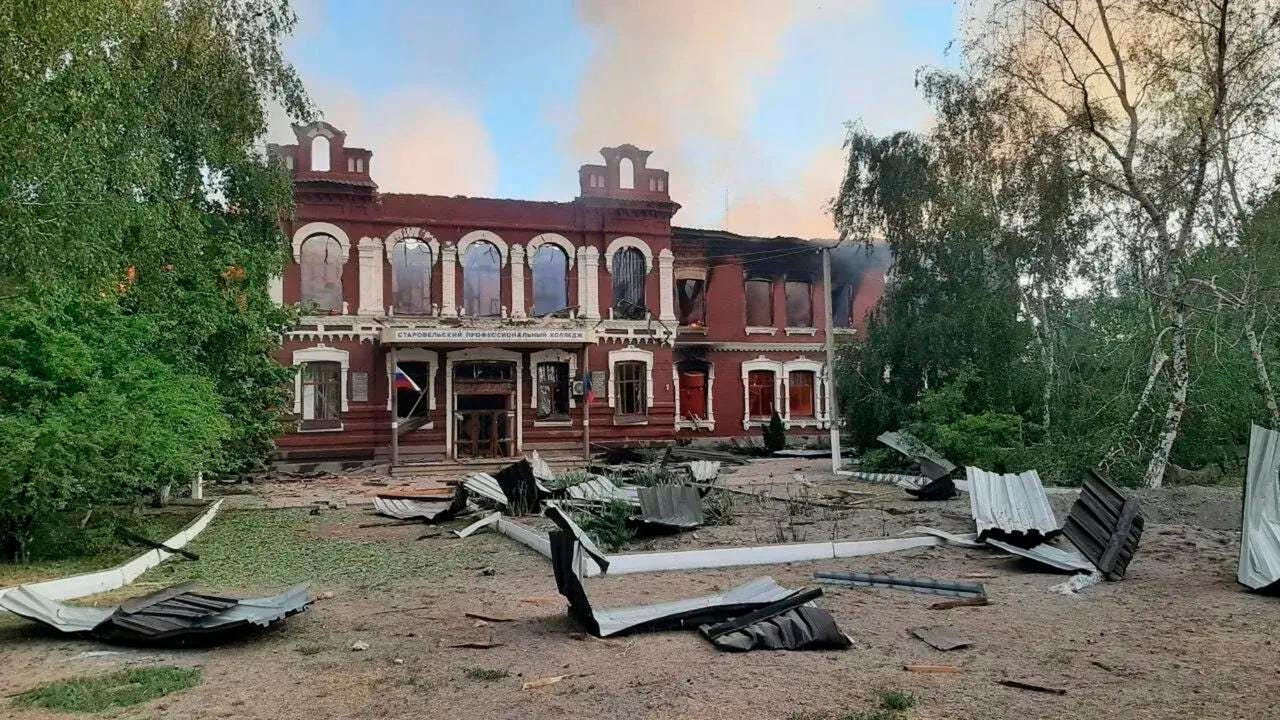
This image is used for illustrative purposes only.
In the early hours of May 22, 2026, drones struck the vocational college of Starobilsk, a town of roughly 16,000 in Ukraine’s Luhansk region, which Russia has occupied and illegally annexed since 2022. The five-story residential building partially collapsed. Eighty-six teenagers between the ages of 14 and 18 were inside, according to Russian-installed authorities. The death toll climbed as rescue crews dug through the rubble: 21 confirmed dead, more than 40 wounded. One night. Two radically incompatible accounts. And, within days, Orechnik ballistic missiles striking Kyiv.
At a Glance
21 people killed — teenagers in a dormitory — after a strike destroyed a residential building at a vocational college in Starobilsk, in Russian-occupied Ukrainian territory.
Kyiv acknowledges striking “in the area” but denies targeting civilians: the stated target was a headquarters of the Rubikon group, a Russian drone unit accused of carrying out strikes against Ukrainian civilians.
Moscow used the incident to justify a massive retaliation: Orechnik missiles — capable of carrying nuclear warheads, though not armed with them in this strike — hit Kyiv days later, killing at least four people and wounding more than one hundred.
What happened — and what each side claims
Hard facts are rare in this file. What is established: in the night of May 21-22, drones hit the Starobilsk Vocational College, affiliated with Luhansk State Pedagogical University, in a town under Russian military control since 2022. The five-story dormitory collapsed. Emergency teams worked for hours with cranes and heavy equipment to clear the concrete slabs.
On the Russian side, Leonid Pasechnik — the regional governor appointed by Moscow — confirmed that 86 teenagers were in the building at the time of the strike. Vladimir Putin labeled the attack a “terrorist act” and ordered the military to prepare a response. Russia’s foreign ministry characterized it as “a targeted attack against the civilian population” and accused Western intelligence services of helping Ukraine select its targets.
Ukraine’s military command issued its own version minutes after the first Russian accusations. Ukrainian forces had indeed struck “in the area” of Starobilsk, but their stated target was a headquarters of the Rubikon unit — a Russian formation specialized in drone strikes that, according to Kyiv, regularly attacks Ukrainian civilians. The Ukrainian general staff rejected the accusation of having struck a dormitory, calling it “manipulation,” and stressed that Ukraine “strictly complies with the norms of international humanitarian law.”
These two accounts cannot be reconciled at this stage. The central question — whether the dormitory was the intentional target or collateral damage from a strike on a nearby military installation — remains open. No independent source has been able to verify whether Russian military infrastructure was present in the immediate vicinity of the college.
The mechanics of escalation
What stands out in this sequence is not merely the tragedy itself, but the speed with which it was instrumentalized. Moscow did not wait for rescue operations to conclude before setting the retaliation machine in motion. By Friday, May 22, Russian officials were already signaling a military response. By May 25, Russia had warned foreign nationals to leave Kyiv ahead of new strikes. That evening and into May 26, a wave of 90 missiles and 600 drones struck Ukraine — including Orechnik ballistic missiles against the capital, killing at least four people and wounding over a hundred. It was the third time Russia had deployed the Orechnik since invading Ukraine in February 2022.
This pattern — a dramatic incident in occupied territory, immediate denunciation, disproportionate retaliation — resembles a sequence that has appeared before in this conflict. It suggests that the decision to deploy the Orechnik against Kyiv may have been awaiting a sufficiently emotionally charged pretext, though this cannot be formally established.
The real stakes: who controls the definition of a war crime
Starobilsk raises a structural question that extends far beyond this incident: in a war fought across disputed territories, who holds the authority to define what constitutes a war crime?
Russia strikes Ukrainian civilian infrastructure daily — schools, hospitals, power grids — and these strikes have been documented and condemned by international bodies. But when Ukraine strikes in occupied territory — territory that remains Ukrainian under international law — Moscow invokes the same vocabulary: terrorism, crime, the protection of civilians. This symmetry of language is designed to neutralize the perceived legitimacy of Ukrainian resistance and rebalance an international narrative that Russia has been losing since 2022.
For a reader in North America, the analogy would be a state that militarily occupies part of a neighboring country, then invokes international humanitarian law to protect the installations it has forcibly implanted there — a legally tenuous position, but politically effective in media favorable to Moscow.
The night of Starobilsk produced two things: 21 people who will not come back, and a pretext Moscow may have been waiting for.
The bottom line
What this sequence reveals, at its core, is the accelerating irrelevance of international humanitarian law as a shared framework in this conflict. When both sides simultaneously claim its protection and accuse each other of violating it, war ceases to be a rules-governed contest and becomes a competition of narratives. In that competition, the teenagers of Starobilsk are merely props.
The real question is not who targeted what on that particular night. It is whether Europe and its allies have the means — and the will — to impose asymmetric costs on the actor that systematically transforms civilian deaths into war fuel.
Sources: Euronews · AFP · RTBF · RTS · Al Jazeera English