
Starobilsk: a strike on a school and two competing narratives
Moscow claims six dead and dozens wounded after a dormitory collapsed at a high school.

Kyiv acknowledges the attack but insists it targeted a military command post. Between information warfare and international law, the incident lays bare the fundamental ambiguity of strikes in occupied urban territory.
At a Glance
Six people killed, 39 wounded, and 15 missing in Starobilsk — a city of roughly 16,000 in the Luhansk region of eastern Ukraine, under Russian military occupation — after Ukrainian drone strikes on the night of May 22, 2026
Kyiv confirms the attack but says its forces targeted a Russian military headquarters in the same area, not civilians
Moscow has called an emergency session of the United Nations Security Council and promised military retaliation
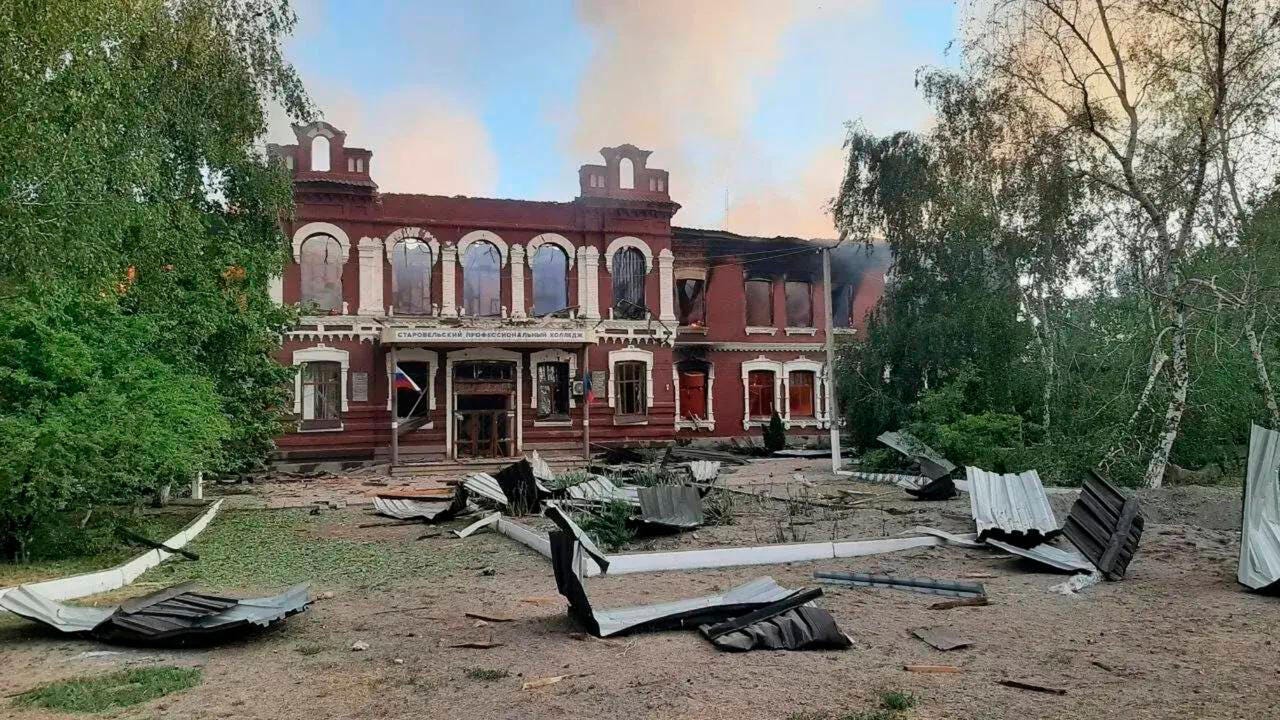
This image is used for illustrative purposes only.
A night of drones over Starobilsk
In the early hours of May 22, Ukrainian drones struck a high school in Starobilsk, a city of roughly 16,000 inhabitants in the northern part of the Luhansk region — territory occupied by Russia and claimed by Moscow as annexed since 2022. The multi-story dormitory collapsed. At the time of the strike, 86 young people between the ages of 14 and 18 were inside, according to a statement from Russia’s Foreign Ministry.
The casualty figures released by Russian occupation authorities put the toll at six dead, 39 wounded, and 15 missing, with search-and-rescue operations still underway. Russian President Vladimir Putin, speaking in remarks broadcast on state television following a moment of silence, stated that the strike — carried out in three successive waves, with sixteen drones targeting the same location — could not be described as accidental. He promised a military response.
Two narratives, one city
Kyiv does not dispute the attack. Ukraine’s military command acknowledged striking Starobilsk but said its forces had targeted the military headquarters of a Russian unit embedded in the urban area. The distinction is significant: throughout more than four years of war, Russian forces have repeatedly used civilian infrastructure — schools, hospitals, residential buildings — as command posts or troop quarters. This practice has been flagged in reports by several international organizations, including the United Nations, and itself constitutes a violation of international humanitarian law.
Russia’s Foreign Ministry characterized the strike as a deliberate attack on civilians and accused Western governments that provide intelligence to Ukraine of bearing co-responsibility for targeting decisions. This line of argument — a constant feature of Russian wartime communication since 2022 — is designed to erode support among Kyiv’s allies. Moscow has also called an emergency meeting of the UN Security Council, the body charged with maintaining international peace and security, made up of fifteen member states including five permanent members with veto power.
The information battle in occupied territory
The incident follows a now-familiar pattern on both sides. Leonid Pasechnik, the Russian-appointed governor of the Luhansk region — not elected, installed by Moscow — immediately posted images of burned-out and partially collapsed buildings on social media. Kremlin spokesman Dmitry Peskov called the event a “monstrous crime of the Kyiv regime.” This rapid media response, which recalls the communication practices observed throughout the war, could reflect a systematic narrative-building effort aimed at global opinion — though the extent to which it is coordinated remains to be established.
On the Ukrainian side, communication remained more measured: technical confirmation of the strike, a reference to the military headquarters, no comment on the casualty count. This asymmetry in messaging does not establish the guilt or innocence of either party — it signals that the battle for public opinion is, like the front lines, an active theater of this war.
What the Starobilsk incident really reveals
The deeper question raised by this episode is not one of direct attribution — impossible to resolve from the outside — but of the framework within which both armies now operate. In a situation of entrenched military stalemate, with ceasefire negotiations stalled, strikes in occupied urban areas create a legal and moral gray zone that each side exploits.
For an American reader, the closest analogy may be the debates that surrounded U.S. drone strikes in Pakistan or Yemen in the 2010s: when a civilian structure is legitimately used for military purposes, does destroying it constitute a war crime or a lawful act of war? International humanitarian law — specifically the Additional Protocol I to the Geneva Conventions — requires the attacking party to assess proportionality and take precautions to limit civilian harm. Whether those obligations were met in Starobilsk cannot, at this stage, be verified by independent observers.
What can be established: both sides have an interest in occupying civilian infrastructure; both sides strike in urban areas; and both sides generate contradictory narratives from the wreckage.
Starobilsk is not an exception — it is a condensed illustration of a war in which the line between military target and civilian casualty is, structurally, impossible to guarantee.
The bottom line
If peace negotiations were to resume — in whatever format — the question of strikes in occupied territory will be one of the hardest knots to untangle. Starobilsk is a Ukrainian city administered by Moscow, populated by Ukrainian civilians, and militarized by Russian forces. It encapsulates, on its own, the impossibility of any simple moral geography in this conflict. The real question may not be: who struck the school? But: how many Starobilsks will it take before both sides agree to stop treating cities as artillery pieces?
Sources: France Info · AFP