
Spain's evangelical surge

Spain now counts nearly 4,800 evangelical churches, mega-events are filling stadiums, and a close ally of Donald Trump just preached to tens of thousands in Madrid — days before the Pope’s arrival. A quiet religious transformation is reshaping one of Europe’s most Catholic countries.
At a Glance
Spain recorded 4,763 evangelical places of worship in September 2025, up from just 2,944 in 2011 — a rise of more than 60% in a single decade.
Latin American immigration is the primary driver: millions of newcomers from Colombia, Venezuela, Brazil and other countries have brought with them deeply rooted evangelical and Pentecostal traditions.
The movement has adopted a new visibility model — mega-events, live music, digital broadcasting — that gives it a public presence unprecedented in Spanish history.
This image is used for illustrative purposes only.
A festival as proof of concept
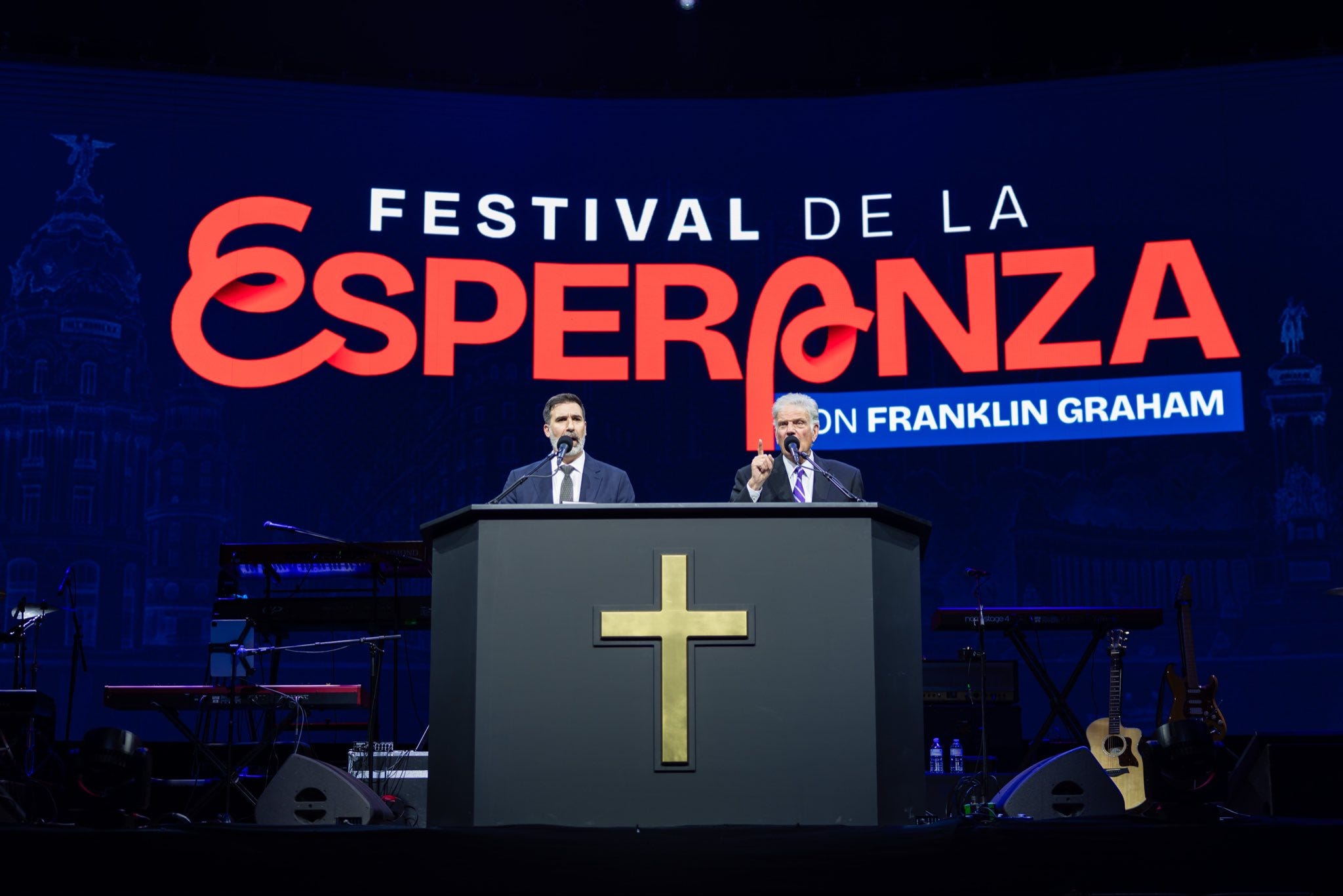
The scene looked more like a rock concert than a religious service. On May 31, 2026, thousands of worshippers sang and raised their hands in the stands of the Palacio Vistalegre arena in Madrid. On stage stood Franklin Graham — son of the legendary evangelist Billy Graham, president of the Billy Graham Evangelistic Association (BGEA), and a close religious adviser to U.S. President Donald Trump — delivering a simple message: “Spain needs hope, and that hope is found in Jesus Christ.” [translated from French]
The Festival of Hope, held May 30–31, was not a spontaneous gathering. It was prepared over 18 months, mobilized some 840 churches across the Madrid region representing multiple evangelical denominations, and drew an estimated 18,700 attendees over the weekend. On the first day alone, organizers reported 12,600 people inside the venue and roughly 2,000 more who couldn’t get in. In the months leading up to the festival, nearly 9,800 people had participated in preparatory evangelism and training activities.
Franklin Graham is not a routine preacher. As head of both the BGEA and Samaritan’s Purse, a faith-based humanitarian organization active in disaster zones worldwide, he occupies a unique intersection of religion and politics. He backed Donald Trump’s first two presidential campaigns and took part in Trump’s January 2025 inauguration ceremony. His presence in Madrid gave the Festival of Hope an international dimension — and a political weight — that extended well beyond the religious.
Nearly 4,800 churches: a map redrawn
According to the Observatory of Religious Pluralism in Spain (Observatorio del pluralismo religioso en España), a government-linked research body that tracks the country’s shifting religious landscape, Spain counted 4,763 evangelical places of worship as of September 2025. That figure was up from 4,455 a year earlier and more than 60% above the 2,944 recorded in 2011.
Catalonia leads with 1,010 evangelical congregations, followed by Madrid with 855, Andalusia with 744, and the Valencia region with 510.
The Roman Catholic Church remains overwhelmingly dominant, with 22,922 registered places of worship. But evangelical churches now account for more than half of all non-Catholic religious centers in the country. In Madrid alone, the number of evangelical churches has grown from roughly 662 to 855 over the past decade.
Evangelical organizations estimate that approximately 1.5 million people in Spain now identify as evangelical, though no official government statistics confirm the figure. That ambiguity is itself revealing: a decentralized movement with no single hierarchy, expanding through the creation of local congregations, is inherently difficult for institutions to measure.
Latin American immigration as structural engine
Behind the numbers lies a demographic reality. Spain has absorbed large waves of Latin American immigration over the past two decades — most recently from Colombia and Venezuela, two countries where evangelical and Pentecostal churches have been deeply embedded for generations, far more so than in most of Europe.
For many immigrants, the congregation serves a function well beyond worship. It provides a social network, a source of practical support, and a sense of belonging in an unfamiliar country. According to sociological research on religious migration in Southern Europe, faith communities frequently function as first-stop resource networks — facilitating personal connections, employment contacts, and cultural continuity for newcomers who arrive without established ties.
Spain’s evangelical growth is therefore not simply a story of mass conversion. It is also a story of cultural transplantation: a religious tradition already deeply rooted in the societies sending migrants to Spain, arriving alongside the migrants themselves.
Analysis: when faith becomes a spectacle — and a political signal
Spain’s evangelical surge raises questions that go well beyond religious sociology. The movement has developed a visibility model — mega-events, personal testimonies, live music production, digital broadcasts — that borrows directly from mass entertainment. A few weeks before the Festival of Hope, an event called The Change Madrid drew an estimated 35,000 people to the Metropolitano stadium, one of the largest venues in the country, and featured a personal testimony from Dani Alves, the Brazilian former professional soccer player, on his religious conversion following his imprisonment.
This format did not originate in Spain. It was developed in the United States starting in the 1970s, driven by televised evangelism, before being exported globally. Franklin Graham’s appearance in Madrid places Spain squarely within a tradition of American transnational evangelism — a form of religious soft power that has, for decades, exported its formats, its codes, and its theology well beyond American borders.
The timing is worth noting, even if no causal link can be established: the Festival of Hope took place just days before the visit of Pope Leo XIV — elected in May 2025 as the Catholic Church’s first pope born in the Americas — to Spain. Whether or not the proximity was intentional, it illustrates a symbolic tension that could deepen in coming years — between an institutionally receding Catholicism and a structurally ascending evangelicalism. That tension has already reshaped religious life across Latin America. The question now is whether Southern Europe will prove different.
Spain is not becoming a Protestant country. But it is becoming a religiously plural one — faster and more profoundly than its institutions have yet registered.
The Bottom Line
What is happening at Vistalegre and the Metropolitano is, at its core, a stress test for a long-standing assumption: that Southern Europe, historically a stronghold of sociological Catholicism, is somehow immune to the religious dynamics that have already transformed Latin America. The evidence, increasingly, suggests otherwise.
Sources: Euronews · Observatory of Religious Pluralism in Spain · Instituto Nacional de Estadística (INE) · Billy Graham Evangelistic Association