
Spain-China: Madrid's reversal fractures Europe's united front
In less than a week, Spain co-signed a document calling on the EU to toughen its trade defenses against China — and then publicly walked it back.

This about-face, which unfolded in late May 2026, reveals less about Spanish diplomacy than it does about the European Union’s chronic inability to speak with one voice on China. The real question is whether a bloc of 27 nations can hold a coherent line when one member can disavow a joint position days after signing it.
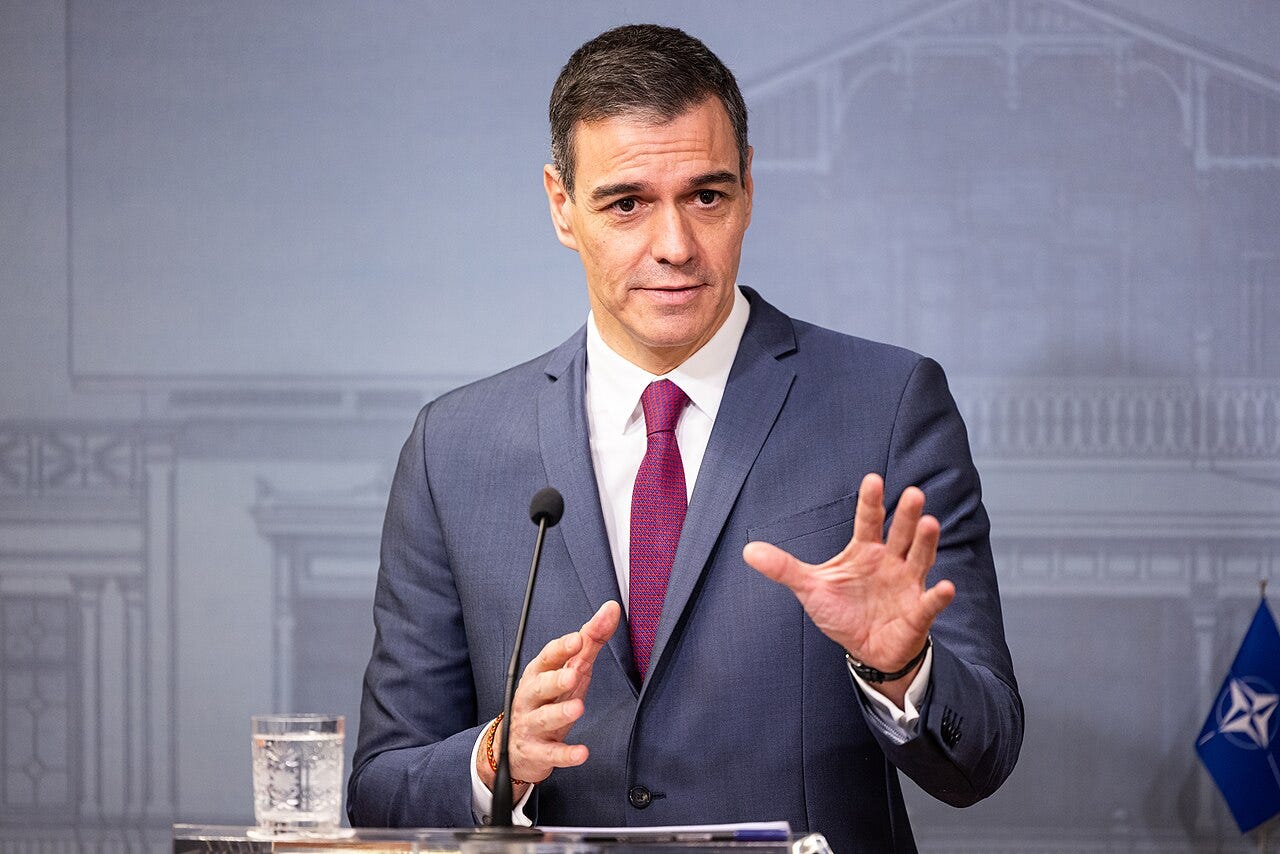
This image is used for illustrative purposes only.
At a Glance
On May 22, 2026, France, Spain, Italy, the Netherlands, and Lithuania co-signed a position paper submitted to the European Commission — the EU’s executive arm — calling for stronger trade defense mechanisms against China.
Days later, Madrid withdrew its political backing from the document, with Economy Minister Carlos Cuerpo insisting the paper had only been reviewed at the technical level and carried no “specific political support” from Spain.
The episode exposes a deepening fault line within the EU between member states pushing for a harder line on China and those — including Spain — that prefer engagement and dialogue.
The signature, the reversal, and what they reveal
On May 22, 2026, France submitted a position paper to the European Commission calling on Brussels to strengthen its trade defense tools against China, make fuller use of existing investigative powers, and potentially create a new instrument to counter market distortions. Five EU member states co-signed: France, Spain, Italy, the Netherlands, and Lithuania.
The reversal came within days. Carlos Cuerpo, Spain’s Minister of Economy and Trade, announced from Berlin that the document had only been examined at the technical level and did not carry any “specific political support” from Madrid. The wording was measured; the message was not.
Cuerpo spelled out Spain’s preferred approach: “We need to engage as equals with both China and the United States,” he said, defending a strategy of commercial rebalancing through negotiation rather than regulatory confrontation. “We need to dialogue with China and its companies regarding our overall economic security strategy and the attraction of Chinese investment.”
Madrid and Beijing: a carefully tended relationship
The reversal surprised few observers of Spanish foreign policy. Spain is widely regarded as one of the EU’s most China-friendly member states. Prime Minister Pedro Sánchez has traveled to China four times in recent years. His most recent official visit, in April 2026, produced 19 bilateral agreements, the majority of them economic in scope. The stated objective: to attract Chinese capital into Spain, particularly in the solar energy and automotive sectors.
The numbers reflect this trajectory. Chinese investment flows into Spain surged from €149 million in 2024 to €643 million in 2025 — a more than fourfold increase in a single year, according to the Spain-China Council Foundation, a private organization backed by Spain’s Ministry of Foreign Affairs.
This economic partnership also carries a geopolitical dimension. During his April visit, Sánchez publicly argued that China is indispensable to resolving the wars in Ukraine and the Middle East. “There are objectives that are unattainable without China, which must be more involved in defending international law effectively,” he stated [translated from French], according to El País.
Washington’s warning
The Madrid-Beijing relationship has also been shaped, in part, by friction with Washington. In early March, Donald Trump threatened to cut commercial ties with Spain after Madrid refused to allow U.S. military bases on Spanish soil to be used for strikes against Iran. That confrontation gave Sánchez additional incentive to diversify Spain’s diplomatic alliances — and to signal, from Beijing, that Spain intended to chart its own course.
Washington responded. Benjamin Leon, the U.S. Ambassador to Spain, cautioned Madrid against deepening its ties with China in critical sectors — specifically data, defense, and telecommunications. “If Spain makes sure China stays away from critical areas, why not negotiate with Beijing? But I see them beginning to infiltrate those areas, and Spain needs to be very vigilant,” Leon said, according to Reuters.
Analysis — Europe’s impossible consensus on China
The geography of disagreement
Spain’s reversal crystallizes a long-standing fault line within the EU. On one side, France, Belgium, the Netherlands, and Lithuania have broadly advocated for a more defensive — and in some cases assertive — posture toward Beijing. On the other, countries including Spain, Germany, and the Czech Republic, for different but converging reasons, have resisted approaches that could be perceived as confrontational.
This divide is not new. But it is sharpened considerably by the context of Donald Trump’s second term. With Washington imposing its own tariffs on European goods while waging a low-grade trade war with China, EU member states must navigate two contradictory pressures: align with the U.S. hard line on China, or protect bilateral trade relationships that directly benefit their economies.
Spain as a case study
The Spanish situation illustrates what might be called the asymmetric dependency paradox. Madrid is well aware that its trade deficit with China accounts for 74% of Spain’s total trade deficit — a substantial exposure. Rather than treating this as a vulnerability to be corrected through regulation, however, Spanish authorities have chosen to see it as a negotiating asset: if China needs access to Spanish markets, Spain can theoretically extract concessions in return.
This logic may prove fragile. China, as a structurally surplus-oriented exporting power, has little incentive to voluntarily rebalance flows that favor it. The recent history of EU-China trade relations — most notably the dispute over Chinese electric vehicles — suggests that calls for dialogue, absent binding enforcement mechanisms, tend to produce limited tangible results.
The cost of European incoherence
Beyond the Spanish case, what is at stake is the EU’s credibility as a coherent trade actor. A position paper co-signed by five member states and disavowed by one of them days later sends a signal of weakness to Beijing — and one of disorganization to Washington. The European Commission, which negotiates on behalf of all 27 member states, is left managing contradictory national positions that its interlocutors will not hesitate to exploit.
Spain didn’t simply change its mind — it laid bare, in accelerated form, the mechanics of the EU’s deepest structural challenge: building a common trade policy toward China when member states remain divided between economic self-interest and collective leverage.
The Bottom Line
The question is not whether Madrid was right or wrong. It is whether a union whose members can jointly sign a document and publicly disown it within the same week is genuinely equipped to hold its ground in a world increasingly defined by U.S.-China rivalry. The answer will shape far more than bilateral trade flows.
Sources: L’Express · Politico · Reuters · El País · Le Monde · Spain-China Council Foundation