
Slovenia's illiberal turn: Jansa is back
Janez Jansa is back as Slovenia's prime minister. His return strengthens Europe's illiberal bloc — and tests Brussels's ability to hold the line.

At a Glance:
Jansa secured his investiture on May 22, 2026, with 51 votes in favor and 36 against, backed by a fragile minority coalition of three center-right parties and the external support of an anti-establishment movement.
A longtime ally of former Hungarian Prime Minister Viktor Orbán, he has pledged a return to “Slovenian values” and plans to cut public funding to NGOs he considers too politically active.
This is Jansa’s fourth time leading the Slovenian government — after tenures in 2004–2008, 2012–2013, and 2020–2022 — and it raises renewed concerns about democratic backsliding inside the EU.
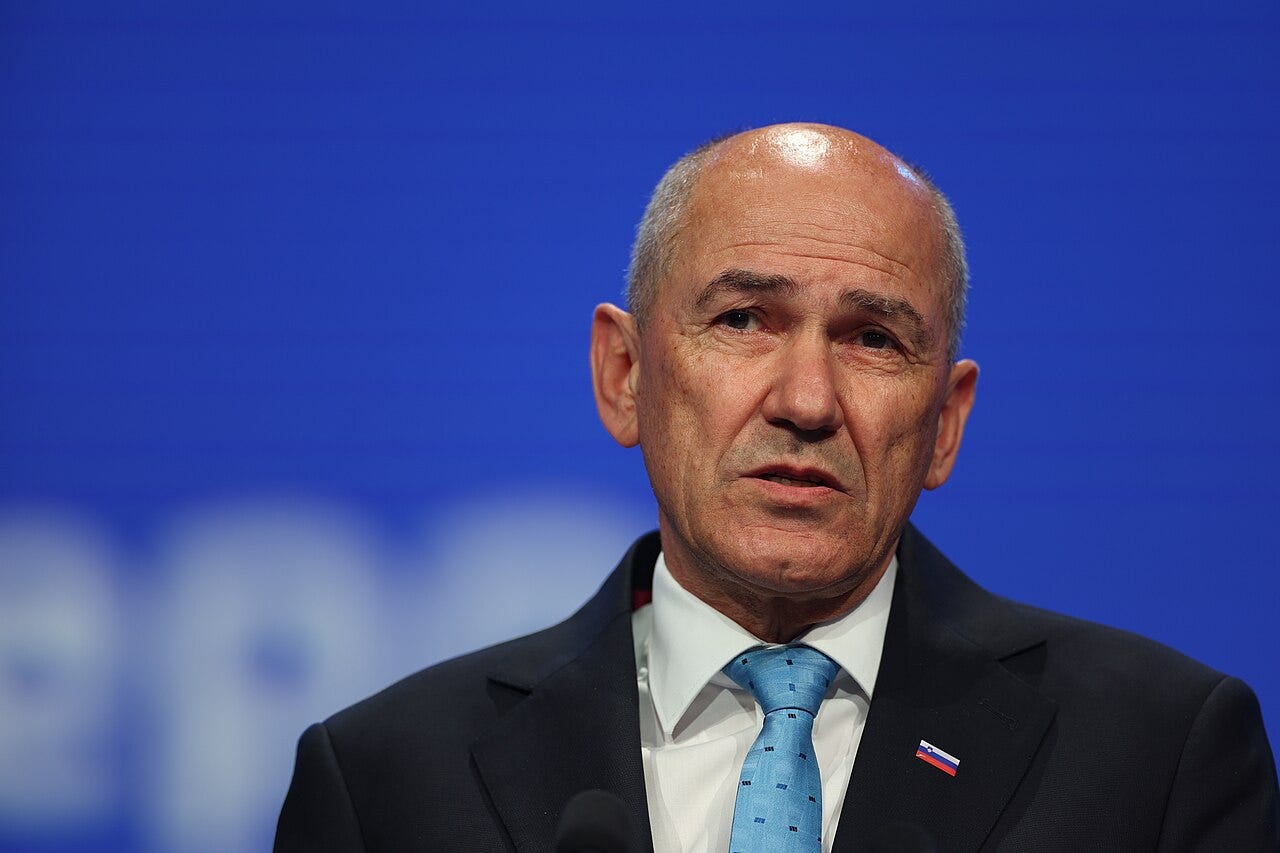
This image is used for illustrative purposes only.
A thin majority, but a real one
The math was tight: 51 votes for, 36 against, out of 87 members of parliament present in Ljubljana when the investiture vote was held. Janez Jansa takes office as Slovenia’s prime minister for the fourth time, propped up by a minority coalition of three center-right parties — his own Slovenian Democratic Party (SDS), the Christian-democratic Nova Slovenija (NSi), and the conservative Democrats led by Anže Logar — controlling 43 of 90 parliamentary seats, three short of the 46 required for a majority. The additional votes came from Resni.ca, an anti-establishment movement that agreed to support Jansa’s candidacy without formally joining the government. That arithmetic fragility is unlikely to slow him down — his previous tenures showed he does not wait for consensus to govern.
An old face with a familiar playbook
At 67, Jansa is no stranger to European chancelleries. As leader of the Slovenian Democratic Party (SDS), he has long maintained close ideological and political ties with Viktor Orbán, the former prime minister of Hungary who became the defining figure of illiberal sovereigntism in Central Europe. Like Orbán, Jansa has built his political identity around polarization: “Slovenian values,” the defense of the “traditional family,” and a stated intent to cut public money to NGOs he regards as political actors.
For American or Canadian readers, the closest reference point might be a governor in the DeSantis wing of the Republican Party — culturally conservative and skeptical of supranational liberal institutions. The key difference: Jansa operates within a formal rule-of-law framework, which he reshapes through legislation rather than frontal rupture.
What his 2020–2022 tenure tells us
Jansa’s previous government served as a live stress test. His administration clashed repeatedly with the European Commission over rule-of-law concerns and pursued what critics described as an effort to reshape the media landscape and redirect public funding away from civil society organizations. Whether those pressures crossed the threshold of formal infringement procedures — or remained at the level of political tension — would require documentation beyond the scope of this article. What is clear is that the experience generated significant institutional friction with Brussels and fed a broader European debate about the limits of the EU’s tools when a member state’s government tests its norms from within.
His return suggests that the Slovenian electorate that brought him back was not asking for a softer version of Jansa.
Why this matters beyond Slovenia
① The illiberal network grows. With Jansa now in Ljubljana, the informal web of sovereigntist governments in Central and Eastern Europe — anchored by Hungary and, arguably, Slovakia under Prime Minister Robert Fico — could become more cohesive. These governments do not yet form a formal blocking coalition inside the EU Council, but they share consistent reflexes on rule of law, migration, and resistance to Brussels oversight.
② Brussels has limited tools. The budget conditionality mechanisms deployed against Budapest demonstrated their limits: effective in the short term, they tend to generate a political martyrdom dynamic that benefits the targeted leaders domestically. Applying similar pressure on Slovenia — a eurozone member of two million people — risks producing the same effect without guaranteeing any durable correction.
③ The coalition is the variable to watch. Jansa’s majority rests on a conditional alliance. Should Resni.ca withdraw its support over a budget vote or a values-based flashpoint, he could find himself in a minority position before year’s end. Whether that would trigger early dissolution depends on Slovenia’s constitutional framework — a scenario worth monitoring closely.
④ Timing is everything. This comeback arrives as the European Union navigates one of its more complex internal sequences: stalled enlargement, a contested Green Deal — the EU’s flagship climate agenda — and renewed Franco-German friction over the EU’s next long-term budget framework. An assertive Jansa government on rule-of-law grounds would consume institutional bandwidth at a moment when Brussels has no shortage of other fires to manage.
The bottom line
Janez Jansa is back in power for the fourth time. Slovenia is a small country — two million people, a modest GDP by EU standards. But the symbolism exceeds the size.
The question this return raises is not simply “what will Jansa do?” It is whether the European Union remains willing — and capable — of enforcing its own rule-of-law standards against elected governments that challenge them from within.
That question has no clean answer yet. It may not for some time.
Sources: France Info · AFP · L’Essentiel · RTBF · Hungarian Conservative