
Russia's shadow fleet: the EU trapped by its own sanctions

The European Union established in late April 2026 the legal groundwork for one of its most ambitious sanctions against Russia: a potential full ban on all maritime services to tankers carrying Russian oil — insurance, flags, freight, banking operations. Then it immediately shelved the measure indefinitely. This paradox captures the impasse Brussels now faces over Russia’s shadow fleet: capable of laying the legal foundations for landmark measures, unable to activate them.
At a Glance
The EU’s 20th sanctions package, adopted in late April 2026, created a legal basis for banning maritime services to Russian tankers — but the measure was frozen immediately, pending coordination with G7 partners.
The geopolitical context — the closure of the Strait of Hormuz, persistently high oil prices, and American sanctions waivers — has made activating the measure virtually impossible, according to European diplomats themselves.
Greece and Malta — and potentially Cyprus — whose maritime industries would be directly hit, are blocking any unilateral EU action without prior alignment from G7 partners.
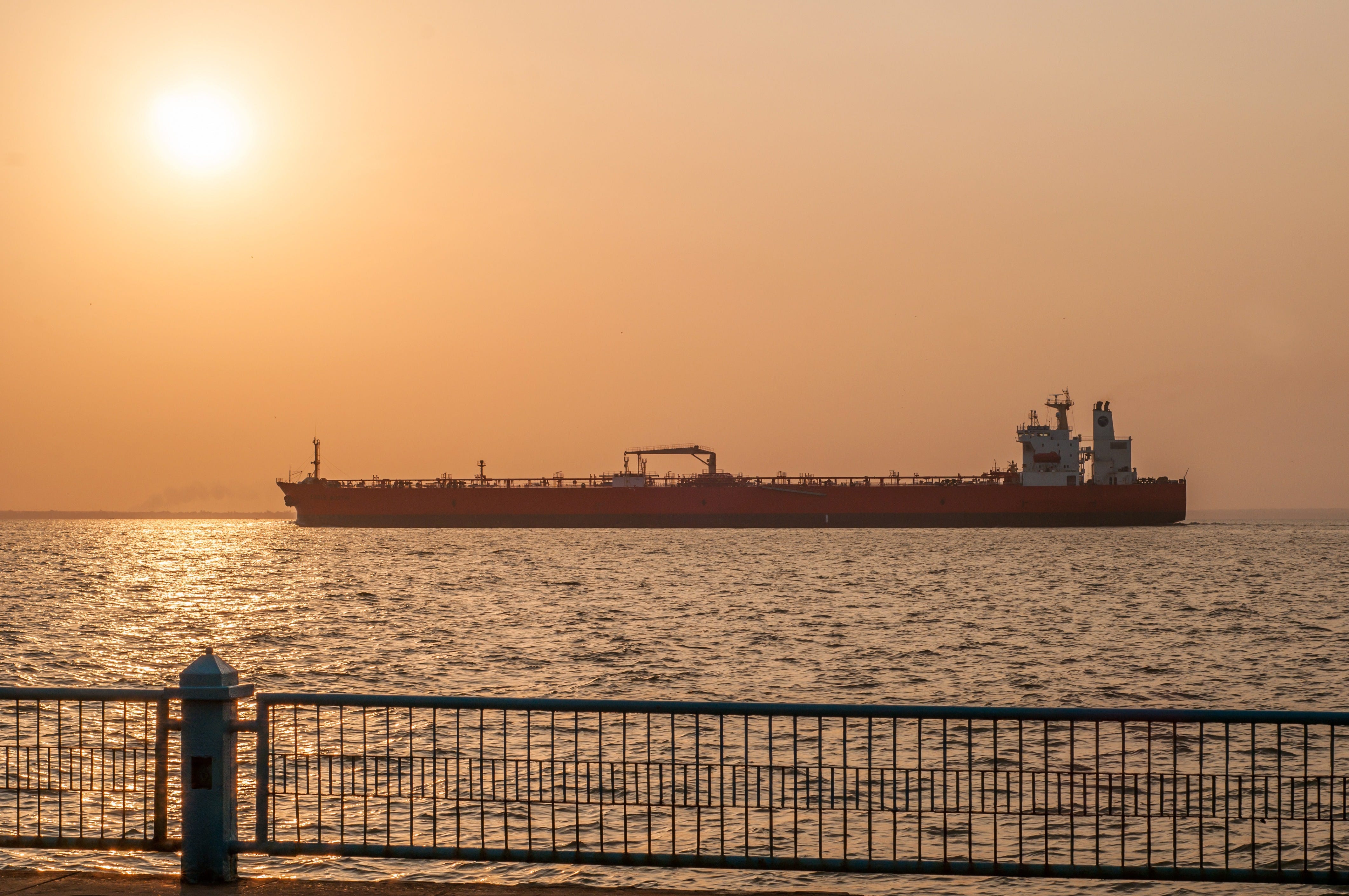
This image is used for illustrative purposes only.
The 20th package’s frozen ambition
The 20th sanctions package passed in late April 2026 contained an unprecedented provision: a legal basis enabling a future ban on any European company from providing maritime services — insurance, freight, flag registration, financing — to tankers carrying Russian oil. Such a ban, once activated, would deal a direct blow to Moscow’s ability to sell oil on world markets, targeting not the product itself but the entire logistical infrastructure that makes it tradeable.
The measure was shelved from the moment the package was adopted. Officially, Brussels wants to coordinate the move with its G7 allies, following the model of the Russian oil price cap first imposed in 2022. That cap had been designed jointly with the United States, the United Kingdom, Japan and Canada — a multilateral architecture considered more robust and harder to circumvent than unilateral EU action.
In that context, establishing the legal basis served as a signal: demonstrating that Europe was ready, without triggering the economic effects of the measure before allies came on board. “It was the best way to send the message that we were ready,” one European diplomat explained. “It was a deliberate choice.”
When the G7 looks away
The problem is that the G7 shows little urgency in following suit. The United States has granted three successive waivers on Russian oil sanctions to manage disruptions caused by the crisis in the Strait of Hormuz — a strategic chokepoint through which, according to widely cited estimates, roughly a fifth of global oil trade passes. The United Kingdom has loosened certain measures, prompting irritation in Brussels.
David O’Sullivan, the EU’s special envoy for sanctions, put the core political constraint plainly: the main challenge for all Western economies right now is access to energy at reasonable prices. That constraint weighs on any initiative that could further reduce global supply.
The tensions in the Gulf deepened after American and Israeli strikes against Iran, launched just weeks after the 20th package was adopted, making any additional price-raising measure politically untenable.
The G7 summit scheduled in Évian, France, in mid-June — where Ukrainian President Volodymyr Zelensky is expected to attend and press for stronger sanctions — represents the next formal opportunity to revive the issue. But no European diplomat is seriously betting on a breakthrough.
The double internal resistance
External resistance is compounded by a dual blockage within the EU itself. Greece, Malta — and potentially Cyprus — three member states with major economic stakes in maritime shipping, refuse to endorse a ban imposed without prior international coordination.
Greece is home to one of the most powerful shipowning industries in the world. Malta operates one of the largest ship registries in Europe — a significant strategic and economic asset. Cyprus, for its part, is a major hub for maritime business and ship management in the eastern Mediterranean. Without a parallel commitment from Chinese and Indian competitors, these countries argue that a full services ban would amount to transferring market share to foreign operators without meaningfully limiting Russia’s export capacity.
A spokesperson for Malta’s Ministry of Foreign Affairs warned that unilateral European action risked creating “loopholes” in the sanctions regime, arguing that without alignment among key partners, operators could simply shift jurisdictions and undermine the sanctions’ stated purpose. [translated from original statement to Euronews]
How the shadow fleet exploits the gaps
This episode illustrates a structural tension in EU sanctions policy: the widening gap between stated intent and activation capacity. Establishing a legal basis for a measure while simultaneously shelving it generates political signal without economic cost — a posture that satisfies the most Atlanticist member states in the short term but erodes the credibility of the overall framework.
It is plausible that continued inaction benefits Moscow, which could go on accessing European services through intermediaries or operators registered in jurisdictions not covered by any future ban. Russia’s shadow fleet — tankers flying flags of convenience, often uninsured or underinsured under international standards, specifically designed to circumvent sanctions — has thrived precisely in the gaps of international regulation. A legal basis with no activation timeline does little to close them.
Meanwhile, the Russian oil price cap presents its own challenge. Under EU rules, the cap is set dynamically at 15% below the average market price of Russian crude — a mechanism that has been in force since the 2025–2026 revision cycle. With Ural crude prices surging in response to Gulf tensions, the next scheduled review on July 15 risks pushing the cap upward, effectively loosening the financial constraints on Russian oil exports. That is precisely the outcome EU diplomats are now scrambling to prevent by designing a locking mechanism before the deadline.
The EU has voted for a sanction it cannot bring itself to activate, waiting for allies who show little enthusiasm.
The bottom line
Between rising energy prices, internal vetoes and G7 silence, Brussels finds itself in the uncomfortable position of having laid the legal groundwork for a credible threat — without the will or the conditions to deploy it. The real question is no longer whether a maritime services ban will eventually be enacted. It is whether the EU, acting alone, can absorb the economic cost of its own sanctions ambitions.
Sources: Euronews