
Russia's mass strikes on Ukraine signal a war of attrition
In the early hours of June 2, 2026, Russia launched one of its most intensive aerial assaults since the war began.

Nine civilians were killed, dozens wounded, and three major Ukrainian cities struck simultaneously. The episode illustrates Moscow’s emerging doctrine of systematic terror — and the international community’s growing inability to stop it.
At a Glance
The June 2 attack involved 73 missiles and 656 drones, including ballistic and hypersonic weapons — a combination that signals a deliberate strategy of exhaustion targeting Ukraine’s air defenses.
A preliminary toll of nine civilians killed in Kyiv (4), Dnipro (5), and Kharkiv, with dozens more wounded. Ukraine claimed to have intercepted 602 drones and 40 missiles.
In May 2026, Russia fired 211 missiles and 8,150 long-range drones against Ukraine — a record since the 2022 invasion — despite a three-day ceasefire brokered by U.S. President Donald Trump that both sides accused the other of violating.
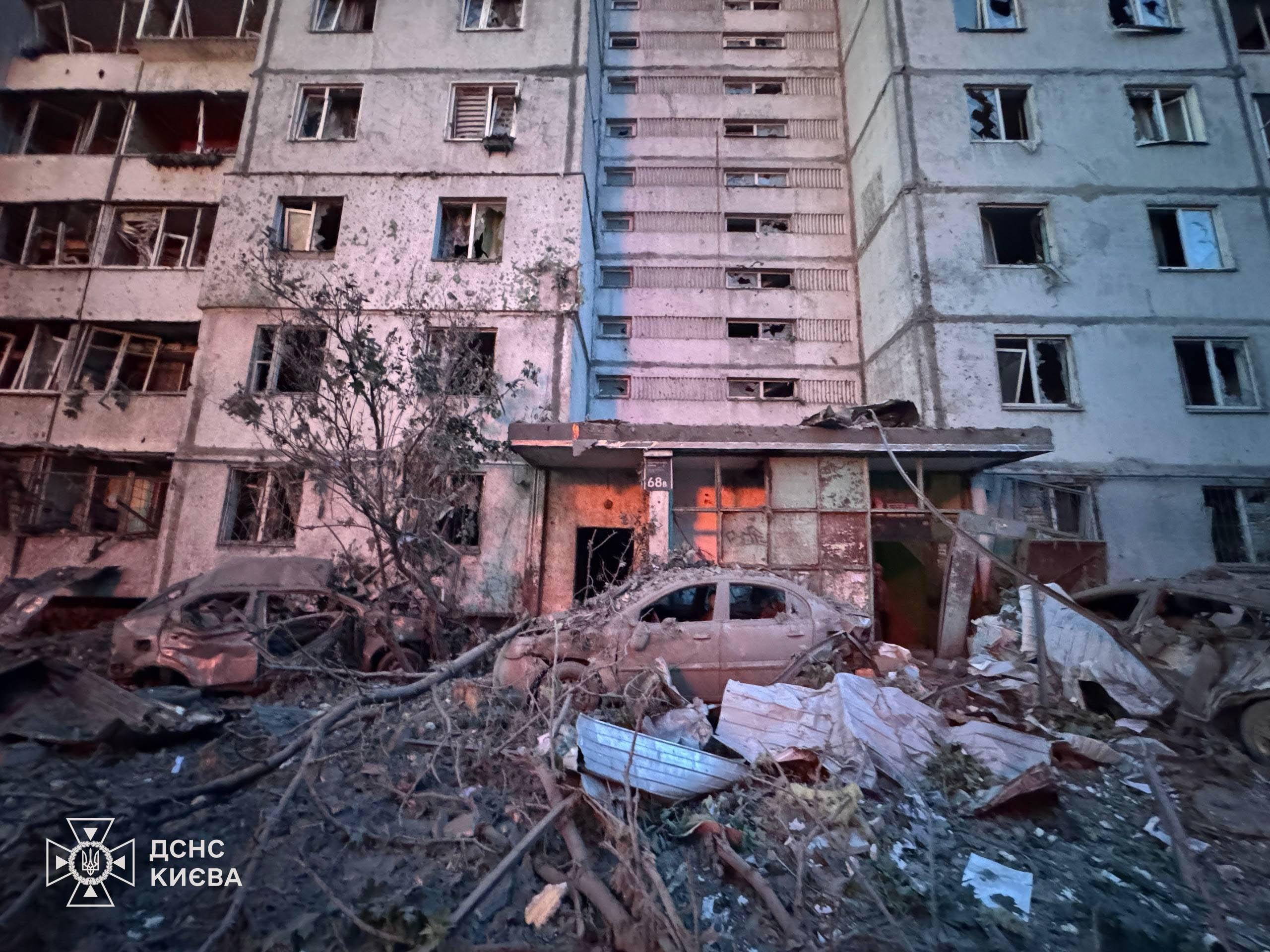
This image is used for illustrative purposes only.
A saturation strike, not improvisation
The night of June 1–2, 2026 was no ordinary attack. Russia simultaneously launched 73 missiles — including ballistic projectiles and Kinzhal hypersonic weapons — and 656 Shahed-type drones (Iranian-designed loitering munitions used by Russia since 2022) across Ukrainian territory. Kyiv, Dnipro, and Kharkiv were struck at the same time.
A preliminary death toll reached nine: four in Kyiv, five in Dnipro. In the northeastern city of Kharkiv, Mayor Igor Terekhov reported ten people wounded, including one child, after the city was hit by 15 drones and two missiles. In Kyiv, Mayor Vitali Klitschko — a former heavyweight boxing world champion who has served as the capital’s mayor since 2014 — confirmed 51 wounded, including three children, across multiple districts. Residents fled into underground shelters carrying bags and blankets as a large plume of smoke rose over the city.
Ukraine claimed to have intercepted 602 of the 656 drones and 40 of the 73 missiles launched — a rate consistent with the roughly 91% figure Kyiv reported for the month of May. Moscow, for its part, confirmed carrying out a “mass strike” targeting “military-industrial facilities” across Ukraine using “high-precision weapons.”
May 2026: a month of records
The June 2 assault did not emerge from a vacuum. In May 2026, Russia fired 211 missiles against Ukraine — one of the highest monthly totals since the full-scale invasion began in February 2022. Among them was an Oreshnik intermediate-range ballistic missile, capable of carrying nuclear warheads, used for the third time since the war started.
The drone figures are even more striking: 8,150 long-range drones in May alone, a 24% increase over April. That record came despite a three-day ceasefire announced by U.S. President Donald Trump, starting May 9, which had briefly revived hopes of a return to the negotiating table. The truce held in name only. Both Moscow and Kyiv accused the other of violations, and Russia launched one of its worst attacks on the Ukrainian capital mid-month — a missile that destroyed most of a residential building, killing approximately 20 people.
The logic of exhaustion
Why this escalation, and why now? Several structural factors are converging.
Militarily, Moscow appears to have embraced a strategy of depleting Ukraine’s air defense systems. By flooding Ukrainian defenses with low-cost drones, Russia forces Kyiv to expend expensive interceptor missiles — stockpiles that Ukraine’s own officials have repeatedly warned are running dangerously low, dependent on deliveries from Western allies. This economic asymmetry may well be at the core of Russia’s current doctrine: each drone destroyed costs Moscow less than it costs Kyiv to shoot it down.
Politically, diplomatic paralysis benefits the aggressor. Negotiations to end the war remain at a standstill. The Trump ceasefire produced no lasting results. And the debate now stirring across European capitals — whether to reengage with Russian President Vladimir Putin — collides with the nightly reality of strikes that pause for nothing.
On the Russian side of the border, one civilian was killed in the Kursk region in a Ukrainian drone attack, according to local governor Aleksandr Khinchtein. Ukrainian President Volodymyr Zelensky, who had warned the previous Friday that Moscow was preparing a “massive new strike,” confirmed the assault in a statement calling Putin “a war criminal and a loser whose only card is terror” [translated from French]. The symmetrical escalation — each side striking deeper into the other’s territory — shows how far this conflict has traveled from the front lines. Little space remains for any diplomatic off-ramp that neither belligerent currently has reason to take.
“A war criminal and a loser whose only card is terror.” — Volodymyr Zelensky, Ukrainian President, June 2, 2026 [translated from French]
The Bottom Line
The war in Ukraine has entered a phase where the question is no longer “when will negotiations resume?” but “who exhausts first?” Moscow is betting on Western fatigue and the insufficiency of Ukraine’s missile defense stockpiles. Kyiv is betting on its ability to hold out and strike deep into Russian territory. Caught between them, civilians in Kyiv, Dnipro, and Kharkiv are paying the price of a diplomatic deadlock that no one, for now, appears capable of breaking.
The real question posed by the night of June 2 may be this: how far is the West prepared to go to ensure that Ukraine does not exhaust its resources before Russia does?
Sources: France 24 · AFP