
Russia's diplomatic threat: a new weapon in an old war
Russia threatened Kyiv's embassies and told diplomats to leave. Over 50 nations condemned Moscow at the UN — but the U.S. wasn't among them.

This was not a standard warning. When Russia’s Foreign Ministry publicly called on foreign diplomats to evacuate Kyiv ahead of planned bombardments on Monday, May 26, 2026, it was signaling something categorically different: an explicit threat against diplomatic missions protected under international law. Within 48 hours, more than 50 countries had responded at the United Nations. The United States was not among them.
This image is used for illustrative purposes only.
At a Glance
Russia’s Foreign Ministry called on all foreign nationals — including diplomatic staff — to leave Kyiv, warning of imminent strikes on “decision-making centers” and defense industry sites in the Ukrainian capital.
The preceding weekend (May 23–24, 2026), a massive Russian attack involving, according to Ukrainian authorities, 90 missiles and 600 drones killed at least four people and wounded more than one hundred in Kyiv, with the reported use of the Oreshnik ballistic missile — a nuclear-capable delivery system.
More than 50 countries, including EU member states, the United Kingdom, Canada, Australia, Japan, and the Baltic states, signed a joint UN statement condemning the threats; the United States was not among the signatories.
A calculated escalation, not an accident
The sequence was precise. On the night of May 23–24, Russia launched what Ukrainian authorities described as one of the most intense aerial assaults since the full-scale invasion began in February 2022: 90 missiles and 600 drones according to Kyiv, including the Oreshnik — a nuclear-capable ballistic missile whose reported use in this conflict marks a deliberate threshold crossing. At least four civilians were killed and more than a hundred wounded. Residential neighborhoods were devastated.
The following day, President Vladimir Putin claimed the attack was retaliation for a Ukrainian strike on a vocational school in the Russian-occupied Luhansk region, which Moscow says killed 21 people. Then came the verbal escalation: Russia’s Foreign Ministry published an appeal Monday urging foreign nationals to leave Kyiv. Foreign Minister Sergei Lavrov drove the point home during a phone call with U.S. Secretary of State Marco Rubio — evacuate your embassy.
The Vienna Convention on Diplomatic Relations of 1961, the cornerstone of international diplomatic law — roughly equivalent in scope to the constitutional protections afforded to foreign embassies under U.S. law — guarantees the inviolability of diplomatic missions and their personnel. What Moscow was signaling, explicitly or implicitly, was that it no longer considers itself bound by that constraint within Kyiv’s perimeter. This sequence could indicate a deliberate attempt to redraw the rules of engagement unilaterally, though that cannot be established with certainty at this stage.
The diplomatic response: 50 countries, without Washington
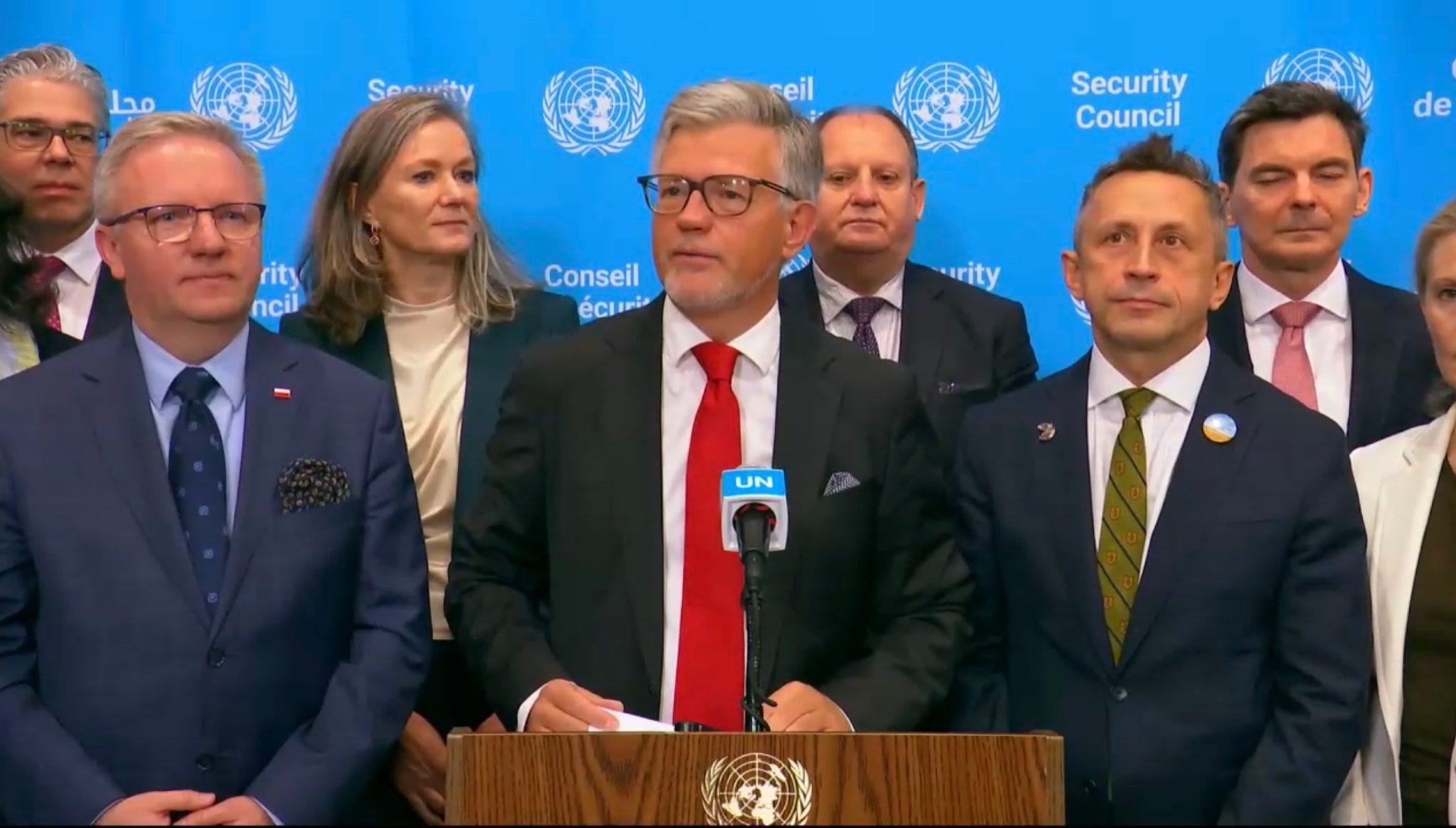
The response came quickly. On May 26, in New York, Ukraine’s Permanent Representative to the United Nations, Ambassador Andriy Melnyk, read a joint statement on behalf of a coalition of more than 50 states — the European Union, the United Kingdom, Canada, Australia, Japan, South Korea, the Baltic states, Germany, France, and Poland among them — condemning recent threats by Russia against diplomatic institutions and embassies in Kyiv. UN Secretary-General António Guterres said he was closely monitoring Russian statements about planned strikes and called for restraint.
Several European capitals also summoned their respective Russian ambassadors for formal explanations — a diplomatic gesture that, under standard protocol, constitutes official disapproval short of sanctions.
The absence of the United States from the joint statement is significant. Rubio declared Tuesday that Washington remains prepared to act as mediator. That posture — at odds with the solidarity displayed by European allies — reflects the ongoing tension between American priorities (a negotiated exit from the conflict) and the European line, which refuses to treat threats against diplomatic missions as an acceptable feature of modern warfare.
Ukrainian Foreign Minister Andriï Sybiha called Lavrov’s warning to Rubio a “brazen provocation” and urged Ukraine’s partners to respond not with precautionary evacuations but with increased military and diplomatic pressure on Moscow.
Analysis — When the threat becomes the weapon
The mechanics of diplomatic coercion
Threatening embassies is not, for Moscow, a tactical improvisation. It is a coercion instrument: forcing Western chancelleries to choose between accepting the risk of keeping their missions in Kyiv — signaling resolve — or evacuating, which would produce a symbolic image of capitulation and undermine political support at home. Think of it as a pressure campaign designed not necessarily to destroy buildings, but to erode the political will behind them.
This pattern has a recent precedent. Earlier in May 2026, Moscow had already called on foreigners to leave Kyiv should Ukraine disrupt the May 9 military parade on Red Square. Each repetition shifts the threshold of what is considered acceptable. It is plausible that this strategy is aimed at testing the cohesion of the pro-Ukraine coalition rather than announcing a genuine intent to strike embassies — but the uncertainty itself is the intended effect.
The Oreshnik as a nuclear signal
The reported use of the Oreshnik warrants particular attention. This nuclear-capable ballistic missile, whose use in this conflict has been reported by both sides, has been framed by Moscow as a demonstration of its range of options. Deploying it in a large-scale urban attack on Kyiv — even in a conventional configuration — constitutes a deliberate rhetorical transgression.
Russia does not use the Oreshnik because it is the most effective weapon for destroying military targets. It does so because it sounds different.
2026’s pace already exceeds all of 2025
Since the start of 2026, Kyiv has suffered 14 large-scale attacks — compared to 15 for the entirety of 2025. The escalation tempo is documented. It does not correspond to the logic of a power seeking an exit from the conflict.
The bottom line
The real question this week raises is not whether Russia will strike an embassy — that remains unlikely and would be diplomatically counterproductive even for Moscow. The deeper issue: for how long can the threat substitute for the actual strike as a tool of pressure, and how long can European allies hold their line without explicit U.S. political backing? The American absence from the May 26 UN statement is not a procedural detail. It is a signal that the coalition supporting Ukraine is fracturing — not on the battlefield, but in the room.
Sources: RTBF · France 24 · Euronews · AFP