
Russia's "Davos" and its inconvenient guests
At the St. Petersburg Economic Forum, Moscow tries to show the world it isn't isolated. The guest list tells a different story about its real standing in the West.

While Moscow welcomed some 20,000 delegates from more than 130 countries for the 29th St. Petersburg International Economic Forum (SPIEF) — long dubbed “Russia’s Davos” and running through June 6 — a Ukrainian drone struck an oil terminal on the city’s outskirts on opening day. The symbolism was hard to miss. Vladimir Putin, scheduled to address the forum on Friday, June 5, wanted to project an image of a Russia that still matters globally. What he got was a roster of Western guests as controversial as they are damaging to that image.
At a Glance
SPIEF 2026 drew senior Asian and African dignitaries from more than 130 countries, but the much-hyped “American delegation” amounted to an architect responsible for a proposed White House ballroom project.
Western attendees included masculinist influencer Andrew Tate, American conspiracy theorist Candace Owens, and Jörg Urban, a German far-right politician from the most radical wing of the Alternative für Deutschland (AfD) party — profiles that prompted criticism from Russian nationalist commentators themselves.
The guest list lays bare the gap between the Kremlin’s propaganda ambitions and the actual quality of its Western supporters.
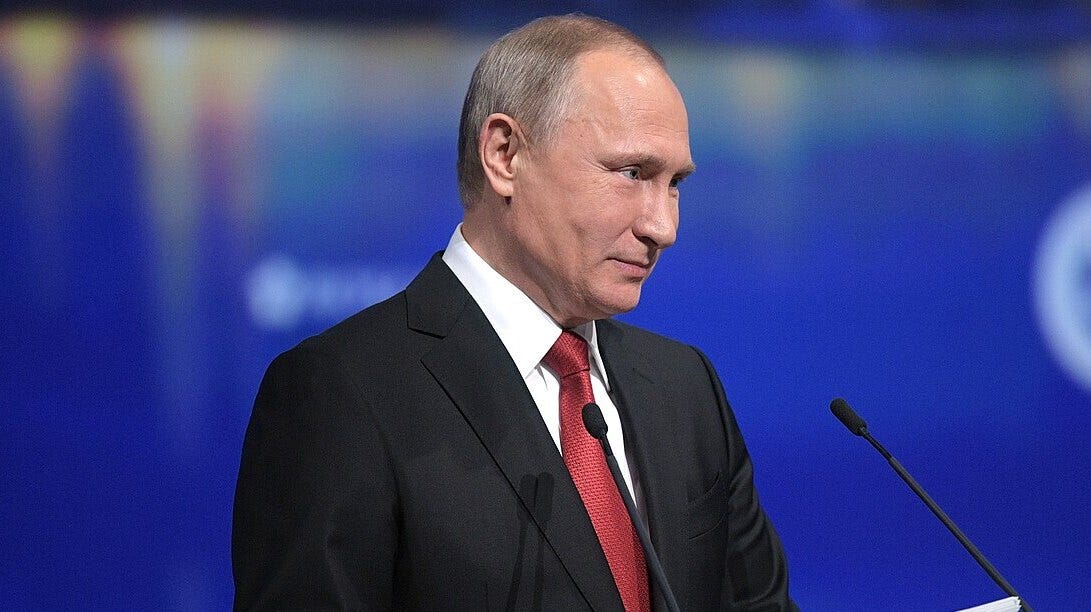
This image is used for illustrative purposes only.
The Global South as showcase, the West as a problem
SPIEF has a clear strategic purpose: to demonstrate that Western sanctions have failed to isolate Russia. This year, the forum designated Saudi Arabia as its guest of honor. Chinese Vice President Han Zheng, Vietnamese Deputy Prime Minister Pham Gia Tuc, Myanmar Vice President U Nyo Saw, Tanzanian President Samia Suluhu Hassan — all were there to signal Moscow’s standing with what it calls the “Global South.” Russia’s weight in global oil and gas markets has given it additional leverage with Gulf states, particularly as tensions in the Middle East continue to reshape energy politics. Haitham al-Ghais, the Kuwaiti secretary-general of OPEC, the Organization of the Petroleum Exporting Countries, also attended.
This Asian and African presence feeds the narrative Moscow wants to project: that of a multipolar power, legitimate and consequential. But the forum raises, almost inadvertently, a question about the other side of that showcase — the Western presence, which was supposed to validate the narrative for European and American audiences.
An “American delegation” that barely registers
Russian state media celebrated what they called the return of an American representative for the first time since 2017-18. The reality was considerably more modest. The “delegation” consisted of Rodney Mims Cook Jr., president of the U.S. Commission of Fine Arts — a federal advisory body — who gained public attention recently as the official overseeing plans for a large and controversial new White House ballroom. Cook himself clarified that he had come not as a policy official or delegation head, but as a Christian who appreciates Orthodox churches. He was photographed in one before participating in a panel discussion on animated film.
The absence of senior diplomats — neither Secretary of State Marco Rubio nor special envoy Steve Witkoff made the trip — could suggest that the Trump administration remains internally divided over the optics of high-profile participation in a Russian state forum, even amid an apparent diplomatic thaw. Sending a figure peripheral enough not to ruffle feathers on either side would represent a kind of calculated ambiguity, though that interpretation cannot be confirmed.
A guest list that exposes a strategy running on empty
The profile of Western invitees deserves closer reading. Jörg Urban, a member of the Alternative für Deutschland (AfD), Germany’s far-right party, and one of its most hardline voices, described Russia as a “guarantor of peace and prosperity in Europe.” Steven Seagal, the American action film actor and longtime advocate for Russia’s 2014 annexation of Crimea, was slated for a panel on culture. Candace Owens, a far-right American commentator facing a lawsuit from French President Emmanuel Macron and his wife Brigitte over conspiracy theories she promoted targeting the First Lady, participated in panels on family values. Andrew Tate and his brother Tristan, British-American masculinist influencers who have faced criminal accusations in multiple countries, including charges related to sexual assault and human trafficking, arrived in Moscow two days before the forum opened without officially confirming their attendance at SPIEF.
Tate’s presence triggered an unexpected backlash: Rybar, one of the most influential pro-war Russian accounts on Telegram, publicly condemned the guest list, calling his inclusion a “casting mistake” incompatible with the “traditional values” that Russia officially claims to champion. When Russian nationalist voices themselves object to the guest list, it is a reliable sign the lineup has missed its target.
What this list really reveals
For years, the Kremlin has cultivated influence among the most radical or destabilized segments of the Western public sphere — conspiracy theorists, masculinists, nationalist politicians, right-wing populists. These figures share a rejection of liberal values that aligns with Moscow’s core message: that the West is morally decadent and in decline. But attracting controversial or politically marginal figures does not constitute an alliance. It suggests, rather, an inability to persuade more credible or mainstream interlocutors.
Russia can still fill a room with Global South dignitaries. It is visibly struggling to recruit credible Western voices willing to lend it the legitimacy it is looking for precisely where it needs it most.
The Bottom Line
SPIEF 2026 raises a question Moscow cannot afford to leave unanswered: can an influence strategy built on the fringes of Western political life still carry any demonstrative value? Or does it end up revealing — to the very audiences it is trying to convince — the depth of the isolation it is trying to deny?
Sources: France 24