
Russia's 2030 clock
Keir Starmer warns Russia could strike NATO as early as 2030 — and vows to release a long-delayed defense plan before July's NATO summit in Turkey.

A Russian attack on NATO by 2030: this is no longer a Cold War scenario revived by alarmist strategists. It is the formal assessment of British intelligence services and several of their allied counterparts. That is what UK Prime Minister Keir Starmer said on June 5, 2026, during a visit to a drone manufacturer in Swindon, in southwest England. Four years. The timeline is short. The response, however, has been slow in coming.
At a Glance
Russia could attack NATO within a four-year window, according to a Western intelligence assessment cited by Starmer.
The UK has committed to raising defense spending to 2.5% of GDP starting in April 2027, targeting 3% in the following parliamentary term.
A ten-year defense investment plan will be published before the NATO summit in Ankara, Turkey, beginning July 7, 2026.
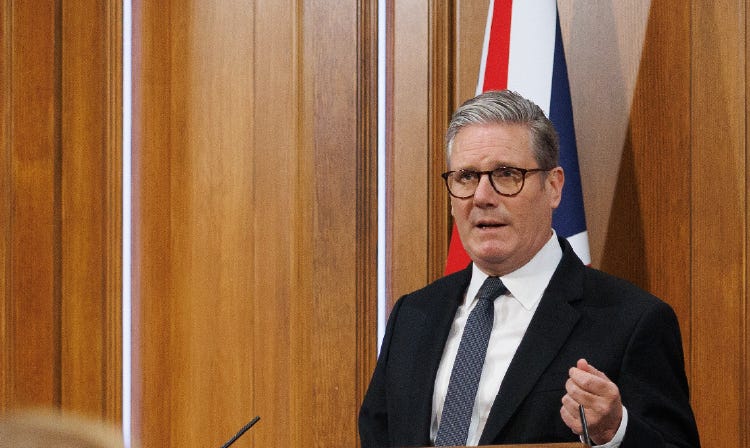
This image is used for illustrative purposes only.
The warning and its echoes
Starmer’s alert did not come in isolation. Last December, Mark Rutte, former Dutch Prime Minister and NATO Secretary General since October 2024, had also warned that Russia “could be ready to use military force against NATO within five years.” Earlier on June 5, Air Chief Marshal Richard Knighton, Chief of the Defence Staff — the UK’s top military officer — told the BBC that in 35 years of service, this was the most dangerous period he had known.
The convergence of these messages within a single day was not accidental. It is laying the political groundwork for a series of budgetary commitments that the United Kingdom — and much of Europe — has been postponing for years.
The plan that kept getting delayed
On Friday, Starmer confirmed that a ten-year defense investment plan would soon be published — a document originally due at the end of 2025, delayed according to British media reports by disagreements between the Treasury and other government departments over its cost. The Prime Minister pledged it would be “fully funded” and released before the NATO summit in Ankara, Turkey.
The announcement comes amid growing transatlantic pressure. U.S. President Donald Trump has repeatedly called on European allies to increase their defense spending and reduce their dependence on Washington for collective security. With its target of 2.5% of GDP by April 2027 and eventually 3%, the UK is seeking to reposition itself as a credible contributor — and to recover diplomatic leverage that some analysts argue has been weakened since Brexit.
Urgency as a political tool
The invocation of a 2030 horizon serves a precise political function: it reframes a budgetary constraint as a strategic imperative. Starmer is not asking Britons to accept higher military spending out of abstract solidarity with distant allies. He is telling them that their own security is directly threatened within a measurable timeframe.
This framing may prove effective in the short term. But it carries a risk: if the threat appears too imminent, it creates pressure on delivery timelines for the equipment — drones, air defense systems, long-range munitions — that the British and European defense industries may not yet be capable of supplying at the required scale.
Starmer’s visit to a drone manufacturer was not just a backdrop. It signaled an industrial policy shift: the UK is betting on non-conventional capabilities as a complement to conventional forces whose numbers remain insufficient relative to stated commitments.
The real question raised by the 2030 warning is not whether Russia will attack. It is whether Europe will have rebuilt its defense industrial capacity quickly enough to keep deterrence credible — and to ensure that Moscow is never tempted to test whether Article 5 of the North Atlantic Treaty, NATO’s collective defense clause, is anything more than a diplomatic formula.
The question is whether the Atlantic alliance, after thirty years of peace dividends, remains a shield — or has become merely a label.
The Bottom Line
If the four-year timeline is accurate, Europe has a historically short window to close decades of defense underinvestment. The stakes go well beyond Ukraine: the deeper question is whether deterrence — not just hardware — is still credible.
Sources: Euronews · AFP