
Russian warship fires warning shots at British yacht in the Channel
On June 16, 2026, a Russian naval frigate fired warning shots at a British-flagged sailing vessel in the English Channel, approximately 23 nautical miles (37 km) south of the Isle of Wight.

The incident — which caught a retired British couple on a routine coastal passage — signals a new level of maritime friction between London and Moscow, coming just two days after Royal Marines boarded a sanctions-busting Russian tanker in the same waters.
At a Glance
The Russian frigate Admiral Grigorovich fired warning shots with small arms at the British-flagged sailing yacht Bright Future, a Bavaria 39 based in Lymington, Hampshire, on June 16, 2026, in international waters off England’s southern coast. No injuries or damage were reported.
The two sides offer conflicting accounts of the key question: Russia says the yacht ignored repeated warnings and continued on a dangerous approach; the yacht’s owners, retired couple Jane and Alan Kelvey, say the vessels were “definitely not on a collision course.” UK Prime Minister Keir Starmer described Russia’s actions as “reckless.”
The incident occurred two days after Royal Marines commandos boarded the tanker Smyrtos in a helicopter raid — the first-ever enforcement operation since the UK authorized the boarding of sanctions-busting vessels in March 2026.
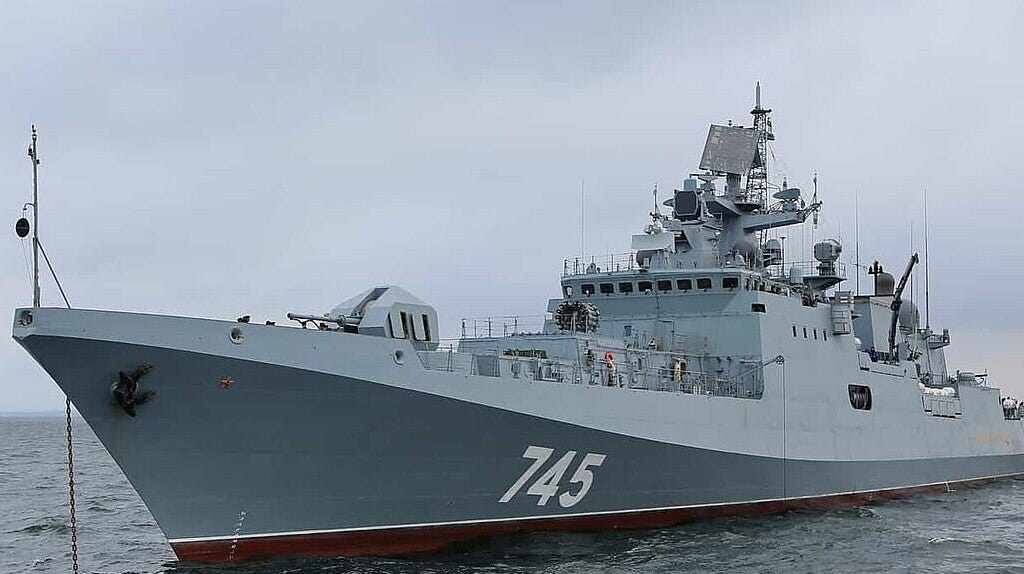
This image is used for illustrative purposes only.
A retired couple, morning fog, and a warship
At around 11:40 a.m. on June 16, the Bright Future — a 2006 Bavaria 39 Cruiser, a standard offshore sailing yacht with no auxiliary engine running at the time — was making its way through the English Channel in foggy conditions. Jane and Alan Kelvey, a retired British couple based in Lymington, were at the helm when their yacht drifted into the path of the Admiral Grigorovich, a Russian Navy frigate operating in international waters some 23 nautical miles south of the Isle of Wight.
The Kelveys’ account offers a precise sequence. The Russian frigate sounded five horn blasts — the standard maritime signal used to alert another vessel — at which point the couple immediately altered course by about two degrees to port, a small but deliberate adjustment intended to show they had seen the warship and were responding. About a minute later, the frigate sounded another five horn blasts and then fired four to five rounds from small-caliber weapons. The Kelveys stated the rounds were not aimed at them directly and that the firing was unnecessary because the vessels were, in their words, “definitely not on a collision course.”
Russia’s Ministry of Defense gave a different sequence. According to Moscow, the frigate’s crew first attempted radio contact, then fired flares and sounded acoustic signals. The yacht, it said, ignored all warnings and continued closing in until it was within 150 meters of the warship’s hull — at which point the commander ordered warning shots across the bow. The Bright Future then changed course.
HMS Mersey, a Royal Navy patrol vessel already shadowing the Grigorovich, assisted the Kelveys. A second British vessel, HMS Tyne, conducted a welfare check: no casualties, no damage. The couple continued on their passage to France, the Bright Future later appearing on AIS tracking data moored in Cherbourg.
The UK Ministry of Defense did not adjudicate on the question of collision risk, but confirmed the shots “were not aimed at the vessel” and constituted an attempt to prevent a possible collision. Prime Minister Keir Starmer, Britain’s head of government, called Russia’s actions “reckless.”
The Grigorovich: a calculated presence
The Admiral Grigorovich was not simply passing through. Since early spring 2026, the Russian frigate had maintained a sustained presence in the English Channel, escorting Russian-linked civilian vessels — tankers belonging to what Western governments call Moscow’s shadow fleet, used to ship Russian oil in defiance of international sanctions — between the Atlantic, the Mediterranean, and the Baltic. The Royal Navy had previously stated there was “not a single day in April” when the frigate was not under close surveillance.
That sustained presence reframes the June 16 encounter as structural friction rather than isolated accident. In March 2026, the British government formally authorized its armed forces to board vessels suspected of evading sanctions imposed on Russia over its war in Ukraine. Two days before the Bright Future incident, Royal Marines commandos executed the first such operation: a nighttime helicopter boarding of the tanker Smyrtos in the English Channel, conducted in cooperation with France. The vessel’s captain — a 38-year-old Indian national — was charged with shipping Russian petroleum products in violation of international sanctions and remanded in custody after appearing in a British court on the same day as the Kelveys’ encounter.
British defense officials nonetheless stated they do not believe the two events are directly connected.
Analysis: a new geography of confrontation
The Bright Future incident is, in itself, contained: no injuries, no damage, and — on the core facts of what happened — broadly similar accounts from both sides. The genuine dispute is narrower and more revealing: did the Kelveys pose a collision risk, or not? Moscow says yes; the Kelveys say no. That gap matters, because it is precisely the kind of ambiguity that makes maritime incidents in contested waters so difficult to manage — and so easy to exploit.
The English Channel — one of the world’s busiest shipping lanes — is now simultaneously the site of sanctioned tanker boardings, Russian military escorts, and warning shots fired at civilian vessels.
Russia maintains it acted in strict accordance with international navigation rules, and the available facts do not formally contradict that claim. But the Grigorovich‘s prolonged presence in the Channel — escorting shadow fleet tankers while being shadowed in turn by the Royal Navy — suggests a calculated display of military visibility, timed precisely as the UK was escalating pressure on Russian-linked shipping. Whether the warning shots against the Bright Future were a proportionate safety measure or a deliberate show of force cannot be established from available sources. What is clear is that the two interpretations are not mutually exclusive.
For London, the institutional stakes are sharper still. Defence Secretary Dan Jarvis had framed the Smyrtos boarding as a direct blow to Russian war financing; days later, a Russian warship was firing across the bow of a retired couple’s sailboat in the same stretch of water. The sequence may be coincidental. It does not feel that way.
The bottom line
Jane and Alan Kelvey set sail from Lymington in the fog and found themselves between a Russian frigate and a diplomatic incident. The Bright Future is not a crisis — but it is a data point. The English Channel is becoming a space where the rules of international maritime law, written for less fraught times, are tested daily by actors who have every reason to interpret ambiguity in their own favor. The deeper question for Europe is not what happened on June 16. It is who gets to decide what happens next time.
Sources: Euronews · France 24 · AFP · UK Ministry of Defense · Russian Ministry of Defense · BBC · Yachting Monthly