
Russian strikes set Kyiv's Dormition Cathedral ablaze

While Washington announces a diplomatic breakthrough with Tehran that opens an unprecedented path toward calm in the Middle East, Moscow chose Sunday night into Monday to launch one of its deadliest missile barrages on Ukraine in weeks. At least nine people are dead, and the roof of the Dormition Cathedral, the centerpiece of the historic Kyiv Pechersk Lavra monastery complex and a UNESCO World Heritage site, went up in flames in the heart of Kyiv.
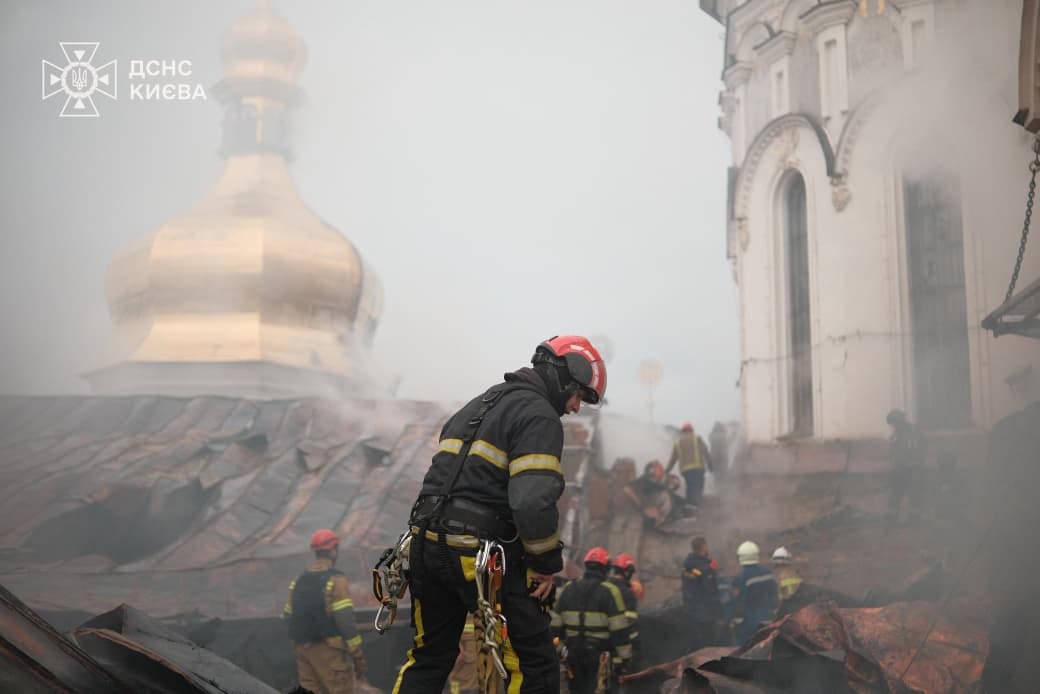
This image is used for illustrative purposes only.
At a glance
A wave of Russian strikes on Kyiv and Kharkiv killed at least nine people — four in Kyiv and five emergency workers who died fighting fires in Kharkiv — and set fire to a UNESCO-listed historic cathedral.
The attack came as a deal between Washington and Tehran opened a path to peace in the Middle East, underscoring the absence of progress in Ukraine after more than four years of war.
Ukrainian President Volodymyr Zelensky and Russian President Vladimir Putin each called President Trump on Sunday, on the eve of a G7 summit in France where the war in Ukraine is among the top items on the agenda.
A night that hit nearly every district of Kyiv
Russian bombardments struck nearly every district of the Ukrainian capital overnight from Sunday to Monday, killing at least four people and wounding around two dozen. Roughly 140,000 residents in northern Kyiv were left without power.
The fire broke out inside the grounds of the Kyiv Pechersk Lavra, a centuries-old monastery complex listed as a UNESCO World Heritage site: the roof of the Dormition Cathedral caught fire, and one of the complex’s golden domes eventually collapsed onto the ground. More than a dozen fire trucks were deployed to fight the blaze from inside the building and from aerial platforms. Russian strikes had already damaged several buildings in the same complex in January.
Tymur Tkachenko, head of Kyiv’s military administration, condemned what he called a “direct strike” on the site. Metropolitan Epiphanius, the head of the Orthodox Church of Ukraine — the church that broke away from the Russian Orthodox Church’s Moscow Patriarchate in 2019 — called the attack “a crime against humanity, history, and Christianity” [translated from Ukrainian]. Kyiv Mayor Vitali Klitschko confirmed the fire on the cathedral’s roof. The Mystetskyi Arsenal, one of Ukraine’s flagship public cultural institutions, was also hit in the strikes.
Kharkiv, Dnipro, Sumy: a death toll that keeps climbing
Kharkiv, Ukraine’s second-largest city in the northeast, bore the heaviest toll of the night. Ukraine’s interior minister, Igor Klymenko, said five workers from the State Emergency Service were killed while fighting fires sparked by renewed Russian strikes, and that at least nine others were wounded.
In the neighboring Dnipropetrovsk region, Oleksandr Hanzha, head of the regional military administration, reported one person wounded after a strike on the city of Dnipro. Further northeast, in the Sumy region, regional official Oleg Grygorov reported three people wounded, including a child.
On the Russian side, a Ukrainian drone strike hits 200 kilometers from Moscow
Ukraine carried out a drone strike on the Russian city of Tula, roughly 125 miles south of Moscow — either in retaliation for, or in parallel with, the drone campaign Ukraine says it has stepped up against Russian oil infrastructure in recent weeks, aimed, according to Kyiv, at cutting into the revenue funding Moscow’s war effort. Tula’s regional governor, Dmitry Milyaev, reported three deaths and three people wounded, including a one-year-old child.
Diplomacy moves elsewhere, the front line stays frozen
The contrast has become hard to ignore. Just as President Trump announces a framework agreement with Iran and prepares to head to the G7 summit in France — the annual gathering of the world’s major democratic economies (the United States, Canada, the United Kingdom, France, Germany, Italy, and Japan), held this year in the French spa town of Evian — the war between Russia and Ukraine grinds on. Triggered by Russia’s full-scale invasion in February 2022, it has become the deadliest conflict on European soil since World War II, producing its daily toll of deaths and damage to cultural heritage.
The phone calls placed Sunday by Zelensky and Putin to Trump may not be a scheduling coincidence. Zelensky’s adviser, Dmytro Lytvyn, described the conversation as a “substantial” exchange covering “all the issues,” while the Kremlin said its call with Putin touched on the peace negotiations underway with the United States and Iran. Kremlin foreign policy adviser Yuri Ushakov said Trump’s special envoys, Steve Witkoff and Jared Kushner — currently deeply involved in the Iran file — would soon return to Russia. This convergence of diplomatic channels suggests Washington could be looking to extend the momentum it built with Tehran to the Ukraine file, though it remains too early to tell whether this round of calls reflects real progress or simply renewed contact.
For European taxpayers and citizens, this night of strikes illustrates a cost that goes beyond the human toll alone: a thousand-year-old religious and cultural site damaged, a public cultural institution hit, and part of a European capital left without electricity — damage that adds to an already enormous reconstruction bill, one that G7 leaders meeting this week in Evian will, sooner or later, need to factor into their discussions on support for Ukraine.
The real question raised by this sequence is less about who carried out the strike than about its timing. That diplomacy is advancing in the Middle East at the very moment the Ukrainian front flares up could be no more than a coincidence of timing — or it could suggest that, more than four years into the invasion, the diplomatic tracks around Ukraine remain structurally disconnected from the rhythm of operations on the ground.
The bottom line
A G7 summit opens in France with Ukraine on the agenda — a file the weekend’s calls between Washington, Kyiv, and Moscow could either revive or leave untouched. The question this night of strikes raises isn’t only about the human cost, already heavy.
It’s how many more sites like the Kyiv Pechersk Lavra will have to burn before the momentum seen with Iran finds an equivalent at Europe’s eastern edge.
Sources: Euronews · France Info (AFP)