
RT France is gone. Its narratives aren't.
When the EU banned Russia Today in 2022, it shut down a Kremlin mouthpiece.

More than four years later, RT France’s former director has a larger audience than ever — on private French channels — and no regulator has yet stopped her.
When the EU banned RT France in 2022, its director found a bigger platform in Bolloré’s media empire — and exposed Europe’s blind spot on state disinformation.
At a Glance
The European Union banned RT France in March 2022, days after Russia’s full-scale invasion of Ukraine; RT’s former French director, Xenia Fedorova, now appears as a regular contributor on CNews and Europe 1 — both owned by billionaire Vincent Bolloré — while hosting a weekly religious program on CStar, and France’s media regulator has issued zero sanctions in response.
France’s foreign ministry has documented her alignment with Kremlin talking points in an internal memo; the interior ministry nevertheless renewed her ten-year residency permit in 2024, describing the decision as a routine administrative process that never reached the political level.
On June 3, 2026, twenty-five centrist members of the European Parliament formally requested EU sanctions against her — the first test of a legal framework created in October 2024 to address coordinated disinformation, which has never yet been used.
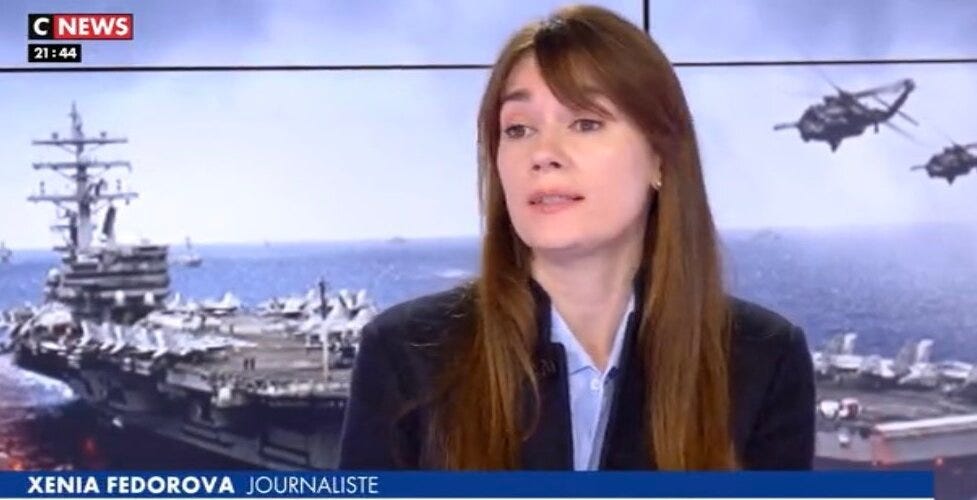
This image is used for illustrative purposes only.
What banning RT didn’t fix
On March 1, 2022, six days after Russia’s invasion of Ukraine began, the EU Council adopted Regulation 2022/350, banning RT from broadcasting across all member states. The regulation was blunt in its language: RT constituted “an instrument of permanent disinformation” that threatened “public order and security” across the European Union. RT France went dark within days. Its director since 2017, Xenia Fedorova, lost her post.
What the regulation did not anticipate was the question of individuals.
The text banned an entity — not the people who ran it. It included no provision governing the subsequent career of the top executive of a banned state propaganda outlet. That gap was about to matter.
The Bolloré empire as a relay station
Less than a year after RT France’s closure, Fedorova was appearing as a regular guest commentator on CNews. Then on Europe 1. She was given a weekly slot to host a program on Orthodox churches, broadcast on CNews and CStar — the one format she controls outright. She contributed a regular column to JDNews, a supplement of the Journal du dimanche. In early 2025, she published a memoir titled Bannie (”Banned”) with Fayard. Every one of these outlets is owned or controlled by Vincent Bolloré, the French billionaire whose media empire — documented in a 2022 French Senate inquiry into media concentration — consistently tilts toward the far right and critics of European integration.
The difference from RT France is not incidental. According to Maxime Audinet, a researcher specializing in Russian influence operations at France’s Institute for Strategic Research (IRSEM, the French Ministry of Defense’s in-house think tank), the Bolloré media portfolio has given Fedorova “incomparably greater visibility in the French media landscape than she ever had at RT France.”
What has not changed are her positions. Since joining the Bolloré network, Fedorova has argued on air that “it is the West that decided to prolong the conflict in Ukraine,” that Europe is tempted to “go to war against Russia,” and that “freedom of expression is not real in France.” She has denied Russia’s 2014 annexation of Crimea. She has described the Maidan revolution in Kyiv as a coup d’état. In her JDNews column, she has dismissed the deportation of Ukrainian children — documented by the International Criminal Court — as “a legend.”
None of these positions are flagged at air time as coming from the former director of a state propaganda channel banned by the European Union. She is introduced as a “Russian journalist.”
On May 21, 2026, Fedorova attended a luncheon at Vivendi’s Paris headquarters hosted by the “Institut de l’Espérance,” a political think tank Bolloré recently created ahead of the 2027 French presidential election. Fellow guests included a sitting cabinet minister, a former French army chief of staff, and a close aide to Jordan Bardella, president of France’s far-right Rassemblement National (RN) party. When French Prime Minister Sébastien Lecornu called Agriculture Minister Annie Genevard the following morning to demand an explanation for her attendance, no formal action followed.
The safeguards that failed
Why did more than four years pass with no effective institutional response?
At France’s media regulator, the Autorité de régulation de la communication audiovisuelle et numérique (Arcom, roughly equivalent to the FCC in the United States), the answer comes down to one number: zero sanctions against CNews specifically related to Fedorova’s appearances, despite multiple formal complaints. In May 2026 alone, Arcom received two separate complaints targeting her for “lack of journalistic honesty and rigor” — one over her May 9 claim that Latvia was “glorifying Nazism,” the other over her May 10 assertion that the West had “decided to prolong” the war in Ukraine. As of this writing, Arcom is still examining both complaints; no ruling has been issued.
This passivity has precedent. In February 2024, France’s highest administrative court, the Conseil d’État, had already been forced to overturn Arcom’s refusal to investigate a complaint by Reporters Without Borders (RSF) about CNews’s editorial line — ordering the regulator to reopen a case it had closed. Arcom operates within a legal framework built around political pluralism and editorial freedom. It was designed to prevent overt partisan capture, not to handle the case of a commentator whose positions the foreign ministry has internally documented as tracking Kremlin propaganda.
At the interior ministry, the timeline is equally telling. In 2024 — two years after RT France was banned — Paris police prefect Laurent Nuñez renewed Fedorova’s ten-year residency permit. On June 1, 2026, on France Inter public radio, Nuñez described the renewal as purely “administrative,” operating “by right,” and said it had “never escalated to the political decision-making level.” French law does allow authorities to refuse or revoke a residency permit on national security grounds — but exercising that provision would have required a political instruction that was apparently never issued.
As for the foreign ministry: it held an internal memo documenting Fedorova’s alignment with Kremlin talking points. That memo produced no public action until May 29, 2026, when Foreign Affairs Minister Jean-Noël Barrot publicly called her a “registered propagandist who serves as a relay for Kremlin disinformation.” That was the first time a sitting French minister named her in those terms. More than four years after RT France was shut down.
Europe’s first real test of its disinformation sanctions framework
Since October 2024, the European Union has had a legal instrument theoretically designed for precisely this situation: a framework for individual sanctions targeting those “responsible for engaging in coordinated disinformation and information manipulation.” The framework was adopted because institutional sanctions — like banning RT — had demonstrated clear limits against individuals capable of working around them.
On June 3, 2026, twenty-five MEPs from the centrist Renew Europe group — the European Parliament’s third-largest bloc — at the initiative of French MEP Nathalie Loiseau, sent a formal letter to European Commission President Ursula von der Leyen and European Council President Antonio Costa, requesting individual sanctions against Fedorova. According to Agence Europe, their letter describes her as “perfectly consistent in her pro-Kremlin stance and in line with her known links” to Margarita Simonyan, the head of RT, who has documented ties to Kremlin influence networks. The MEPs argue it would be “logical” that the same grounds used to ban RT France should now serve as the basis for personal sanctions against the woman who ran it.
Imposing those sanctions requires a decision by all 27 EU member states, on a proposal from the Commission — a process that is slow, diplomatically complex, and requires unanimity. No decision had been announced as of this writing.
What makes this case structurally different from the RT ban is precisely what makes it harder. In 2022, the EU was targeting a Russian state entity broadcasting on European soil. In 2026, it would be targeting an individual speaking on a private French channel — raising direct questions about freedom of speech, press freedom, and the reach of EU sanctions into the editorial choices of member states’ private media.
Analysis
A pattern, not an isolated case
Fedorova is not a singular anomaly. France’s IRSEM has mapped Russian influence operations across Western Europe since 2019, identifying a layered ecosystem of alternative news portals, media personalities, and amplification networks that carry Kremlin-aligned narratives without formal ties to Russian state entities. What the Fedorova case adds to that map is the insertion of those narratives into the mainstream media circuit of a major EU country — via a private conglomerate whose editorial orientation creates a functional alignment with Russia’s declared information objectives: weaken European institutions, undermine support for Ukraine, fracture Western alliances.
The mechanics of convergence
Attributing deliberate coordination between Bolloré and the Kremlin would go beyond what available sources allow. What those sources do reveal is a convergence of interests that could make coordination unnecessary. Bolloré has built a media empire whose editorial tilt — toward the French far right, skeptical of European integration — aligns functionally with Russia’s stated information objectives. Fedorova, in that space, may not need instructions: her long-established positions find their natural audience there.
The question no one has answered
The Fedorova case forces a question that neither French law nor EU law has definitively resolved: does press freedom protect the regular broadcast, on private national channels, of narratives that a government’s own foreign ministry has documented as tracking the positions of a foreign state under sanctions? In the United States, the Foreign Agents Registration Act (FARA), in force since 1938, requires those acting as agents of foreign principals to register as such — RT America was designated a foreign agent under FARA in 2017. France and the European Union have no functional equivalent applied to individuals broadcasting on private domestic media. That gap is what the Fedorova affair has made visible — and what the October 2024 sanctions framework tentatively, perhaps insufficiently, tries to fill.
The Bottom Line
Banning RT France in 2022 was a response to a state entity. The Fedorova affair poses a different and harder question: what do you do when the same narratives circulate freely, carried by an individual, in the studios of a private national outlet that enjoys the full protections of press freedom?
If the EU activates its sanctions against Fedorova, it will cross an unprecedented threshold — targeting an individual for what she says on a member state’s media — with all the civil liberties implications that entails. If it does not, it will validate a darker reading: that the RT ban was symbolic enough to close a channel but insufficient to neutralize the operation it represented. Either way, the outcome will set a precedent for every European democracy confronting the same question — and there are many.
Sources: EU Council Regulation 2022/350 · Arcom, pluralism deliberation of July 17, 2024 · Agence Europe, June 3, 2026 · IRSEM, reports on Russian influence operations · RSF, “CNews: The Great Evasion,” November 2025 · French Senate, report of the commission of inquiry on media concentration, March 2022 · France Inter · AFP · France 24 · Euronews · Franceinfo