
Rome's viral €44 gelato bill
A Florida tourist's €44 gelato tab near Rome's Piazza Navona goes viral — and exposes a broader debate on overpriced tourist spots in Europe.

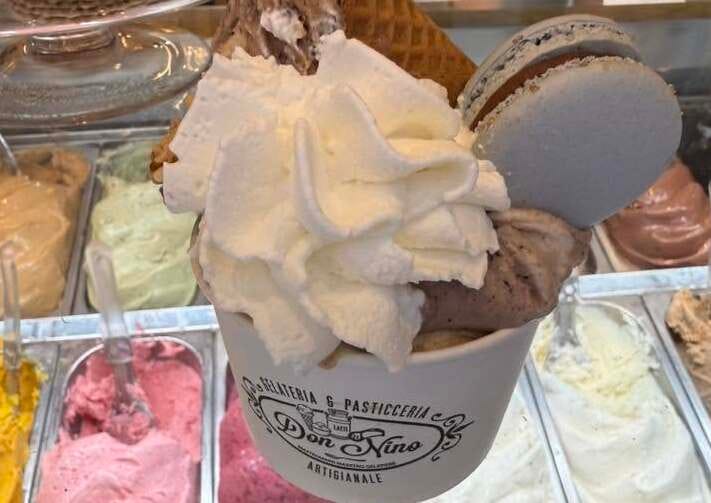
A Florida woman posts a receipt. Within 48 hours, the story has circled the globe. Two gelato cups — each with three flavors, plus unadvertised extras — at Don Nino, a gelateria on Via di Tor Millina, steps from Rome’s Piazza Navona: €44 (approximately $48 at current exchange rates). Not for a fine-dining experience. Not for a bottle of wine at a luxury hotel. For ice cream, eaten standing at the counter, on June 3, 2026.
The incident thrust Nicole Ann, an American tourist from Florida, into the center of a debate that goes well beyond the price of a dessert.
This image is used for illustrative purposes only.
At a Glance
On June 3, 2026, an American couple was charged €44 for two gelato cups at Don Nino gelateria, near Rome’s Piazza Navona — extra items including macarons, pistachio cannoli, and whipped cream were reportedly added during preparation without clear prior notice that they were paid supplements.
Nicole Ann’s post in a Facebook travel advice group for Rome visitors went viral, generating hundreds of reactions and international media coverage.
The incident reignited the debate over “tourist trap” practices in Europe’s most frequented historic districts, and the inadequacy of consumer protection mechanisms in these high-traffic areas.
This image is used for illustrative purposes only.
What happened on Via di Tor Millina
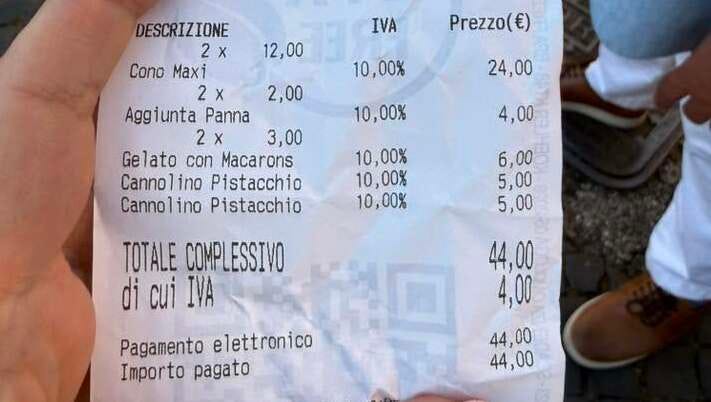
Nicole Ann’s account is specific. On June 3, she and her husband stopped at Don Nino to order two cups, each with three flavors. During preparation, staff added extras — macarons and pistachio cannoli — without clearly indicating these were charged supplements. When it came time to pay, Nicole thought she heard “14 euros.” The receipt said 44.
The itemized bill, published online, tells the story: two “maxi” portions at €12 each, plus charges for whipped cream, macarons, and pistachio cannoli. No table service. No dining room. Just a counter.
Don Nino operates several locations in Rome; online reviews suggest complaints about pricing concentrate on its outlets in the highest-traffic tourist zones, while other locations draw more mixed assessments.
Nicole acknowledged she should have “checked the price more carefully before buying” and said she would not dispute the charge. She also noted she had traveled to other parts of Italy without ever encountering similar gelato prices.
Rome’s center as a pricing playground
The Don Nino incident is not an isolated case. The streets immediately surrounding Piazza Navona — one of Rome’s most famous baroque squares, renowned for its 17th-century fountains and open-air cafés — along with the Trevi Fountain and the Pantheon have long constituted a pricing environment of their own. The density of tourist traffic, combined with rapid customer turnover, enables pricing practices that would be unsustainable in any other commercial context.
For an American or Canadian reader, the closest parallel would be restaurants lining Times Square in New York or Fisherman’s Wharf in San Francisco — areas where prices can run two to three times higher than a few blocks away, and where the customer base is overwhelmingly non-local, with little ability to comparison-shop before buying.
The mechanics of the trap
What sets the Don Nino affair apart from a simply steep price is the question of unadvertised supplements. The addition of macarons and cannoli during preparation, without clear communication that they carried an extra charge, could constitute what consumer-rights specialists might describe as a potentially deceptive commercial practice.
European Union consumer protection rules — including a directive adopted in 2011 governing consumer rights across EU member states — generally require transparent pre-purchase disclosure of the total price to be paid. Enforcing those rules in informal settings like a gelato counter, particularly in very high-traffic tourist areas, remains practically difficult.
It would be premature to conclude that a clear violation occurred without knowing the exact signage displayed in the shop at the time. But the sequence Nicole Ann describes — items added during preparation, total discovered only at the register — could suggest a gray area between aggressive commercial practice and a failure to inform, even if that cannot be formally established at this stage.
Italy and mass tourism: a structural question
The Don Nino story lands in the middle of a broader tension between Italy and its own visitors. Rome, Florence, Venice — Italy’s major art cities sit at the center of a European debate on the sustainability of mass tourism and the regulations needed to protect both residents and visitors.
Venice pioneered a day-visitor entry fee for parts of its historic center. Cities like Barcelona and Amsterdam have moved to restrict short-term vacation rentals. Rome, by contrast, has not developed comparable price-regulation mechanisms in its most visited zones.
Could the virality of Nicole Ann’s receipt accelerate a regulatory conversation in that direction? The question deserves to be asked — without predicting any near-term political response. Neither Roman nor Italian authorities had publicly commented on the incident at the time of publication.
Nicole Ann’s receipt is worth more than €44. It documents, with disarming clarity, the tension between what European cities sell — history, beauty, a way of life — and what they charge to get close to it.
The Bottom Line
The real question is not whether a gelateria near Piazza Navona has the right to set high prices. The real question is whether Europe’s tourist economy will ever develop the tools to ensure that the surprise isn’t systematically at the visitor’s expense. And if not — how many viral receipts will it take before that changes?
Sources: Euronews