
Robotaxis in Munich: Uber bets on agentic AI to crack open Europe
Uber is partnering with Israeli AI startup Autobrains to deploy driverless taxis within defined operational zones in the Bavarian capital — pending German regulatory approval.

A potential first for Western Europe’s autonomous vehicle market.
At a Glance
Uber plans to launch autonomous robotaxis in Munich in partnership with AI company Autobrains and Nvidia’s DRIVE Hyperion computing platform — regulatory clearance is still pending. The vehicles would operate without a driver, but only within pre-defined zones (Level 4 autonomy, not full open-road capability).
The technology uses a so-called “agentic” architecture: multiple specialized AI systems each handle a distinct aspect of driving, rather than relying on a single centralized model.
Europe remains far behind the United States and China in commercial robotaxi deployment — Munich could become the first Western European city to cross that threshold.
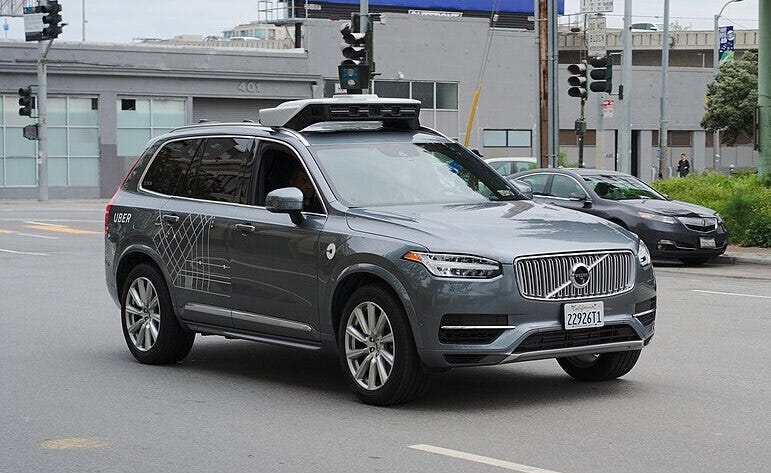
This image is used for illustrative purposes only.
Munich: an automotive capital stepping into unfamiliar terrain
The announcement came on June 1, 2026, in Taipei, at Nvidia’s GTC technology conference — but the city it concerned is thousands of miles away. The geographic mismatch was deliberate: the message was aimed at global tech investors, not the residents of Munich.
Munich makes sense as a proving ground for reasons beyond symbolism. The city is home to BMW and one of Europe’s densest automotive research ecosystems. Its urban traffic density — a genuine operational challenge for any autonomous system — and Germany’s relatively advanced regulatory framework on self-driving vehicles make it a credible laboratory. The stated ambition stretches beyond Bavaria: the partners want to build a model that can be replicated in other cities and on different vehicle platforms.
What “agentic” actually means
At the heart of the project is the driving software developed by Autobrains, an Israeli company founded in 2019 that specializes in driver-assistance systems. The company challenges the dominant approach in autonomous vehicle development — a single large AI model responsible for all driving tasks — in favor of a distributed architecture.
Igal Raichelgauz, Autobrains’ founder, laid out the reasoning at GTC: scaling autonomous driving to the real world is incompatible with asking one model to handle every possible road scenario. Instead, multiple specialized AI agents simultaneously evaluate different traffic situations and make real-time decisions. This agentic AI approach — think a team of specialists rather than one generalist — is designed to be more robust when confronting the unexpected, which remains the fundamental challenge for any autonomous system.
The hardware infrastructure runs on Nvidia’s DRIVE Hyperion platform, a computing and sensor architecture designed for Level 4 autonomous vehicles. Level 4 automation means the car can complete trips without a human driver — but only within pre-defined operational zones. This is distinct from Level 5, which would require full open-road capability under any conditions. No one needs to be behind the wheel, but the geography of operation remains bounded.
What sets this project apart from others: the partners claim compatibility with vehicles from multiple automakers, rather than relying on a proprietary fleet built from scratch — the route taken by Waymo, the autonomous vehicle subsidiary of Google. Uber and its partners want to integrate the technology into existing vehicle models. Which automakers are involved, how large the fleet will be, and when the first paying passengers might actually board have not been disclosed.
Uber’s strategy: platform, not carmaker
The Munich project reflects a strategic pivot Uber formalized several years ago. The company walked away from building its own autonomous driving systems — eventually divesting its dedicated autonomous vehicle unit — to become a technology distributor instead. Uber now integrates external partners into its existing ride-hailing network, the app-based system through which users book trips.
In recent months, Uber has announced similar agreements with other autonomous driving technology providers. With Nvidia, the company envisions a long-term rollout across several dozen cities worldwide.
A senior Nvidia automotive executive told Euronews in January that partially autonomous driving would arrive within the year. “We need to move as fast as regulation allows,” he said. “And I think it is opening up.” [translated from French] That assessment could prove more accurate in Germany than anywhere else in Europe.
Europe lags behind — but for how much longer?
The current state of commercial deployment illustrates the continent’s disadvantage. Waymo reportedly operates driverless ride-hailing services in several major American cities. Chinese players including Baidu Apollo and WeRide are running fleets in Beijing, Wuhan, and Guangzhou. Elon Musk, whose Tesla is developing its own fully autonomous driving technology, has predicted that self-driving vehicles could eventually dominate road traffic — without specifying a precise timeline.
Europe, by contrast, has accumulated pilot projects without reaching commercial scale. The planned launch of autonomous taxis in Madrid — a separate Uber initiative — illustrates the regulatory delays characteristic of the continent. If Munich delivers on its promise, conditional as it remains on pending authorizations, it would mark a genuine first for Western Europe.
The stakes go beyond industry. Robotaxis have the potential to reshape urban mobility: lower transportation costs, improved access for elderly and mobility-impaired passengers — but also sustained pressure on professional driving jobs. In Germany, where automotive sector unions carry significant political weight, the commercial introduction of autonomous fleets is unlikely to unfold without social friction.
The bottom line
Will Munich be the trigger that opens Europe’s autonomous vehicle market — or one more pilot project that produces more press releases than passengers? The answer depends less on the technology, which appears mature in its basic parameters, than on German regulators and their capacity to balance innovation, road safety, and the preservation of a transportation model that employs hundreds of thousands of people across the continent.
The real question is no longer “does it work?” — it is “who benefits, and at what social cost?”
Sources: Euronews