
Return hubs: Macron and Sánchez break ranks
Macron and Sánchez reject return hubs for migrants outside the EU, breaking from a coalition of 19 states. A defining standoff at the Brussels summit.

At a Glance
The European Parliament formally approved the new Return Regulation on June 17, 2026, authorizing EU member states to build so-called “return hubs” — offshore detention centers for rejected asylum seekers — in non-EU countries. Formal Council adoption and publication in the EU’s Official Journal are still required before the regulation takes full legal effect, though provisions on return hubs will apply immediately once that process is complete.
French President Emmanuel Macron and Spanish Prime Minister Pedro Sánchez publicly rejected the policy at the Brussels EU summit on June 19, calling it neither effective nor consistent with European values.
A coalition of 19 EU member states, led by Denmark and Italy, signed a joint declaration to implement the hubs as fast as possible, leaving France and Spain as a significant minority.
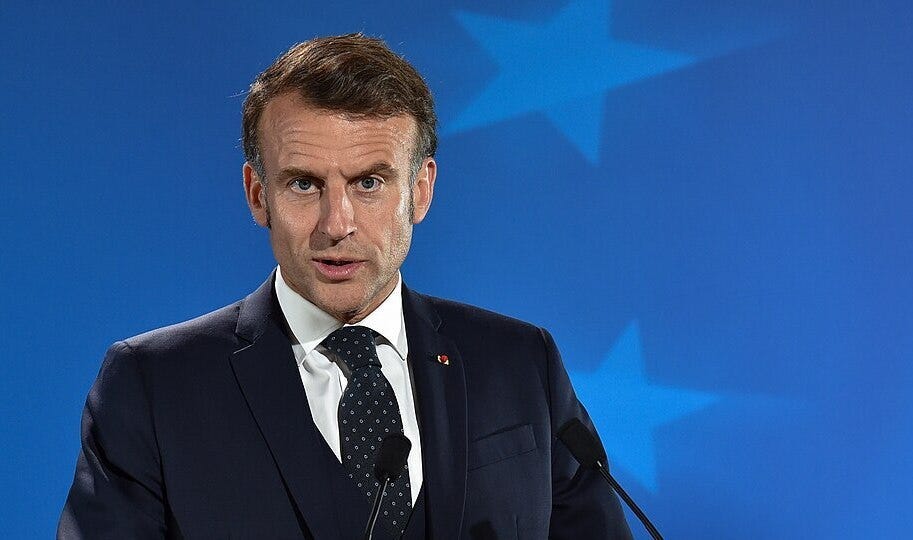
This image is used for illustrative purposes only.
The sharpest EU migration split in decades
The Brussels EU summit of June 19, 2026 crystallized a fracture that had been building for months. As 19 heads of state and government signed a joint declaration pledging to “make full use” of a new regulation authorizing migrant detention centers in third countries outside the EU, Emmanuel Macron cut to the point:
“I have never seen a return center in a third country that actually works.” [translated from French]
The statement, delivered at the close of a two-day summit, was no diplomatic nuance. It was a direct repudiation of a policy direction that the majority of France’s EU partners had just endorsed.
What the Return Regulation actually does
The Return Regulation began as a European Commission proposal in March 2025. A political agreement between the Council of the EU — the body representing member states — and the European Parliament was reached on June 1, 2026, with formal parliamentary approval following on June 17. The regulation will enter into full legal force upon formal adoption by the Council and publication in the EU’s Official Journal — a step expected in the coming weeks. Notably, provisions relating to return hubs will apply immediately once that process is complete.
The regulation’s core ambition is to speed up and harmonize deportation procedures across the EU for migrants with no legal right to remain. Two provisions have drawn the most scrutiny: an extension of detention periods to up to 24 months (up from 18), and — most controversially — the authorization for member states to negotiate bilateral agreements with non-EU countries to host “return hubs.” These hubs can serve either as final destinations or transit centers for rejected asylum seekers, including individuals with no prior ties to the host country. Unaccompanied minors are explicitly excluded from transfer to return hubs; however, families with minor children may be transferred under the final text, after the Council modified an earlier draft that had excluded them.
Italy has been the trailblazer. For several months, Rome has been operating two facilities in Albania — in the towns of Shengjin and Gjader — under a bilateral agreement. Early results have been limited, with only a few dozen migrants held at any one time, according to available data, while operational costs have run high. It is precisely this track record that Macron and Sánchez have deployed as evidence against scaling up the model.
Nineteen states versus two
The political arithmetic is unambiguous. 19 EU member states — including Germany, the Netherlands, Austria, Denmark, and Greece, which had already formalized their cooperation as early as March 2026 — signed a joint declaration committing to “move as fast as possible toward third-country-based solutions.” Countries reportedly under consideration as potential hub partners include Rwanda, Mauritania, Ethiopia, Uzbekistan, and Libya.
Standing against this bloc, Macron and Sánchez argued the financial case as well as the principled one. Spain’s prime minister said the return hubs would amount to squandering economic resources Europe can ill afford. Both leaders also raised a geopolitical objection: diverting development funds earmarked for Africa to build deportation centers, they argued, would undermine Europe’s credibility across the African continent and damage strategic partnerships built over decades.
Macron went further, announcing that he would formally oppose the use of the EU budget to finance the construction of any such centers — adding a budgetary dimension to his principled opposition.
The real question: does any of this work?
The French and Spanish position rests on an empirical claim as much as a values argument: offshore return centers have not been shown to work. Italy’s Albania model — which was meant to serve as the proof of concept — has produced returns far below initial projections, at costs that critics describe as disproportionate.
That record stands in contrast to the expectations of a majority of member states, which are betting on deterrence effects rather than immediate operational capacity. Pressure from the rise of far-right parties across Europe since the 2024 elections has driven a competitive toughening on migration, in which center-right governments — and even some Social Democratic ones, notably in Denmark — have chosen to participate.
More than 250 civil society organizations have condemned the plan, warning of the risk of creating what they call “offshore prisons” with weakened legal protections. The regulation itself conditions any bilateral hub agreement on the partner country respecting international human rights standards and the principle of non-refoulement — that is, the prohibition on returning someone to a country where they face serious harm. Whether that condition can be meaningfully enforced in practice remains an open question.
The bottom line
France and Spain have chosen a minority battle they cannot win on the vote count — the Return Regulation is law in all but its final administrative step. What remains to be seen is whether Macron can translate his opposition into a genuine budgetary veto, or whether the institutional weight of a 19-state coalition will prove too strong to resist.
Beneath the debate over hubs lies a more fundamental tension: can the EU build a common, effective migration policy when internal political fault lines run this deep — and when enforcement rates remain stubbornly low regardless of which side sets the rules?
Sources: France Info · Euronews · Reuters · Council of the European Union · European Commission · European Parliament · France 24 · Public Sénat