
Pure hydrogen powers a real grid for the first time

In Bermeo, northern Spain, Finnish technology group Wärtsilä connected the world’s first large-scale pure-hydrogen engine to a national electricity grid — a breakthrough that reframes one of renewable energy’s most stubborn problems.
At a Glance
The Wärtsilä 31H2 — the world’s largest engine running on 100% pure hydrogen — successfully supplied electricity to Spain’s national grid in June 2026, the first demonstration of its kind at industrial scale.
The technology targets one of renewable energy’s core weaknesses: providing carbon-free, dispatchable power when wind and solar fall short.
Customers from around the world attended the Bermeo trial, signaling active commercial interest — but scaling the technology still depends on hydrogen infrastructure investment and regulatory clarity.
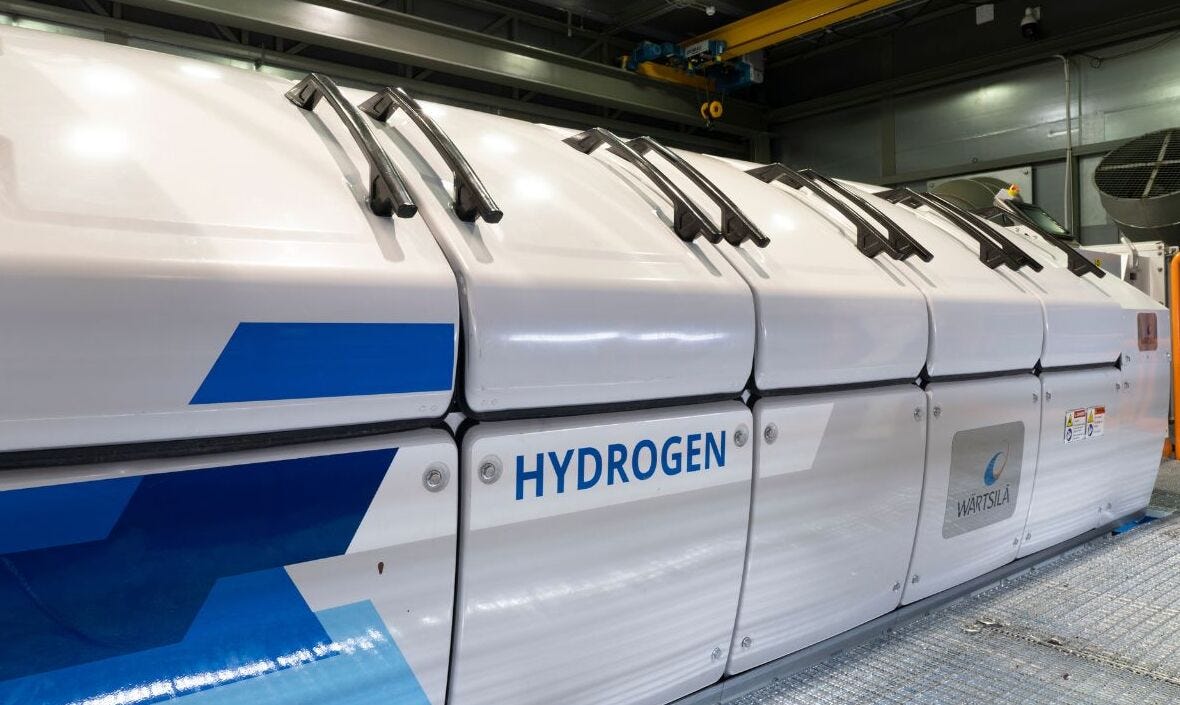
This image is used for illustrative purposes only.
A large industrial engine, running exclusively on pure hydrogen, just injected electricity into Spain’s national grid. What looked like a laboratory promise three years ago is now a verifiable industrial reality. On June 11, 2026, Wärtsilä — a Finnish technology group listed on Nasdaq Helsinki — demonstrated at its facility in Bermeo, in northern Spain, that large-scale electricity generation from 100% pure hydrogen, with zero carbon emissions, is technically achievable under real grid conditions.
The Wärtsilä 31H2 is part of the Wärtsilä 31 platform, described by the company as one of the world’s most efficient four-stroke multi-fuel engines. Its defining characteristic: it burns pure hydrogen — no blending with natural gas, no fossil fuel backstop. This is not a “hydrogen-ready” engine, a hybrid technology designed for future conversion. It is an engine running on green hydrogen today, in live grid conditions.
A step beyond the current frontier
The Bermeo demonstration marks a qualitative leap over existing technologies. Japanese manufacturers have made their own advances: in 2025, Kawasaki Heavy Industries began selling a large gas engine capable of running on a blend of up to 30% hydrogen by volume mixed with natural gas. Wärtsilä goes further — 100% hydrogen, with no compromise on fuel composition.
The structural problem this engine solves
The rapid build-out of renewable energy is creating a growing contradiction inside European power grids. Wind and solar generate electricity intermittently — abundantly when conditions are right, insufficiently during demand peaks or low-generation periods. That intermittency requires dispatchable capacity: power plants capable of starting quickly to cover shortfalls.
Today, that role is largely played by natural gas plants — a fossil fuel whose combustion produces carbon dioxide. Green hydrogen, produced through electrolysis powered by renewable electricity, could fill the same role without emissions. It would also allow excess renewable electricity to be stored chemically, then released into the grid when needed. According to projections cited by the International Energy Agency (IEA), global renewable energy deployment is expected to grow by nearly 4,600 GW by 2030, placing mounting pressure on grid balancing capacity.
Spain as a strategic test bed
The choice of Bermeo was deliberate. Spain ranks among Europe’s most advanced countries in integrating renewables into its electricity mix — which means it confronts grid balancing challenges earlier than most. The Iberian Peninsula also has some of Europe’s highest solar irradiation and wind potential, making it a natural candidate for large-scale green hydrogen production. Wärtsilä’s Rasmus Teir, Director of Technology Strategy and Decarbonisation, said the trial proves the technology is ready, and that the focus must now shift to regulation, investment clarity, and infrastructure to scale it.
Analysis: what this proves — and what it doesn’t yet
Wärtsilä’s breakthrough is genuine on the technical level. It should not, however, be mistaken for a completed industrial revolution. Several conditions remain unmet before pure-hydrogen engines can constitute a significant share of Europe’s or the world’s electricity mix.
Green hydrogen availability is the first bottleneck. Producing green hydrogen through electrolysis remains expensive, and the large-scale storage and distribution infrastructure — dedicated pipelines, storage sites, terminals — is still in early development across Europe. An engine capable of burning hydrogen has real operational value only if that fuel is available at a competitive cost.
The regulatory framework is the second obstacle. Wärtsilä stated plainly that the technology is ready but is waiting for “decisive regulation” and “investment clarity.” The European Union has been developing rules to define and incentivize renewable hydrogen — a process that remains complex and contested. Translating policy intent into bankable industrial projects is the missing link.
The potential application horizon extends beyond power generation. Wärtsilä notes that its hydrogen engines could power energy-intensive data centers, manufacturing facilities, and off-grid environments — markets expanding rapidly as artificial intelligence drives electricity demand upward.
A platform play, not just a product launch
It is plausible that the Bermeo demonstration serves Wärtsilä’s commercial strategy as much as its technological reputation. By inviting customers from around the world to witness live grid operation, the Finnish company converts a technical proof-of-concept into an early sales argument. Orders for the 31H2 engine in coming quarters could become a key indicator of whether the market believes pure-hydrogen generation is commercially viable — not just technically possible.
The Bermeo engine raises a question that European governments can no longer defer: if the technology for storing and delivering energy through hydrogen now exists, what is the real obstacle to deployment? The honest answer mixes fuel cost, regulatory uncertainty, and slow infrastructure investment. The Spanish demonstration doesn’t remove those obstacles — it makes them harder to excuse.
Sources: Wärtsilä Corporation · Euronews · International Energy Agency (IEA)