
Pope Leo XIV in the Canary Islands: Europe's unmarked graves
Pope Leo XIV traveled to the Canary Islands to honor migrants who died crossing the Atlantic — and deliver a pointed political challenge to Europe, Africa, and global indifference alike.

At a Glance
Pope Leo XIV traveled to Arguineguín, Gran Canaria, on June 11, 2026, to pay tribute to the thousands of migrants who have died attempting to cross the Atlantic Ocean from Africa.
In a strikingly direct address, he challenged Europe, countries of origin, and the individuals who allow traffickers and criminal networks to flourish — a three-part indictment rarely heard from a pope.
According to the International Organization for Migration (IOM), the UN’s migration agency, approximately 1,200 migrants died or went missing on the Canary Islands route in 2025 — a figure the IOM itself describes as a minimum estimate. The actual toll is likely higher.
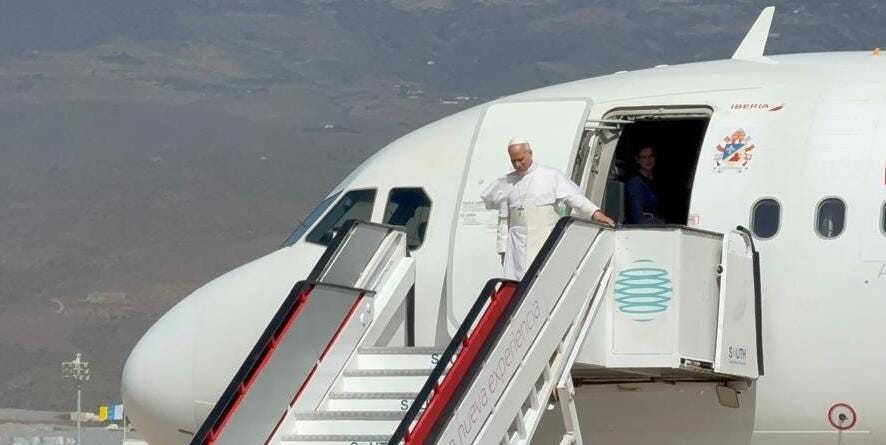
This image is used for illustrative purposes only.
A site with a dark history for an unsparing message
The choice of Arguineguín was deliberate. It was at this coastal town on Gran Canaria — the largest island in the archipelago, located roughly 60 miles off the northwest coast of Africa — that during the Covid-19 pandemic of 2020, thousands of migrants were packed onto a concrete pier under conditions condemned by Spain’s ombudsman and by the Catholic Church as inhumane. The site, since known as the “muelle de la vergüenza” — the “pier of shame” — became a symbol of the crisis that exposed the limits of Europe’s hospitality under pressure.
It was from that same port that Pope Leo XIV — born Robert Francis Prevost in the United States, who spent years as a missionary in Peru before being elected to the papacy — cast a bouquet of flowers into the sea in silence before delivering one of the most politically charged speeches of his week-long visit to Spain. Standing beside Pedro Sánchez, Spain’s Prime Minister, the pope spoke without diplomatic hedging. He denounced the mafias that trade in despair and the traffickers who enslave women and children, and condemned the indifference of those who allow the poor to be consumed by exploitation or oblivion. [translated from Spanish]
A three-part indictment: criminal networks, Europe, and countries of origin
What could distinguish Leo XIV’s address from the usual rhetoric around migration is its three-part target. He did not stop at condemning smugglers — the kind of denunciation that tends to attract broad consensus. He spoke directly to Europe, warning that it could not proclaim human dignity while growing accustomed to its seas becoming “cemeteries without gravestones.” [translated from Spanish] And he addressed African nations directly, arguing that they too must create conditions of peace, justice, and development.
This symmetry of shared responsibility — neither absolving Europe nor letting states of origin off the hook — could constitute a political stance that extends beyond the strictly pastoral. The pope also called for the establishment of “legal and safe processes” that allow people to migrate without risking their lives. The visit coincided, by calendar rather than coincidence, with the June 12 entry into force of the European Pact on Migration and Asylum — as if timed to remind the continent that legal frameworks and human reality do not always align.
The numbers: one of the world’s deadliest crossings
The Atlantic route between West Africa and the Canary Islands is among the most lethal maritime migration corridors in the world. In 2025, the IOM recorded approximately 1,200 deaths or disappearances on this route — a minimum count, as the agency’s methodology excludes unwitnessed or unreported sinkings. Organizations such as Caminando Fronteras, which tracks what they call “invisible shipwrecks,” estimate the actual toll significantly higher.
In 2024, nearly 50,000 irregular arrivals were registered on the islands — an unprecedented recent figure. That number fell sharply to approximately 18,000 in 2025, according to Spain’s Interior Ministry, a decline attributed both to difficult sea conditions and to bilateral agreements reached between Spain and the governments of Mauritania, Senegal, and The Gambia to combat organized criminal networks. The route runs along a brutal geographic arc: from the coasts of those countries, small overcrowded boats known as pateras travel hundreds of miles across open Atlantic waters. Each figure in the IOM’s ledger represents a person who vanished without a grave, lost in an ocean without witnesses.
What this visit says about Leo XIV’s papacy
This trip fulfills, symbolically, an unfulfilled wish of Leo XIV’s predecessor. Pope Francis — who died in 2025 after making pastoral visits to Lampedusa and the Greek island of Lesbos to bear witness to migration — had announced his intention on several occasions to travel to Spain for the same purpose. Leo XIV makes good on that intention, and adds his own imprint: a more explicitly political address, delivered at a moment when European migration policy is being formally reconfigured.
The choice of the Canary Islands — rather than a Mediterranean port — also signals a deliberate effort to broaden the geographic frame of Europe’s migration debate. While Lampedusa remains the most photographed crossing point, the Atlantic route could be considered a front in its own right: less visible in the European media landscape, but no less deadly. Vatican News, which covered the visit from Gran Canaria, described Arguineguín as moving from the “pier of shame” to a “pier of hope” — a reframing the local Church has been working toward for years, with Caritas providing language courses, schooling for children, and legal assistance for those seeking regularized status.
The Canaries are also, the pope noted from Gran Canaria’s parliament building, a crossroads. The islands are home to a large population of Cuban and Venezuelan migrants who arrived in earlier decades fleeing economic collapse — a reminder that forced displacement runs in many directions, and that Europe’s outermost islands have long absorbed what the continent’s center prefers not to see.
Europe cannot proclaim human dignity while growing accustomed to its seas becoming “cemeteries without gravestones.”
The Bottom Line
Europe has a right to asylum, dedicated institutions, and solemn treaties affirming human dignity. It also has, by now, several years of data no one disputes: thousands of deaths annually on its maritime borders. The question Leo XIV is raising is not theological — it is political. How long can a community of shared values coexist with a de facto policy that, through inaction or calculation, determines who deserves to arrive and who may disappear at sea?
Sources: France Info · France 24 · Vatican News · International Organization for Migration (IOM)