
Pope Leo XIV in Spain: a pontiff reads Europe's fault lines
A weeklong state visit — the first papal trip to Spain in fifteen years — puts Leo XIV at the center of the continent's sharpest debates on migration, diplomacy, and institutional accountability.

Pope Leo XIV landed in Madrid on Saturday, June 6, 2026, greeted by King Felipe VI and Queen Letizia of Spain. His words at the airport were anything but ceremonial. By openly praising Spain’s commitment to international law, multilateralism, and the reception of migrants, the first American-born pope placed himself squarely in one of Europe’s most contentious political debates.
At a Glance
Leo XIV has begun a weeklong state visit to Spain — the first papal trip to the country in fifteen years — praising Spain’s commitment to multilateralism and international law, positions that align with Madrid’s approach to conflicts including Gaza, Ukraine, and Iran, as well as its approach to migration.
The visit unfolds as Spain’s ruling Socialist Party, led by Prime Minister Pedro Sánchez, faces corruption scandals and domestic criticism over migration policy, making the pontiff’s endorsement politically significant.
Leo XIV is also scheduled to meet with survivors of clerical sexual abuse, as the Spanish Catholic Church undergoes a painful reckoning with decades of abuse and institutional cover-up.
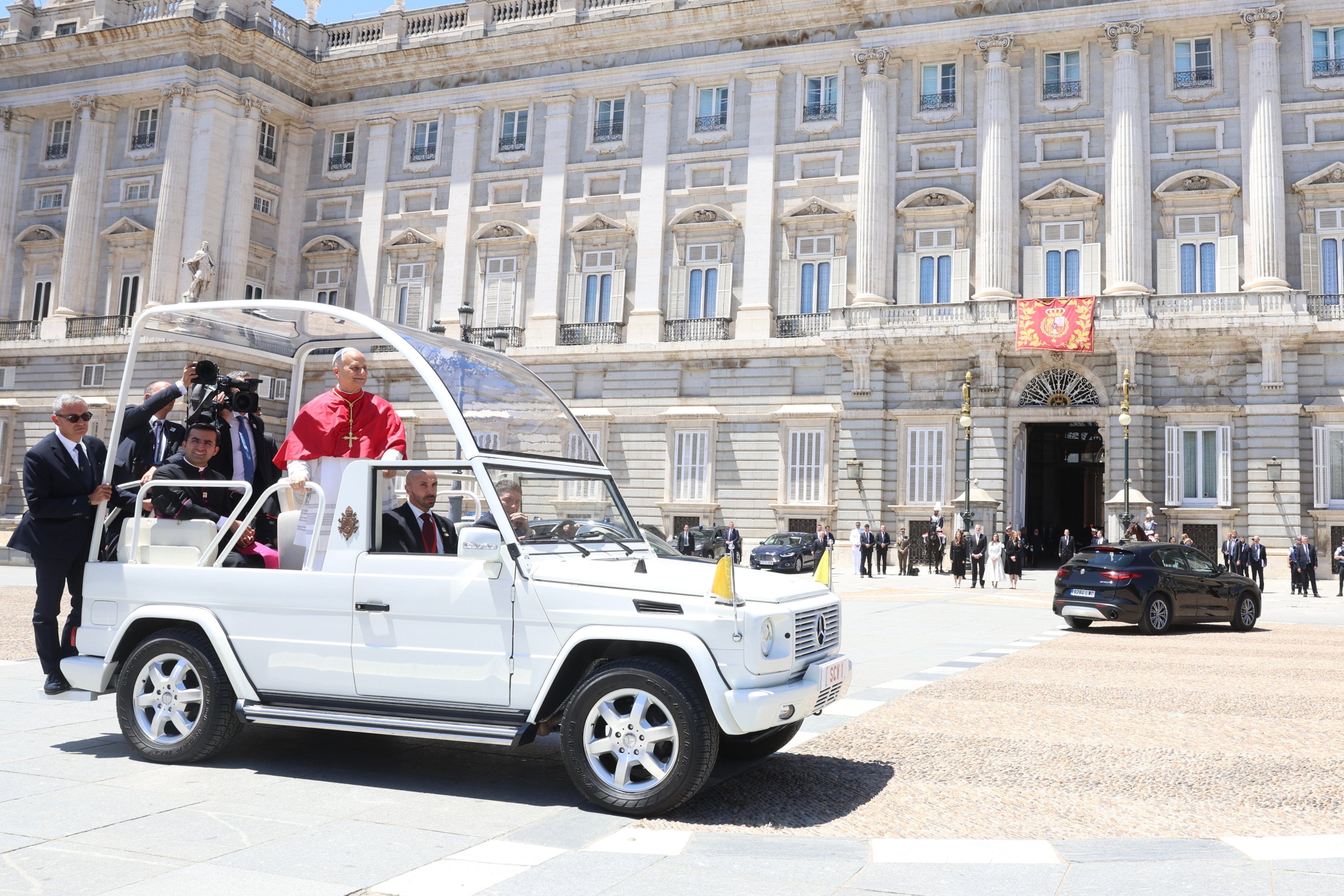
This image is used for illustrative purposes only.
The weight of words at Madrid’s airport
Popes choose their words carefully. Leo XIV — born Robert Francis Prevost in Dolton, Illinois, the first pontiff from the United States — did not disappoint. In praising Spain’s adherence to international law, its support for multilateral diplomacy, and its willingness to accept migrants, he effectively validated a governing philosophy that sets Madrid apart from a growing number of European capitals.
Spain, under Socialist Prime Minister Pedro Sánchez, has charted a distinct course on immigration compared with several EU neighbors. Madrid has resisted certain hardline measures adopted at the European level and maintained legal pathways for asylum seekers and migrants at a time when others have moved in the opposite direction. On the major conflicts reshaping global order — Gaza, Ukraine, Iran — Spain has staked out nuanced positions that prioritize dialogue. Leo XIV’s praise for multilateralism and international law implicitly validates that broader orientation, even if each individual conflict was not addressed by name.
A pontifical endorsement with a double edge
The Sánchez government receives this papal support at a moment of political vulnerability. The Spanish Socialist Workers’ Party (PSOE) is entangled in several corruption cases involving figures close to the party leadership. Migration management — particularly at the Canary Islands, a major entry point into the EU for migrants crossing from West Africa — has also drawn sharp criticism domestically and from European partners.
In this context, the implicit blessing of a newly elected pope with strong international credibility carries real political weight. It would be a mistake, however, to read this as partisan endorsement. What Leo XIV praised aligns with the Catholic Church’s longstanding social doctrine: welcoming the stranger, prioritizing dialogue, rejecting zero-sum geopolitics. Those principles could apply to governments across the political spectrum.
The Church confronting its own wounds
The most delicate dimension of this visit is not diplomatic — it is institutional. Leo XIV is scheduled to meet with survivors of sexual abuse committed by members of the Spanish clergy. The Catholic Church in Spain is, with some delay compared with Ireland, France, or the United States, entering a phase of systematic reckoning with decades of abuse and cover-up.
Estimates from a parliamentary inquiry and independent surveys have pointed to potentially tens of thousands of cases across several decades — a figure that varies widely depending on methodology, but whose scale alone triggered a national reckoning. The Spanish Church had been criticized for its slowness in acknowledging the problem and compensating victims. For Leo XIV, this meeting sends an unambiguous signal: the new pontificate intends to confront this file, even during a high-profile state visit.
A historic address and a spire reaching skyward
Beyond the political symbolism, two moments on the agenda carry their own historic weight. The pope will address both chambers of the Spanish Parliament in a joint session — a first in the history of relations between the Vatican and Spain. Speaking directly to a secular legislature is no mere protocol; it represents a mutual recognition between two distinct sources of authority.
In Barcelona, Leo XIV will preside over the inauguration of the central spire of the Sagrada Família, the basilica designed by Antoni Gaudí, the Catalan architect whose modernist masterpiece has been under construction since 1882. With this spire completed, the building becomes the tallest church in the world — a monument that transcends Catalan or Spanish borders.
Analysis: when Rome reads the European map
Leo XIV’s visit to Spain reflects a broader pontifical reading of Europe at a pivotal moment. The continent faces the rise of nationalist movements that challenge the foundational commitments of European integration — freedom of movement, solidarity among member states, a common approach to migration. Against that backdrop, choosing Madrid as a first major European stop — and praising pro-multilateralism and pro-migration positions there — is a political act in the broadest sense of the term.
This visit suggests, without one being able to establish it as a deliberate Vatican strategy, a pontifical willingness to weigh in on Europe’s values debate. The Catholic Church no longer commands the monolithic social influence it held across Western Europe in the twentieth century. But it retains the capacity to anchor moral reference points that European institutions sometimes struggle to articulate.
At a time when several European governments invoke the continent’s “Christian roots” to justify exclusionary migration policies, an American pope who spent decades ministering in Peru sends a message whose reach extends far beyond the Iberian Peninsula.
The bottom line
Spain gives Leo XIV an ideal stage — a Catholic country under secular government, grappling with the same tensions as its neighbors on migration and political polarization, yet having chosen a distinct path. What he does with it — diplomatic validation, a call for national reconciliation, a meeting with abuse survivors — says as much about the state of the Church in Europe as about the state of Europe itself. The question that will remain open after this visit: are European institutions still capable of articulating the values the Vatican just reasserted in Madrid, or have they ceded that ground to Rome?
Sources: Euronews