
Philippe in Kyiv: a candidate, a war, a European wager
Édouard Philippe meets Zelensky in Kyiv and calls for European troop deployments in Ukraine after the war — a bold stance ten months before France's presidential election.

Kyiv, May 26, 2026. Just as Russia announced its intention to intensify direct strikes on the Ukrainian capital, the mayor of Le Havre and French presidential candidate chose to fly in. The gesture was deliberate. Its meaning, unmistakable.
Édouard Philippe — who served as France’s Prime Minister under President Emmanuel Macron from 2017 to 2020, and now heads Horizons, the centrist party he founded — did not come as a diplomatic tourist. Attending the International Summit of Cities and Regions, he laid a wreath at the Wall of Remembrance (a memorial honoring Ukrainian soldiers killed since 2014), walked through downtown Kyiv alongside a Ukrainian delegation led by Deputy Prime Minister Oleksiy Kuleba, and held a one-on-one meeting with President Volodymyr Zelensky. In under twelve hours, he turned an institutional visit into a foreign policy statement.
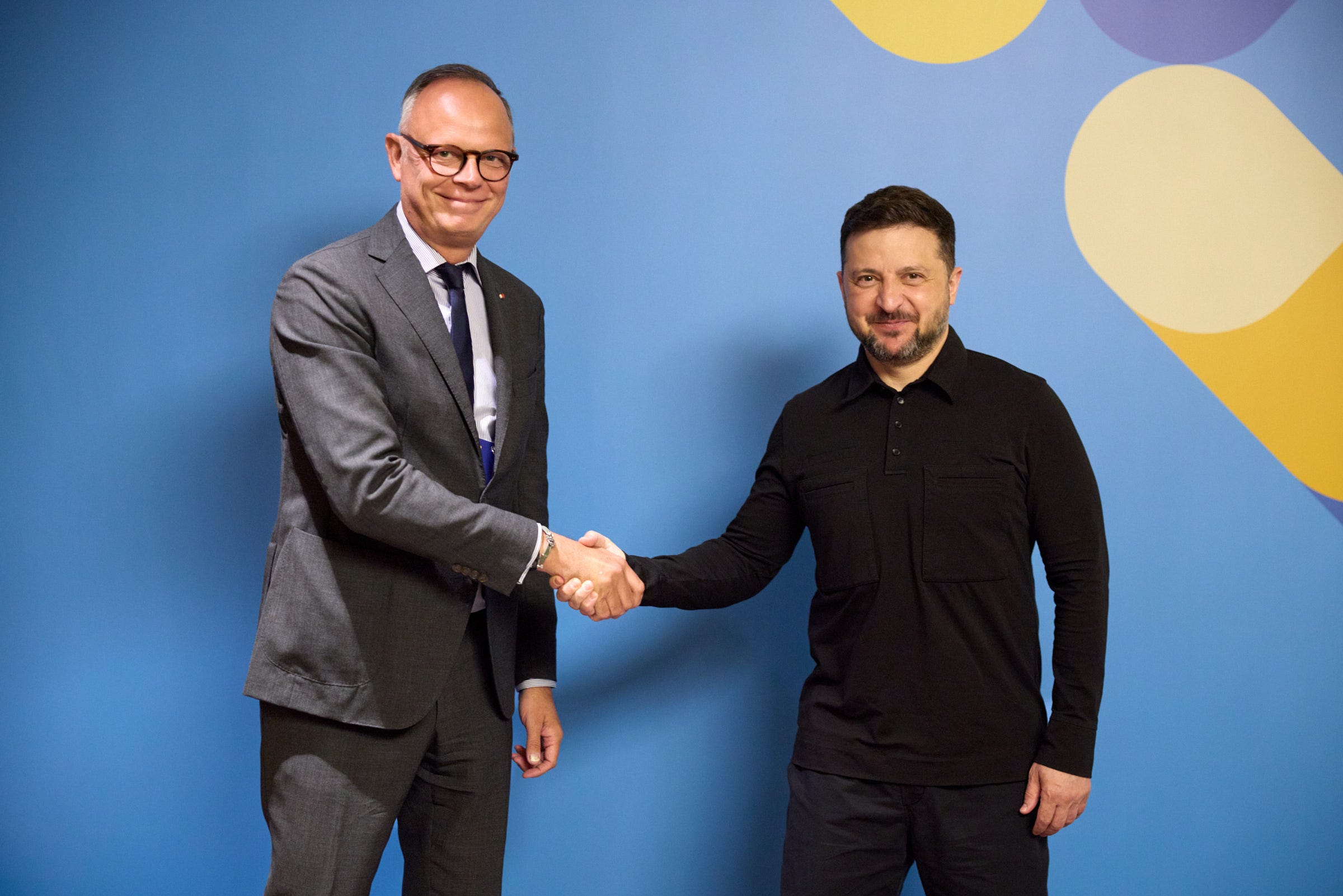
This image is used for illustrative purposes only.
At a Glance
Philippe met with Zelensky in Kyiv on May 26, 2026, on the sidelines of the International Summit of Cities and Regions, and called for the deployment of European troops in Ukraine once the conflict ends.
He backed Ukraine’s integration into NATO, describing it as the country’s best security guarantee, and discussed Ukraine’s EU membership bid.
The trip came as Russia announced plans to escalate strikes directly on the capital.
Kyiv as campaign backdrop — or genuine commitment?
The timing was not incidental. Russia had just announced an intensification of its strikes on Kyiv — a backdrop that gave the visit heightened symbolic resonance. Traveling to a city under threat is, in itself, a message aimed as much at Ukrainian audiences as at French voters.
On the social network X, the Horizons party leader pledged to stand with the Ukrainian people even beyond the end of the war — a framing more ambitious than it sounds. It implies a vision for the post-conflict period: a security architecture, a sustained commitment, and a significant budgetary cost.
That is precisely the heart of Philippe’s position. Once hostilities end, European troops should be deployed in Ukraine to deter any further Russian aggression. Several European countries have already floated the idea — and given Washington’s growing reluctance to guarantee European security since 2025, Paris positioning itself on this terrain would represent a significant shift. In American strategic debates, this is the kind of commitment often discussed under the banner of European strategic autonomy — the idea that Europe must be able to defend itself without relying primarily on U.S. military power.
Ukraine in NATO — a line Paris is crossing?
During his meeting with Zelensky, Philippe described Ukraine’s armed forces as the most battle-hardened in Europe and committed to working toward Kyiv’s integration into the NATO alliance — the North Atlantic Treaty Organization, the collective defense structure founded in 1949 that binds the United States, Canada, and Western Europe under a mutual security umbrella. He called NATO the “best security guarantee” for Ukraine.
This position carries considerable political weight in France. The hard left (La France Insoumise, the party led by Jean-Luc Mélenchon) opposes Ukrainian NATO membership. The far-right Rassemblement National — France’s largest opposition party, led by Marine Le Pen — has long maintained an ambiguous relationship with Moscow. By staking out an unambiguous pro-NATO enlargement position, Philippe draws a clear dividing line from his electoral rivals, and from France’s Gaullist tradition of strict non-alignment.
Zelensky, for his part, noted France’s consistent support on the question of EU membership. The two files — NATO and the EU — operate through different mechanisms but converge on the same logic: anchoring Ukraine permanently within Western institutional structures.
What this visit reveals about Europe in 2026
The geopolitical backdrop of this trip says something broader about the state of Europe. Ten months from a French presidential election in which Philippe was, according to polling published in March 2026, leading against Rassemblement National’s Jordan Bardella, candidates are using Ukraine as a civilizational marker.
The question is no longer simply “how much aid for Kyiv?” but “what kind of Europe after the war?” Philippe answers with an integrationist vision — European troops, NATO membership, EU accession — one that assumes a major scaling-up of collective European military capacity. That is a question Washington’s uncertain commitment to European defense, especially since 2025, has made more urgent than ever.
This sequence — presidential candidate, Kyiv under threat of escalation, specific commitments on security guarantees — could signal a reconfiguration of France’s strategic debate, where European defense ceases to be a theoretical horizon and becomes a concrete electoral commitment. Whether French public opinion, attentive to tight budgetary constraints at home, is prepared to accept the cost remains an open question.
The Bottom Line
Can Europe genuinely guarantee Ukraine’s security after the war — without the United States, or in spite of them?
That is the question Philippe implicitly raises by going to Kyiv. His answer binds his credibility as a candidate. It also, if it finds allies across the continent, points toward a fundamental redefinition of France’s role in Europe’s security architecture. Between the promise and the real capacity, the gap remains large — and no campaign speech has honestly measured it yet.
Sources: Euronews