
Norway joins France's advanced nuclear deterrence framework
Oslo formally joins Macron's new European nuclear deterrence framework — distinct from but complementary to NATO — and fills a critical gap on the Arctic flank.

At a glance
Norway, which held back in March 2026, has now joined the advanced deterrence framework announced by Macron at Île Longue — an unprecedented arrangement that ties European partners to France’s nuclear strategy without sharing the launch decision.
Oslo maintains its longstanding policy: no nuclear weapons on Norwegian soil in peacetime. Its participation centers on joint exercises and conventional military support.
The accession closes a gap that analysts had flagged as a critical weakness: Norway is the only NATO member sharing a land and maritime border with Russia outside the Baltic states and Finland — and had paradoxically been left out of the initial architecture.
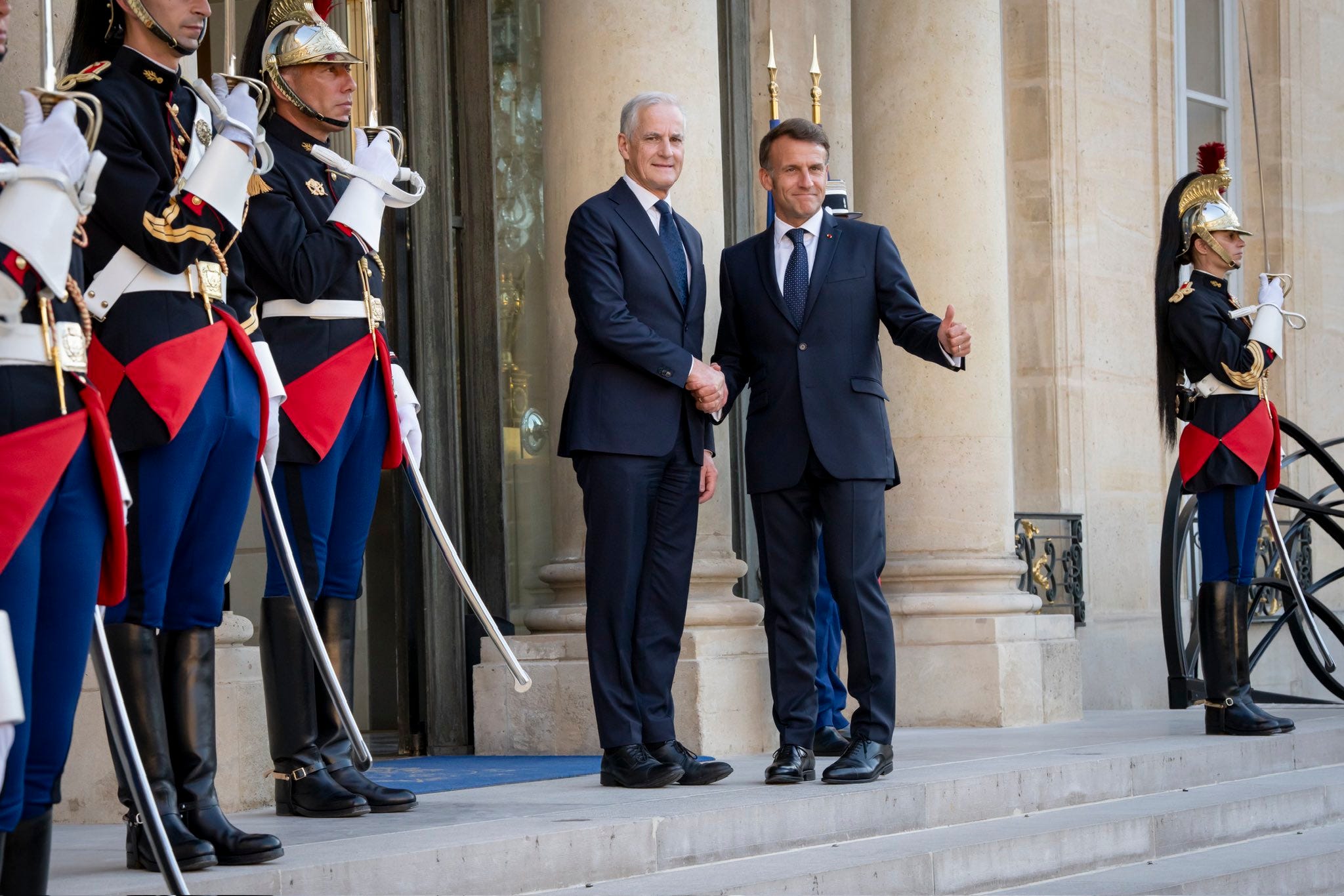
This image is used for illustrative purposes only.
In March, Norway wasn’t on the list. When Emmanuel Macron delivered his landmark speech at the Île Longue submarine base on March 2, 2026, he named eight European partners for what he called “advanced deterrence” (dissuasion avancée) — Germany, the United Kingdom, Poland, the Netherlands, Belgium, Greece, Sweden, and Denmark. Norway was notably absent. Eighty-six days later, Oslo has filled that gap. On May 27, during a visit to Paris by Norwegian Prime Minister Jonas Gahr Støre, Norway formally agreed to join France’s advanced nuclear deterrence framework — a first in the bilateral relationship.
From Oslo absent to Oslo on board: the diplomatic sequence
When Macron unveiled his eight initial partners in March, Norway’s absence drew immediate scrutiny. The following day, Norwegian Foreign Minister Espen Barth Eide told Parliament in Oslo that Norway was “ready to discuss” the new framework, while firmly reiterating a policy that has defined Norwegian nuclear posture for decades: no nuclear weapons on Norwegian territory in peacetime.
The formalization of Oslo’s accession on May 27 reflects discreet bilateral negotiations conducted between Paris and Oslo over the following weeks. Macron called the agreement “a very important step” in the Franco-Norwegian partnership and said it would drive what he described as highly ambitious cooperation going forward.
What “advanced deterrence” actually means
For readers unfamiliar with European defense architecture, France’s advanced deterrence (dissuasion avancée) is a concept distinct from NATO’s nuclear-sharing arrangements — in which the United States pre-positions B61 nuclear gravity bombs at allied bases under a dual-key system, roughly analogous to a shared nuclear insurance policy. The French model involves no transfer of launch authority, which remains exclusively French. Instead, it foresees the temporary deployment of nuclear-capable Rafale fighter jets to allied bases for exercises and strategic signaling, combined with what Macron calls “strategic shouldering”: allied partners provide conventional military support to raise the threshold for entering a nuclear crisis. Macron has consistently framed this as complementary to, not competing with, existing NATO arrangements — a distinction he reiterated at the Île Longue speech.
In American terms, the closest analogy would be an extended deterrence arrangement — similar in broad logic to NATO’s Article 5 collective defense clause — but run by a European sovereign actor rather than Washington.
The button stays French.
France has been the only nuclear power within the European Union since Britain’s departure from the bloc took effect in January 2021. Its arsenal, estimated at approximately 290 warheads before the Île Longue speech, had not been increased since at least 1992. In March, Macron announced that would change — and that France would cease publicly disclosing the size of its arsenal, reversing decades of relative transparency.
The geopolitical logic of Norway’s accession
Norway’s initial absence had been flagged immediately by analysts as highlighting “the enduring limitations of France’s nuclear posture as an extended deterrent.” The strategic rationale is straightforward: Norway is the only NATO member sharing a land border with Russia outside the Baltic flank and Finland, and its maritime Arctic boundary sits astride the transit corridors used by Russia’s Northern Fleet nuclear submarines to reach the North Atlantic. Its exclusion from the initial framework was a difficult gap to justify.
Norway’s May 27 accession could suggest that trilateral negotiations among Paris, Oslo, and existing Scandinavian partners — Sweden and Denmark were both among the original eight — produced a format compatible with Norway’s constitutional and political constraints. It is plausible that the framework allows Oslo to participate in exercises and conventional support without raising the question of nuclear stationing, which Norway categorically excludes. The precise operational terms have not been made public.
Macron referenced Norway’s “key role within the coalition of the willing” on Ukraine — a signal that Paris views defense burden-sharing and nuclear architecture as inseparable pillars of the same European strategic logic.
The Arctic dimension, the overlooked variable
What makes Norway’s accession qualitatively different from the eight earlier agreements is geography. Sweden and Denmark are members of the framework, but neither shares a land border with Russia. Norway controls the waters of the Barents Sea — one of the most strategically sensitive maritime spaces in the Northern Hemisphere, where Russian nuclear submarines must transit to reach open ocean.
Norway’s integration introduces an Arctic dimension that was entirely absent from the initial framework. This could shape the concrete modalities of cooperation — aerial exercises, maritime surveillance, command-and-control interoperability — whose details remain classified or undisclosed.
The bottom line
The question raised by Oslo’s accession is not one of symbolic importance — that much is self-evident. The real test is operational: can Paris and Oslo build a framework that is credible to Russia, satisfactory to Norwegian constitutional requirements, and replicable for partners still on the sidelines? Finland, which shares the longest EU land border with Russia and remains conspicuously absent from the framework, is watching. If the Franco-Norwegian model holds, it may become the template. If it fails to produce visible operational depth, the entire architecture risks appearing as a diplomatic achievement without strategic substance.
Sources: AFP · Reuters · Al Jazeera English · Atlantic Council · CSIS