
Norway goes to war — with complacency
Norway has declared 2026 its year of "total defense," mobilizing shelters, household stockpiles and civilian institutions against a threat its own prime minister now calls real.

A country getting serious — unevenly.
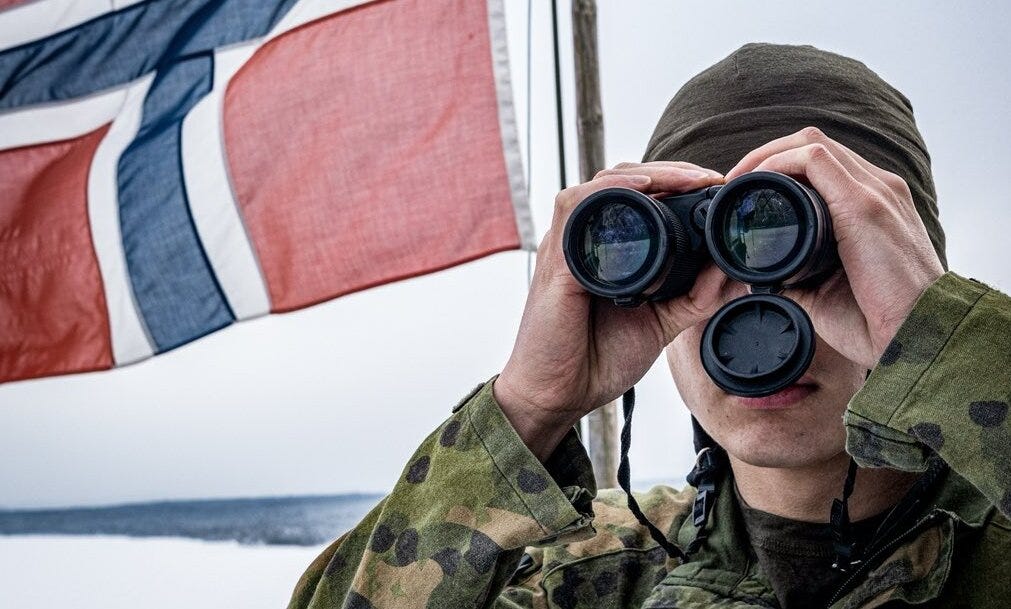
This image is used for illustrative purposes only.
At a Glance
Norway’s Prime Minister Jonas Gahr Støre warned citizens in his 2026 New Year’s address that “war could return to Norway,” formally launching what Oslo calls a “total defense” year — a nationwide mobilization of military, civilian institutions, local governments and ordinary citizens.
The country has roughly 18,600 air-raid shelters capable of protecting fewer than half its 5.6 million residents; the government wants to restore — for new large buildings — a shelter requirement scrapped in 1998 as a post-Cold War “peace dividend.”
The civilian defense corps is set to grow 50% to 12,000 personnel, every municipality will be required to establish a local preparedness council, and households are being urged to stockpile supplies for seven days.
A government that tells its citizens the truth
Norway’s Prime Minister Jonas Gahr Støre did not reach for reassurance in his 2026 New Year’s address. He told his compatriots plainly that “war could return to Norway” [translated from French] — and in doing so, closed out three decades of security complacency. That complacency had a name: the “peace dividend,” the assumption, codified in policy when Norway dropped its air-raid shelter requirements for new buildings in 1998, that the Soviet collapse had made serious military preparation unnecessary.
The current inventory tells its own story. Norway has 18,600 shelters capable of accommodating fewer than half its 5.6 million residents. Øistein Knudsen, director of the Norwegian Directorate for Civil Protection (DSB), notes that much of the existing stock has deteriorated badly since the Cold War era and is in need of substantial renovation. The ambition is not to build expensive hardened bunkers, but to provide basic protection against threats that have become ubiquitous on modern battlefields — above all, drones. To expand coverage over time, the government wants to restore a building requirement — scrapped in 1998 as a post-Cold War “peace dividend” — mandating that new large buildings include shelter capacity.
The doctrine of “total defense” — a Nordic model with European lessons
Totalforsvaret — or “total defense” — is not a rhetorical posture. It is an operational framework designed to align every layer of society — armed forces, emergency services, private sector, local governments and individual citizens — in response to a major crisis or armed conflict. For an American or Canadian reader, the closest analogy would be a far more institutionalized and military-centric version of what the Federal Emergency Management Agency (FEMA) calls “whole-of-community preparedness.” In Norway’s model, however, military readiness is central, not peripheral.
The government’s plan is concrete. The DSB’s civilian workforce is to grow by 50%, reaching 12,000 personnel. Every municipality will be required to establish a dedicated local preparedness council. A national food self-sufficiency target of 50% is set for 2030. Households are being asked to maintain seven-day emergency supplies.
These 100 specific measures — shelter construction among them — were laid out last year in a government white paper signaling Oslo’s full strategic pivot. In May 2025, Norway also published its first-ever national security strategy, built around three priorities: rapidly strengthening defense capacity, building societal resilience, and anchoring both within NATO, of which Norway is a founding member.
On the budget side, Norway’s 2025–2036 long-term defense plan projects a total envelope of 600 billion kroner — roughly €52 billion (approximately $57 billion at current exchange rates) — expanded through successive budget revisions, with a target of 3.5% of GDP devoted to defense by 2035.
The Ukrainian lesson, built into the architecture
What distinguishes Norway’s approach from a simple doctrinal update is the direct integration of Ukrainian wartime experience. Øistein Knudsen puts it without diplomatic softening: his Ukrainian counterparts, fighting an existential war on their own soil, still find time to share operational lessons — what it means to run a civil defense force under bombardment, how civilian infrastructure holds or fails under sustained attack. Those lessons are directly shaping Norwegian choices.
This pedagogy raises a question few Western governments are willing to ask openly: at what point does societal resilience stop being a posture and become an operational requirement? Oslo appears to have settled the question.
Between mobilization and structural friction
Public readiness remains uneven. A DSB survey found that 37% of Norwegians say they have increased their personal preparedness over the past year — but only 21% believe war on Norwegian soil is a realistic prospect within five years. The gap between individual action and risk perception points to a structural challenge in crisis communication that well-functioning democracies have rarely managed to close.
At the institutional level, friction points persist. Jarle Løwe Sørensen, a Norwegian crisis management researcher, identifies the fault lines: bureaucratic, legal and organizational mechanisms that prevent the system from fitting together optimally. Jurisdiction boundaries between police, firefighters, health services and the national guard do not always align — a coordination problem structurally similar to the interagency failures U.S. authorities confronted after Hurricane Katrina, with results that experts have judged still incomplete.
Kristine Kallset, Norway’s State Secretary at the Ministry of Justice and Public Security, frames the shift plainly: “For many decades in Norway, we had the luxury of being able to devote our resources to other things.” That luxury, she makes clear, is no longer available.
The bottom line
Norway is making a democratic bet: tell citizens the truth about the threat, give them tools to respond, and reform institutions accordingly. That bet — treating voters as adults rather than as constituents to be managed — is rare in Western Europe. The open question is durability. Can societal mobilization hold over time, or does perceived urgency erode when the threat remains abstract for most people?
What Norway is building in 2026 may be less a military apparatus than a test of democratic resilience in the face of a diffuse, long-duration threat. Whether that resilience can outlast the news cycle is a question no doctrine can answer in advance.
Sources: AFP · Mer et Marine · Norwegian Ministry of Foreign Affairs (norway.no) · Trade Commissioner Service of Canada