
NATO jets shoot down drone over Latvia
French fighter jets on NATO's eastern flank intercepted and destroyed a drone over Latvian territory on June 8, 2026.

The incident — the latest in a series of aerial intrusions this spring — is less straightforward than it appears: the aircraft likely originated in Ukraine, diverted by Russian electronic warfare. That distinction matters, but it does not make the episode any less revealing about the state of Europe’s air defenses.
At a Glance
French fighter jets stationed in the Baltic states as part of NATO’s permanent air policing mission shot down a drone over Latvian territory on June 8, 2026. The aircraft is believed to have originated in Ukraine and been diverted by Russian electronic warfare.
The incident comes less than two weeks after similar alerts in May 2026, including a drone crash near Rēzekne on May 7, when Latvia’s National Armed Forces (NBS) warned residents of multiple unidentified aircraft over national territory.
In response to a surge in airspace violations, European leaders have launched the Eastern Sentry program and agreed to build a “drone wall” along their eastern borders — a system whose initial capabilities are not expected before late 2026, with full deployment projected for early 2028.
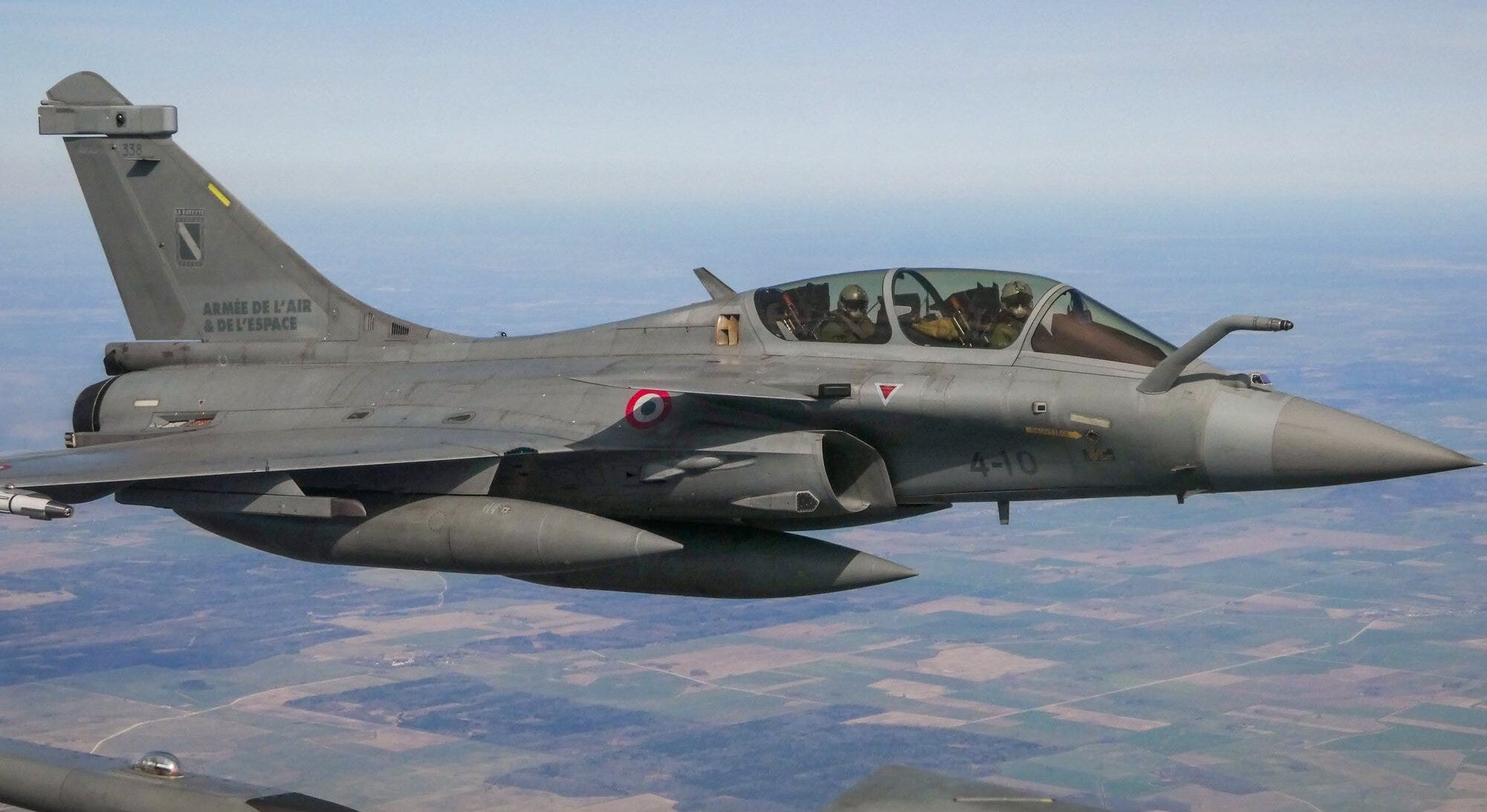
This image is used for illustrative purposes only.
A drone over Latvia — and a more complicated picture
On the morning of June 8, Latvia’s National Armed Forces — known by their Latvian acronym NBS — triggered an air alert over the country’s eastern regions: Ludza, Balvi, Alūksne, Krāslava, Rēzekne, and Augšdaugava. Emergency alerts were pushed to residents’ mobile phones. The NBS instructed people to take shelter indoors, close windows and doors, and keep at least two walls between themselves and any exterior — a standard precaution against drone debris.
French fighter jets — part of NATO’s rotational air policing mission in the Baltic states, under which Alliance members take turns patrolling the airspace of Estonia, Latvia, and Lithuania — intercepted and destroyed the aircraft. The alert was lifted around 10:30 a.m. local time. Additional military units were deployed along Latvia’s eastern border to reinforce surveillance capabilities.
The NBS confirmed the drone had entered Latvian airspace from the direction of Russia. What official statements did not immediately clarify — but what Latvian authorities have indicated in similar past incidents — is that the aircraft was most likely a Ukrainian drone diverted by Russian electronic warfare rather than a Russian military device launched directly at NATO territory. That distinction carries legal and political weight: it suggests Moscow’s role may be that of a manipulator of third-party weapons systems rather than a direct aggressor. Either way, the effect on Latvian airspace is identical.
This was not the first such incident this spring. On May 7, a drone crashed near Rēzekne; further alerts followed in mid-May. June 8 was a repetition, not an anomaly.
A systematic pattern on NATO’s eastern flank
Since last September, drone incursions into NATO airspace have reached an unprecedented frequency. Europe’s response has taken shape in two stages.
First, a political commitment: at a summit in fall 2025, European leaders agreed to develop a “drone wall” along the Alliance’s eastern borders — a layered system designed to detect, track, and intercept unauthorized aircraft. Initial capabilities are expected by late 2026, with fuller deployment projected for early 2028. Second, an operational response: following a drone violation of Polish airspace, NATO Secretary General Mark Rutte announced the Eastern Sentry program in September 2025, a deterrence initiative aimed at reinforcing NATO’s eastern posture across surveillance, anti-drone systems, and rapid response coordination.
U.S.-made anti-drone systems have been positioned on the eastern flank. At the same time, a report published two days before the Latvian episode noted that the Baltic states are still working to close gaps in radar coverage, with some equipment deliveries facing delays within EU procurement channels — a known friction point, though not a systemic failure across all recent assessments.
Moscow’s denial and what it conceals
The Kremlin has dismissed as “unfounded” any suggestion that Russia bears responsibility for drone incidents over NATO territory. That position is consistent — and consistently rejected by European capitals.
Some Alliance officials, along with independent defense analysts, describe the broader pattern as probing: a series of calibrated pressure tests designed to measure NATO’s reaction time, map radar coverage gaps, and assess the coherence of the allied response. That remains an analytical reading, not an established fact. What is harder to dismiss is the electronic warfare dimension: if Russia is systematically redirecting Ukrainian drones into NATO airspace, it achieves the effect of an incursion while preserving plausible deniability — a more sophisticated challenge than a direct border violation, and one that current NATO doctrine is still adapting to.
Analysis: the gap between capability and readiness
The Latvian episode exposes a structural tension in European defense. The immediate response capacity — French jets intercepting a drone within minutes — is real and effective. The persistent gap is elsewhere: in the time needed to build national radar coverage across the Baltic states, in procurement delays that slow equipment delivery, and in the distance between today’s threat tempo and the 2028 timeline for full drone wall deployment.
That asymmetry matters. Defense of NATO’s eastern flank currently depends heavily on projected forces — French, in this case — rather than on consolidated national infrastructure that would make any single ally’s contribution less critical. Eastern Sentry and the drone wall are the right long-term answers. The question is what happens in the interim.
For a continent that long outsourced its security to Washington, French pilots shooting down a drone over Latvia is more than an operational footnote — it is a measure of how much Europe has changed, and how much further it still needs to go.
The Bottom Line
This is not a crisis — it is a rehearsal. Drones will keep crossing, by design or by electronic redirection. The question is no longer whether NATO can intercept them: June 8 settled that. The deeper question is whether the legal and doctrinal frameworks governing NATO’s response have kept pace with the tactics being used against it — and whether the procurement timelines for Baltic radar coverage will be met before the pattern escalates into something harder to manage.
Sources: Euronews · Latvia’s National Armed Forces (NBS) · NATO · European Parliament Think Tank