
Modi in Rome: behind the selfies, a strategic Indo-European pivot
Modi's first bilateral visit to Italy in 26 years seals a special strategic partnership — and a €20 billion trade target that will test whether Europe is serious about India.

At a Glance
The first standalone bilateral visit by an Indian prime minister to Italy in twenty-six years, sealed under the designation of “special strategic partnership” — the highest level the two countries have ever established.
A stated goal of raising bilateral trade from €14 billion to €20 billion within three years, spanning sectors from defense to artificial intelligence.
The visit comes in the wake of the EU-India free trade agreement concluded in January 2026, whose real-world effects remain to be seen.
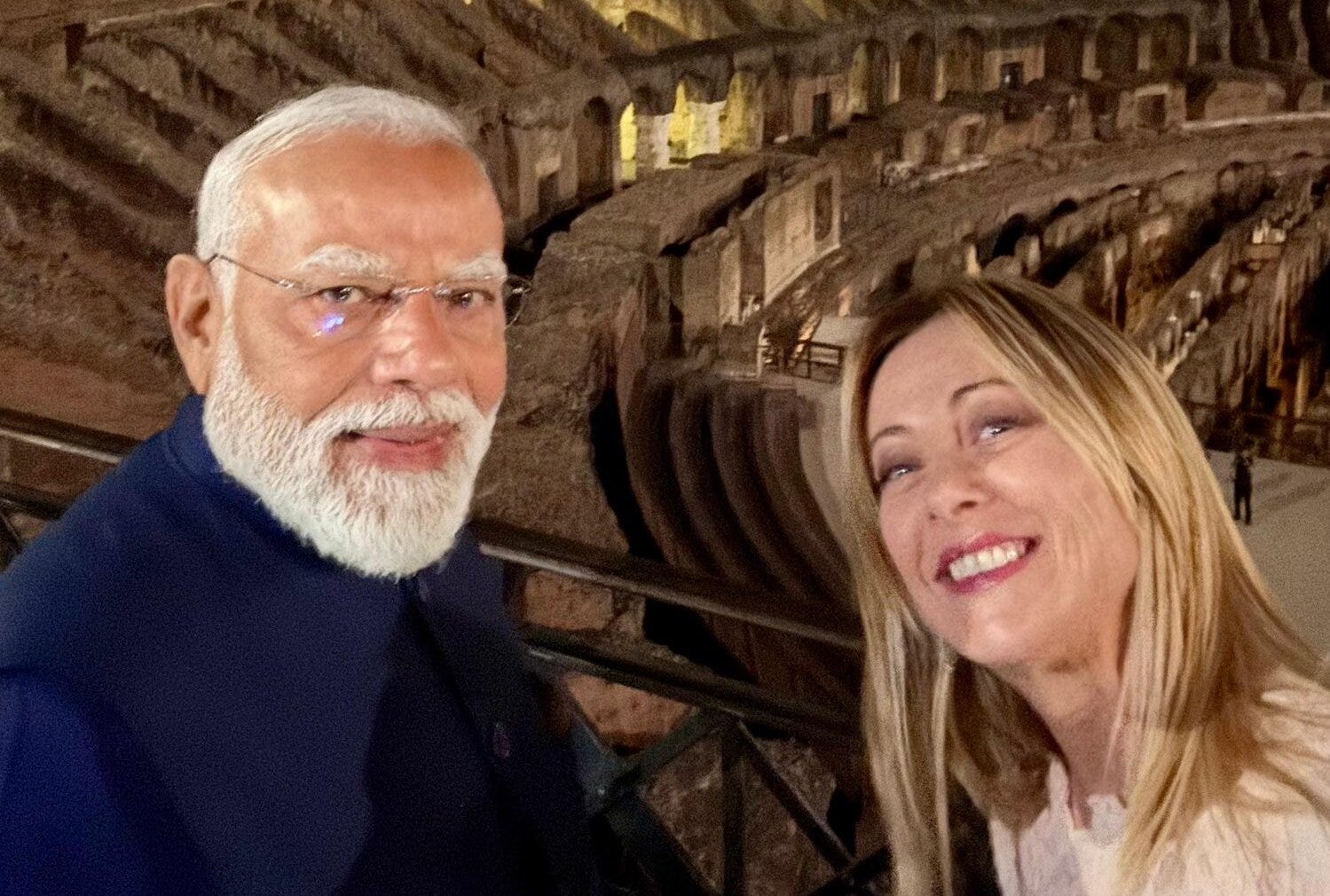
This image is used for illustrative purposes only.
Rome rediscovers New Delhi — 26 years of missed appointments
The last time an Indian head of government came to Rome on strictly bilateral terms, the euro did not yet exist. Narendra Modi, India’s prime minister, had passed through more recently — in 2021 for a G20 summit, in 2024 for a G7 — but multilateral stopovers don’t carry the same diplomatic weight as a state visit. Giorgia Meloni, Italy’s prime minister, had made the trip to New Delhi in 2023, and the two leaders have met at least six times since she took office in 2022.
That asymmetry speaks to the underlying state of the Italy-India relationship: warm in appearance, structurally underexploited. The Villa Doria Pamphilj, a 17th-century baroque estate chosen for their official meeting, provided a setting befitting the ambition on display. Meloni described the outcome as “the highest level ever reached in relations between our two nations.”
€20 billion target: an ambitious goal built on a modest base
India has become Italy’s second-largest trading partner in Asia — a meaningful rise, though one that needs context: China remains dominant by a wide margin. Current bilateral trade stands at €14 billion; Rome and New Delhi have now set a three-year target of €20 billion, an increase of roughly 43%.
The sectors in play span a broad range: defense and aerospace, machine tools, automotive components, chemicals, pharmaceuticals, textiles, agri-food, tourism — and, cutting across all of these, artificial intelligence, quantum computing, space, and civilian nuclear energy. For Meloni, India’s technological dynamism and digital infrastructure complement Italy’s industrial and manufacturing expertise. If that complementarity translates into concrete agreements, it could serve as a model for high-value-added North-South partnerships within the broader EU-India framework.
The visit comes in the wake of the EU-India free trade agreement concluded in January 2026 — a broader framework that reinforces, without having caused, the bilateral momentum now on display in Rome. That accord lowers a significant share of the tariff barriers that had long constrained trade between the two blocs. Think of it as a federal-level trade deal, in function if not in form, for a readership more familiar with agreements like USMCA or CPTPP.
Italy as Europe’s gateway to India
What unfolded in Rome has implications well beyond a single bilateral relationship. Modi’s Italian stop was the final leg of a six-day trip that also took him to the United Arab Emirates, the Netherlands, Sweden, and Norway. The sequence signals New Delhi’s appetite for deepening ties with Western partners — at a moment when its relationship with Washington carries its own complexities, and its posture toward Beijing remains structurally ambivalent.
For Meloni, hosting Modi in Rome serves a dual purpose. Domestically, projecting an active economic diplomacy — one capable of locking in strategic partnerships with major emerging powers — reinforces her standing as a serious governing leader. That image has been carefully cultivated since she took office in 2022, when her party, Fratelli d’Italia (Brothers of Italy), was widely perceived by parts of the European political establishment as a protest movement rather than a party of government — a characterization that, even then, her allies contested.
At the European level, Italy is positioning itself as a natural relay between Brussels and New Delhi. Whether that positioning translates into durable economic flows will be the real test.
The symbolic dimension of the visit — the private dinner on the eve of the summit, the nighttime tour of the Colosseum, the selfies, the candy offered as a play on their names — was not incidental. Political communication on both sides leaned into the warmth of the personal relationship to anchor, in the public imagination, the idea of a natural partnership. Modi’s planned stop at the headquarters of the Food and Agriculture Organization (FAO), the United Nations agency based in Rome, added a multilateral layer to the trip — suggesting that India intends to position itself as a responsible stakeholder in global governance at a time when multilateral institutions are under considerable strain.
The Bottom Line
The real question is not whether Rome and New Delhi want to move closer. It is whether Europe, as a whole, is ready to treat India as a long-term structural partner — or whether it will continue to see it as a secondary market, between rounds of negotiation with Beijing.
A “special strategic partnership” is a diplomatic formula. Its real value will be measured in two or three years, in signed contracts, cross-border investment flows, and — above all — the ability of Italian and Indian companies to turn political intentions into working industrial cooperation.
Sources: AFP · Italian Ministry of Foreign Affairs