
Modi in Gothenburg: India and Europe forge a new era
In Gothenburg, Modi and Von der Leyen moved to activate January's landmark EU-India trade deal — and opened a new front: investment.

Narendra Modi arrived in Europe this week with an agenda that goes well beyond a trade agreement. The Indian prime minister’s five-country tour — the Netherlands, Sweden, Norway, Italy, and a stop in the UAE — is the first major diplomatic offensive since the EU-India free trade deal was sealed in January, after nearly two decades of on-and-off negotiations. Sunday’s meeting in Gothenburg was its symbolic centerpiece.
At a glance
The EU-India free trade agreement, signed January 27, 2026, is the largest bilateral trade deal ever concluded by either party, covering two billion people and roughly 25% of global GDP.
In Gothenburg, European Commission President Ursula von der Leyen — head of the EU’s executive arm, broadly equivalent to a federal administration for its 27 member states — named the next objective: an investment agreement she described as “the missing piece of the puzzle.”
Modi is now in Oslo for the third India-Nordic Summit before concluding his tour in Italy on May 20 with Prime Minister Giorgia Meloni.
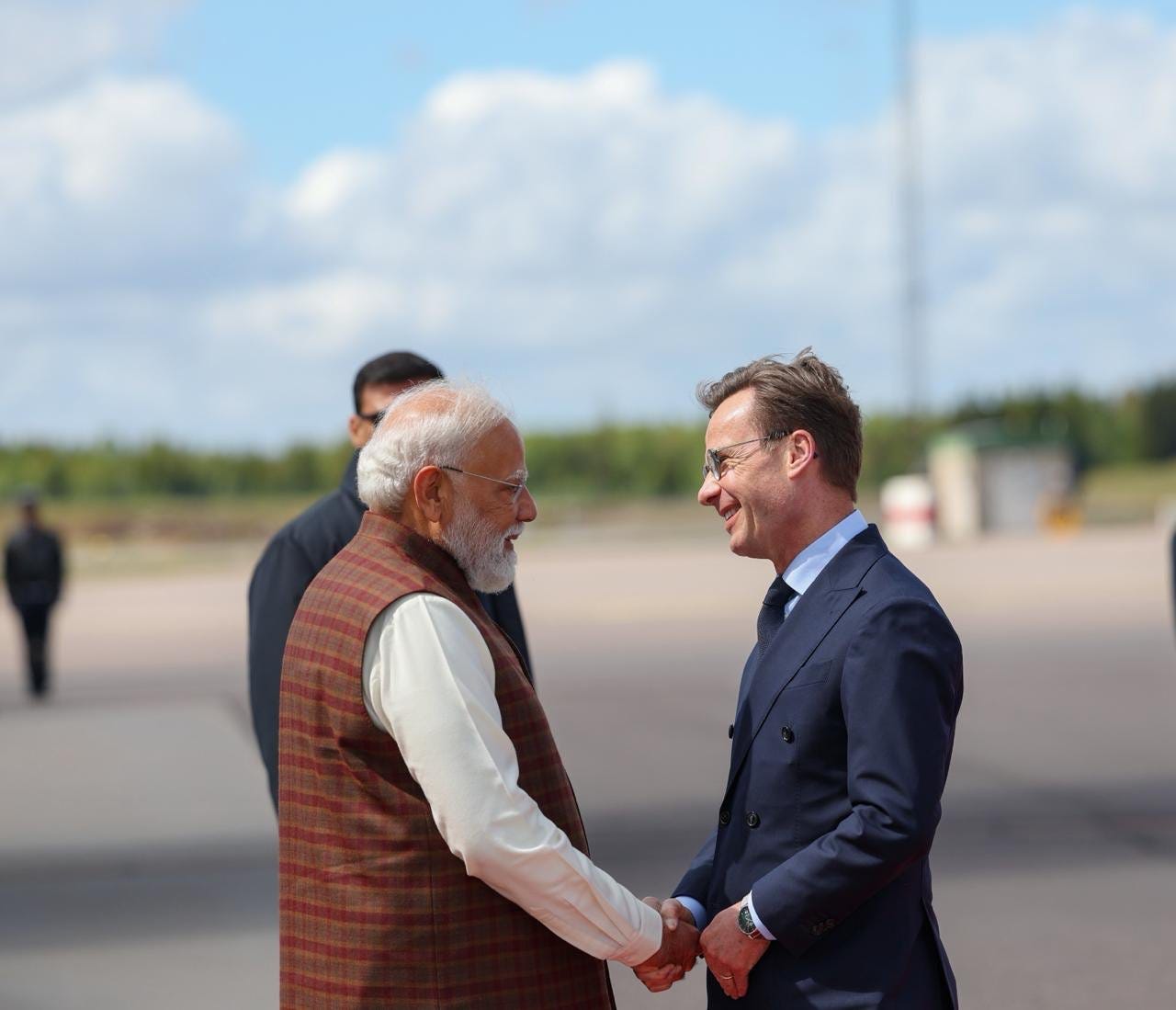
Gothenburg as a signal: what Modi came to Europe to secure
Gothenburg, Sweden’s industrial heartland, was not a neutral backdrop. Modi met Ulf Kristersson, Sweden’s prime minister, and Von der Leyen at the European Business Round Table for Industry — a forum founded in 1983 that brings together the CEOs of Europe’s largest multinationals, a rough counterpart to the U.S. Business Roundtable. The choice of venue said something about the intent: this was a prime minister coming not to ratify a text, but to convert it into capital flows.
The January 27 agreement capped negotiations that began in 2007, stalled in 2013, and were relaunched in 2022. The numbers are striking: the EU and India already exchange more than €180 billion ($200 billion) in goods and services annually — €120 billion in merchandise, €26 billion in services. The deal aims to double EU exports to India, a market long shielded by some of the world’s steepest import tariffs, which Brussels has consistently characterized as very high. Under its terms, India will eliminate or reduce duties on 96.6% of EU goods, while the EU will liberalize 99.5% of its import lines on Indian products — phased in over seven years. The European Commission estimates that 800,000 jobs in Europe are already tied to exports to India.
Beyond trade: investment as the next frontier
Von der Leyen made clear in Gothenburg that the January text is a floor, not a ceiling. A framework governing investment flows between the two economies is absent from the current agreement — and Brussels considers it essential to locking in durable capital links. She called it “the missing piece of the puzzle.”
That ambition carries weight in the current geopolitical context. The EU has been systematically working to reduce supply chain dependencies on China — and, to a lesser degree, on the United States. India, the world’s fourth-largest economy and most populous country, is the most credible medium-term alternative: a constitutional democracy with rule of law, three attributes that Brussels now explicitly values in strategic partnerships after the disillusionment of the previous decade.
The timing is not incidental. The Iranian blockade of the Strait of Hormuz, the narrow waterway through which roughly a fifth of the world’s oil supply passes, triggered by U.S. and Israeli strikes against Iran on February 28, has sent energy prices surging globally. India, which sources roughly half its crude oil through Hormuz, has been hit particularly hard: the rupee has fallen to historic lows, and Modi has asked the public to restrict fuel consumption and gold purchases. This sequence of pressure could suggest that both sides found in shared economic constraint an accelerant that twenty years of conventional trade diplomacy had failed to produce. Establishing that causal link with certainty, however, would require more than the public record currently allows.
Oslo, then Rome: a tour designed to be read as a whole
The tour does not read stop by stop — it reads as a single argument. In the Netherlands, a strategic partnership spanning trade, defense, semiconductors, water, and health. In Sweden, the business forum and the Von der Leyen meeting. In Oslo today, the third India-Nordic Summit — following Stockholm in 2018 and Copenhagen in 2022 — where Modi meets the leaders of Norway, Sweden, Denmark, Finland, and Iceland to advance cooperation on technology, renewable energy, defense, space, and Arctic affairs.
That last point is not a footnote. India maintains a research station on Norway’s Svalbard archipelago, a remote Arctic island chain, and tracks polar developments closely: the opening of new shipping routes as ice retreats has direct implications for Indian logistics, and documented effects on the Indian monsoon and food security.
The Italian conclusion — scheduled for May 20 with Prime Minister Giorgia Meloni — rounds out the sequence. The two leaders adopted a “joint strategic action plan” in 2024, covering defense, security, and migration corridors. Italy is also a key stakeholder in the India-Middle East-Europe Economic Corridor (IMEEC), which both countries have committed to advancing.
The bottom line
The EU-India free trade deal took twenty years to sign. Modi took five days to turn it into a continental tour. The real question is not whether the agreement will be ratified — both sides have made it an explicit political priority. It is whether the European Union possesses the investment instruments, financing mechanisms, and shared industrial policy necessary to deliver the hundreds of thousands of additional jobs it has promised — at a moment when Europe’s structural competitiveness has been under sustained scrutiny, most notably in the September 2024 report submitted to the Commission by Mario Draghi, former president of the European Central Bank and former Italian prime minister.
A trade agreement, however historic, is only as good as what 27 member states can collectively make of it.
Sources: Euronews · European Commission