
Merz in Aachen: No to common debt, yes to Draghi's vision
Merz backed Draghi's competitiveness push in Aachen — then rejected his key prescription. Germany's debt veto opens a fault line with Paris ahead of June's EU budget talks.

At a glance:
German Chancellor Friedrich Merz reiterated his categorical opposition to any form of joint European borrowing in Aachen, citing constitutional constraints and the threat to sovereignty.
He backs a deep reform of the EU budget — more investment, fewer subsidies — and endorses the competitiveness framework laid out by Draghi.
His position puts him on a collision course with France, Spain, and Greece, which are pushing for eurobonds, just weeks before a pivotal budget deadline.
A prize, two visions of Europe
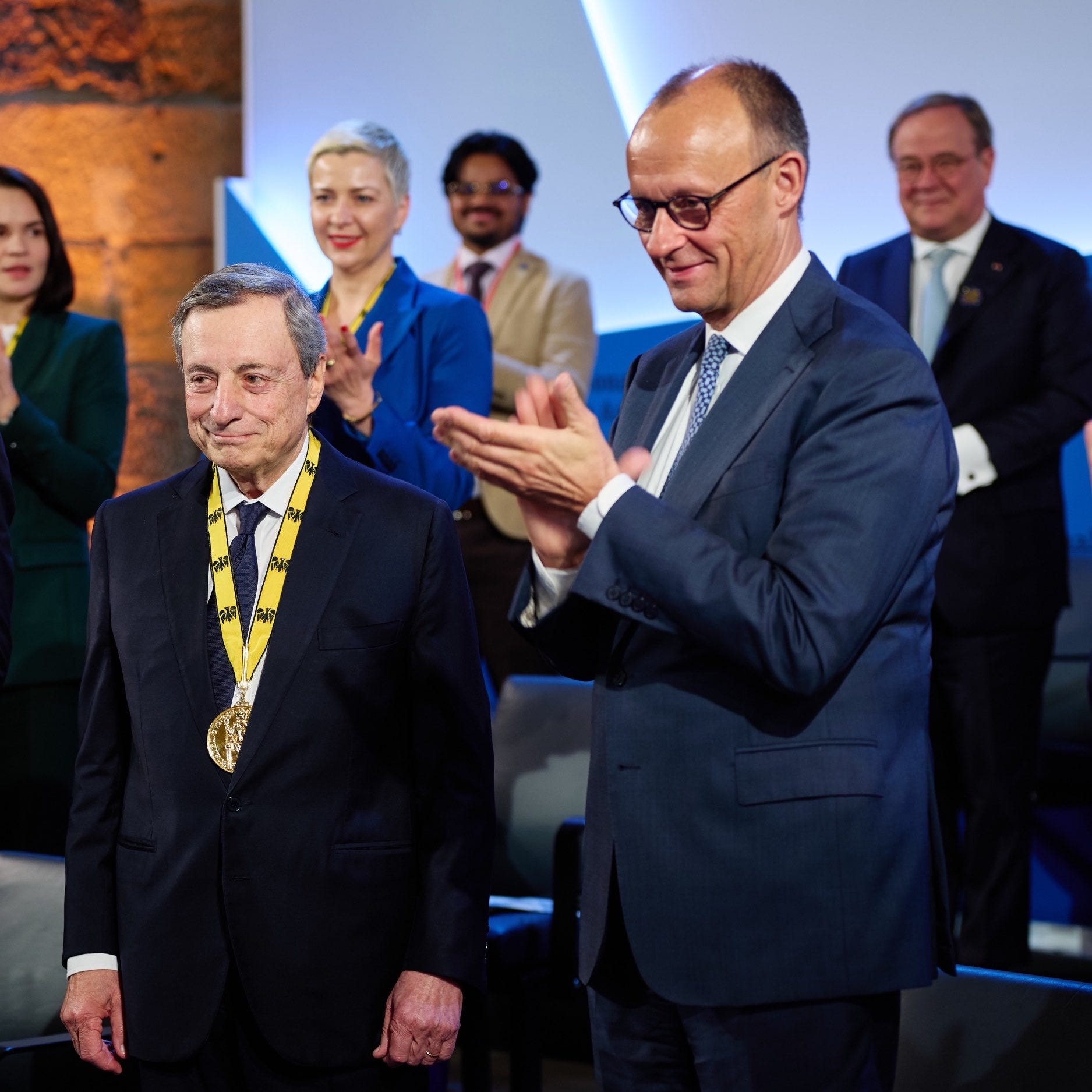
The ceremony was designed for unity. On May 14, at Aachen Cathedral, Mario Draghi — former president of the European Central Bank (ECB) and former Italian Prime Minister — received the 2026 Charlemagne Prize, the most prestigious award for service to European integration, granted annually in the city where Charlemagne built his empire. Friedrich Merz, Germany’s chancellor since early 2025, was there to pay tribute. But beneath the ceremonial pleasantries, Merz delivered a speech of doctrine — and of division.
Merz shares Draghi’s diagnosis: Europe is structurally falling behind the United States and China, its budget remains frozen in a 20th-century architecture, and more than two-thirds of its funds go to redistribution and subsidies rather than productive investment. He even embraced Draghi’s own language, declaring that the EU needs a budget “approved by Draghi.” But the convergence ends there. On the question of how to finance it, the chancellor shut the door without ambiguity: joint debt is not an option.
The refusal of common debt: a constitutional and political veto
Merz’s argument operates on two levels. The first is constitutional: Germany cannot constitutionally commit to a permanent mutualized borrowing mechanism — a constraint Berlin did ease in the spring of 2025 to fund its own defense and infrastructure investment, but which it refuses to extend to the European level. The second is economic and political: excessive debt, Merz argued, erodes sovereignty rather than building it. He noted that some member states already spend more servicing their debt than on national defense — a remark aimed, without naming names, at the southern European economies most burdened by debt.
This is not a new position. It belongs to the ordoliberal tradition — Germany’s distinctive school of economic thought, grounded in rule-based fiscal discipline and deep resistance to deficit spending — that Merz openly claims, and extends the legacy of Wolfgang Schäuble, his mentor and Germany’s finance minister from 2009 to 2017, whom he honored in that same speech. What is new is the timing: with European leaders expected to agree in June on a common position for the multi-year financial framework (MFF) — the EU’s long-term budget, roughly equivalent to a seven-year federal spending plan — the chancellor has chosen to publicly harden his line.
The Franco-German fault line, reopened
France, Spain, and Greece are pushing for the issuance of eurobonds — a form of joint European borrowing — to finance the energy transition and defense spending, against a backdrop of rising energy prices tied to the ongoing war in the Middle East. Draghi himself, in certain statements following the publication of his landmark 2024 competitiveness report, appeared open to this approach as a tool to fund the strategic investment gap he quantified at €800 billion ($880 billion at current exchange rates) in additional annual investment.
Merz does not deny that gap. He suggests that redirecting the existing budget — trimming redistribution, scaling up investment — can absorb part of the shortfall. But for eurobond advocates, internal reallocation alone cannot bridge a gap of that magnitude. The tension between the two approaches is likely to become one of the central fault lines in the summer budget negotiations.
Analysis — What Merz really said to Draghi
The Aachen speech deserves to be read on two levels. On the surface, Merz honors Draghi and conscripts his intellectual authority: the repeated invocation of the 2024 report as the compass for EU budget reform is a shrewd way to shelter a political position behind a technocratic consensus.
At a deeper level, the chancellor turns the very language of European sovereignty against his adversaries. Where Paris frames eurobonds as a lever of strategic autonomy — an argument Macron first made in his landmark 2017 Sorbonne address, in which he called for deeper EU fiscal integration — Berlin reframes them as a long-term source of financial dependency. The rhetorical reversal is politically effective. But it sidesteps a genuine question: if internal budget reallocation falls short, and joint debt is off the table, what is Berlin’s third path to financing the €800 billion Draghi himself identified as necessary?
That question, at this stage, has no explicit answer in the chancellor’s speech — which suggests that the real confrontation is only beginning, and that it will play out at June‘s summits, not in cathedrals.
The question is no longer whether Germany will accept common debt — the answer is no.
The bottom line
Friedrich Merz has just inscribed his budget red line in stone, at the precise moment Europe must decide how to finance its future. The question is no longer whether Germany will accept common debt — the answer is no. It is whether the EU can build its competitiveness and strategic sovereignty without it. Draghi, whom Merz honored on Thursday, believes it cannot. The next multi-year financial framework will determine which of the two is right.
Sources: Euronews · Le Grand Continent · AFP / TradingView