
Mélenchon 2027: The comeback bid
At 74 and on his fourth presidential run, Mélenchon launches in Saint-Denis — rejecting a left-wing primary and declaring war on France's far right.

At a Glance
Mélenchon officially launched his presidential campaign on June 7, 2026, in Saint-Denis, with a platform centered on a new Sixth Republic, retirement at 60, and ecological planning — organizers claimed 26,000 supporters, though independent estimates suggested a smaller crowd.
He flatly rejected any left-wing primary, positioning himself as the only viable opposition candidate and warning rival left parties not to stand in his way in the first round.
He launched a sharp attack on the Rassemblement National (RN), France’s far-right party, accusing it of promoting a form of “supremacism” designed to divide French society along ethnic and religious lines, and singling out RN president Jordan Bardella by name over his proposal to end birthright citizenship.
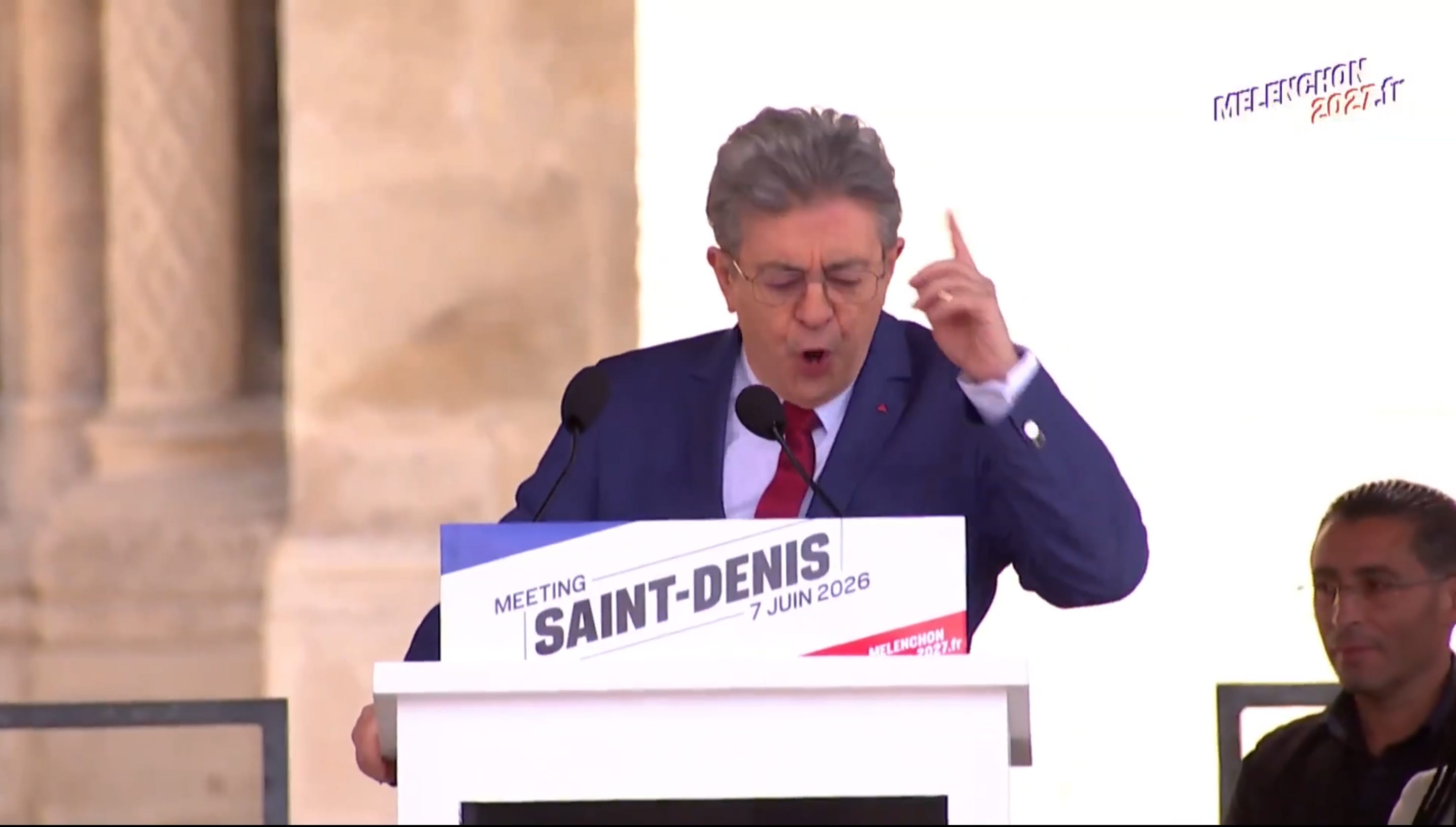
This image is used for illustrative purposes only.
The venue was no accident
Saint-Denis, Seine-Saint-Denis, June 7, 2026. In the shadow of the Basilica of Saint-Denis — the burial site of French kings — Jean-Luc Mélenchon, founder and candidate of La France Insoumise (LFI, the hard-left party he created), formally launched his fourth bid for the French presidency. The choice of location was a manifesto in itself: a working-class, ethnically diverse city on the outskirts of Paris, recently captured by LFI in the March 2026 municipal elections, it embodies the electoral sociology on which Mélenchon is building his campaign.
Organizers claimed 26,000 people gathered alongside Bally Bagayoko, the city’s newly elected mayor, though independent estimates pointed to a smaller crowd. The rally’s framing captured LFI’s entire strategy: anchor the campaign in France’s banlieues (suburban working-class communities), counter narratives about national identity with an assertive alternative, and signal that the radical left now holds solid territorial footholds.
A radical platform, a hegemonic posture
On substance, Mélenchon laid out the broad lines of a program largely consistent with his previous runs: the creation of a Sixth Republic to replace France’s current presidential system, lowering the retirement age to 60 — a major flashpoint in French politics since President Emmanuel Macron raised it to 64 — raising the minimum wage to €1,700 per month (approximately $1,870), and establishing a comprehensive social insurance system managed directly by contributors. New or more emphatic proposals included extended autonomy for Corsica, independence for what he calls “Kanaky Caledonia” (New Caledonia), the nationalization of ArcelorMittal, and a European-wide petition to end the European Union’s trade agreement with Israel.
On posture, the message was one of dominance. Mélenchon ruled out any left-wing unity primary. By noting that he missed qualifying for the runoff in the 2022 presidential election by only 420,000 votes behind Marine Le Pen — RN’s longtime leader and three-time presidential candidate — he presented himself as the left’s only credible path to the second round. His warning to rival parties was unambiguous: those with “no chance” of reaching the runoff should not block his path in the first round.
This exclusionary strategy could prove as decisive as it is risky. It consolidates LFI’s base but could undermine any capacity to broaden his coalition beyond the first round.
The battle of words: “supremacism” vs. birthright citizenship
The sharpest moment of the speech targeted the RN. Mélenchon proposed a new interpretive framework connecting the rise of identity-based nationalism — linking it to conflicts in the Middle East and to Trumpism in the United States — under the term “supremacism”: a drive to rank peoples hierarchically by ethnicity and religion. He named the RN as the vehicle for this project in France.
The attack sharpened around birthright citizenship. In response to Jordan Bardella, president of the RN, who wants to abolish the droit du sol — the legal principle by which anyone born on French soil can acquire French nationality — Mélenchon called the proposal a “crime against the nation.” He defended French national identity as a shared inheritance rather than an ethnic marker, weaving an inclusive counter-narrative rooted in the memory of immigration.
This rhetorical offensive aims to reframe the electoral divide: not left versus right in the traditional sense, but a “republican” inclusive project against a “supremacist” exclusionary one. If this framing were to take hold in the public debate, it could structure the entire 2027 campaign.
Analysis: the mechanics and the deeper question
What the rally reveals about real constraints
Mélenchon is operating in a singular electoral window. LFI has consolidated local strongholds — Saint-Denis being the clearest example — and commands a solid activist base. His 2022 first-round performance gives him an arithmetic legitimacy his left-wing rivals struggle to contest.
But three structural obstacles stand in his way. First, his profile as a “perennial candidate”: at 74, on his fourth attempt, the question of personal political fatigue is real, even if the available sources do not allow for a measurement of its effect on voters. Second, a fragmented left: rejecting a primary consolidates the base but could undermine any capacity to broaden his coalition beyond the first round. Third, his chosen target: by making the RN — rather than Macron’s record in office — his primary adversary, he risks feeding a polarization that has, so far, mainly benefited the far right.
What this moment says about the 2027 presidential race
France’s 2027 presidential election — a two-round system in which candidates must win an outright majority in the second round — is shaping up as a structural test for the European left. LFI represents a radical left that has successfully built territorial strongholds and a campaign machine, but whose electoral ceiling remains a real constraint.
The question is not whether Mélenchon can win the first round. It is whether the French left can build, by April 2027, an electoral architecture capable of defeating the RN in the runoff — with or without him.
The Bottom Line
A campaign launch doesn’t make a presidency. But it sets a frame. By choosing Saint-Denis, rejecting a primary, and going on offense over identity, Mélenchon has defined his campaign as a bet on base mobilization rather than coalition-building. That bet was coherent in 2022. Whether it is enough for 2027 will depend less on him than on the choices — or the absence of choices — made by the other forces of the French left in the months ahead.
Sources: RFI · France Info