
Magyar vs. Sulyok: Hungary's post-Orbán showdown
Hungary's new prime minister threatens constitutional overhaul to remove a president installed by his predecessor — and the president isn't going quietly.

At a Glance
Péter Magyar, Hungary’s new prime minister, announced plans to amend the country’s constitution to remove President Tamás Sulyok, an Orbán appointee who refused to step down before a government-set deadline.
Magyar’s Tisza Party holds a two-thirds supermajority in parliament — the exact threshold needed to rewrite the Fundamental Law — making the ouster legally feasible within approximately one month.
The standoff extends well beyond one man: Magyar has called for the removal of nearly a dozen officials appointed under Viktor Orbán across Hungary’s judiciary, courts, and regulatory bodies.
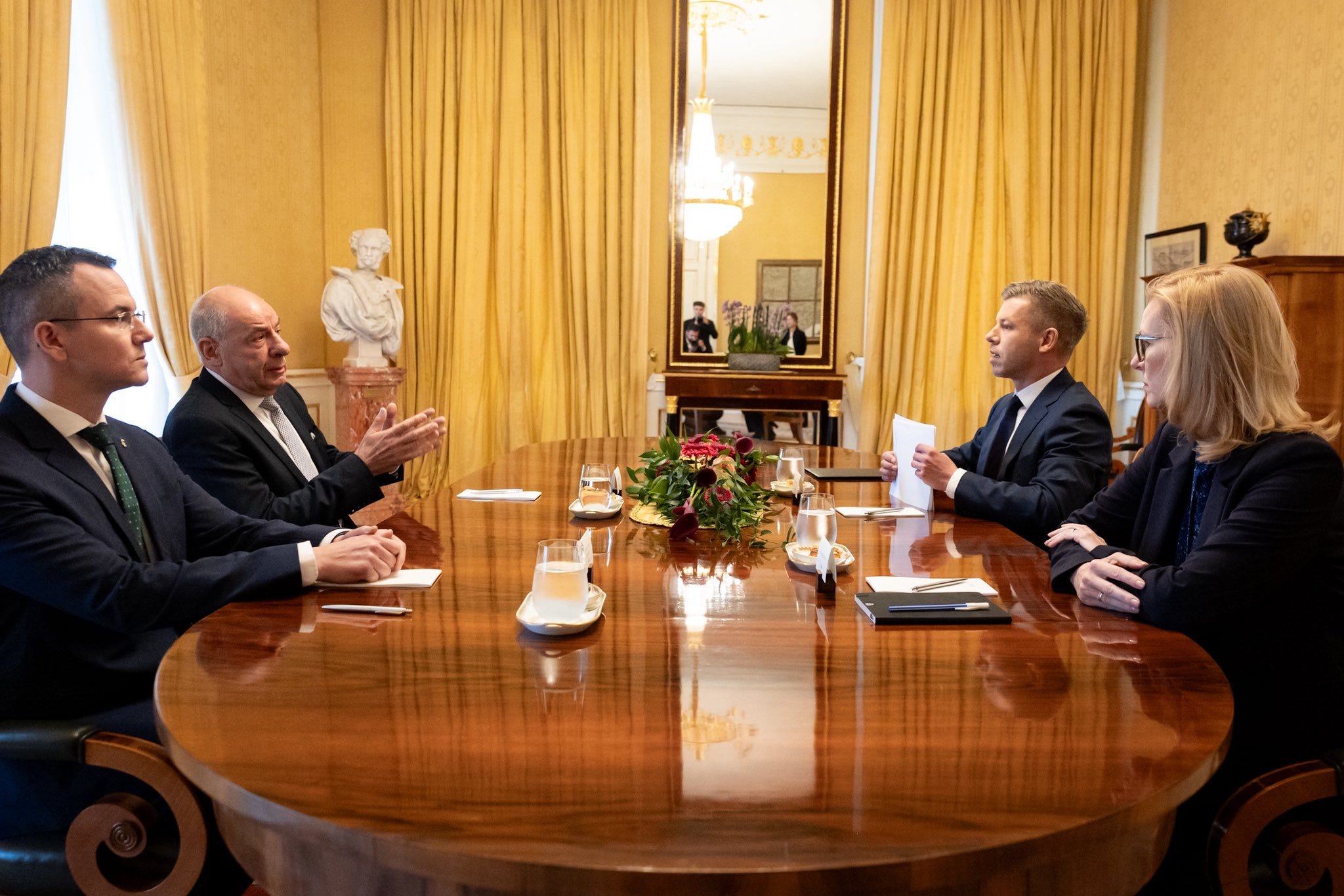
This image is used for illustrative purposes only.
On the morning of June 1, Péter Magyar — Hungary’s new prime minister, who took office just over three weeks ago — walked into the presidential Sándor Palace in Budapest for what turned out to be a decisive meeting. He walked out having received the answer he had been expecting: Tamás Sulyok, Hungary’s largely ceremonial head of state, would not resign.
The confrontation has been building since April, when Magyar’s Tisza Party won a landslide victory that ended 16 years of rule by Viktor Orbán’s Fidesz party. Magyar had given Sulyok until midnight on Sunday, May 31, to vacate the presidency voluntarily. The deadline passed without a resignation.
A president who won’t go
Speaking at a press conference outside Sándor Palace on Monday, Magyar announced that he would brief Tisza lawmakers immediately and launch the “necessary procedures” to remove Sulyok from office. He estimated the process would take roughly a month.
Tamás Sulyok, 70, a former lawyer who previously served as president of Hungary’s Constitutional Court — a position he obtained through Fidesz votes in November 2016 — had responded to the ultimatum the evening before by posting a video on Facebook. In it, he said he was awaiting the opinion of the Venice Commission, the Council of Europe’s advisory body on constitutional matters, and demanded that his case be handled through proper constitutional channels.
Magyar was unmoved.
“Hungary does not belong to Tamás Sulyok, nor to Viktor Orbán.”
Fidesz, the party Orbán leads, fired back, calling Magyar’s demand an “illegal ultimatum” and arguing that Sulyok holds a mandate that runs through 2029 and cannot be terminated outside very specific constitutional conditions.
A constitutional amendment — but not a targeted one
Magyar’s position is precise in its logic, deliberately vague in its mechanics. He specified that the constitutional amendment his government is preparing would not be a law designed to remove one person, but a broader framework that could apply to other institutional leaders who are deemed to have failed their constitutional responsibilities. He also signaled that the reform could include the direct popular election of Hungary’s president — currently elected by parliament — though details remain to be worked out with Tisza MPs.
Tisza holds 141 of 199 seats in Hungary’s National Assembly — exactly the two-thirds supermajority required to amend the Fundamental Law without needing a single vote from the opposition.
The power mechanics behind the standoff
Hungary’s presidency is largely ceremonial. But it is not inconsequential. The president is responsible for signing legislation into law and holds the power to refer bills passed by parliament to the Constitutional Court for judicial review. In a governing program centered on sweeping institutional reforms — of labor law, media regulation, the judiciary, and the budget framework — the presence of a head of state appointed by the previous regime is seen by Magyar’s supporters as a potential veto point on every major piece of legislation.
That is precisely Magyar’s argument. Sulyok, he contends, has never defended the rule of law or national unity, but prioritized loyalty to Fidesz. Sulyok has not publicly addressed these accusations on the merits. His documented response has been limited to invoking the Venice Commission and repeating that he will not resign.
Institution by institution
The presidential standoff is the highest-profile move in a broader operation Magyar has described as removing “all the puppets.” He has also called for the departure of Hungary’s Prosecutor General Gábor Bálint Nagy; the president of the Constitutional Court, Péter Polt, and all 14 of its members; the president of Hungary’s Supreme Court (the Kúria), András Zs. Varga; the president of the National Office for the Judiciary, György Barna Senyei; the president of the State Audit Office, László Windisch; the head of Hungary’s competition authority, Csaba Balázs Rigó; and András Koltay, who chairs the country’s media regulatory authority.
All were appointed under the Orbán era. If Magyar’s institutional overhaul succeeds, it would represent one of the most sweeping post-authoritarian transitions in recent European Union history — a democratic reset by constitutional amendment, targeting a system that was deliberately built to outlast any single electoral defeat.
What this moment actually tests
The Hungarian situation poses a question that European constitutional theory has not yet fully worked through: how does one dismantle an autocratic system that was constructed in formal compliance with constitutional rules?
Viktor Orbán never technically violated Hungary’s constitution — he rewrote it. He won legitimate elections and used his supermajorities to place loyalists at the head of every institution capable of checking his power. Magyar now finds himself in a structurally symmetrical position: the same supermajority, the same constitutional tools, and an electoral mandate just as unambiguous. The question is not legal — it is political.
The Venice Commission, to which Sulyok has appealed, could serve as a guardrail. Its opinions are non-binding, but carry weight in the European debate over the rule of law. How Magyar handles that opinion — whether he incorporates, sidelines, or ignores it — will say a great deal about the nature of the governing model he intends to build in Orbán’s place.
It is plausible that the constitutional reform will move quickly: Magyar has the votes, the political momentum, and a public that, after 16 years of Fidesz dominance, largely supports the reset. What remains uncertain is the shape of the reformed presidency — and whether a directly elected president, if that option is ultimately adopted, would genuinely strengthen Hungarian democracy or create a new rival power center capable of clashing with the executive.
The bottom line
Hungary is testing, in real time, an equation other democracies may eventually face: can you dismantle institutional capture using the same constitutional tools that made it possible? The answer Budapest gives in the coming weeks will matter far beyond Hungary. It will be watched closely by everyone — in Europe and beyond — who is trying to understand what rebuilding the rule of law actually looks like, after it has been methodically hollowed out from within.
Sources: France 24 · Euronews · Al Jazeera English · AP News