
Macron–Lukashenko: one phone call, two very different stories
Macron urged Belarusian President Alexander Lukashenko on Sunday not to let his country be dragged into Russia's war against Ukraine.

Minsk confirmed the call — but not what was said. That gap alone tells you something.
At a Glance
French President Emmanuel Macron called Alexander Lukashenko, Belarus’s authoritarian leader, on Sunday to warn him against allowing his country to be drawn into Russia’s war of aggression against Ukraine.
Both capitals confirmed the call took place, but issued starkly different accounts of its substance.
The conversation came as Russia launched one of its largest aerial assaults of the war overnight, striking Ukraine with 600 drones and 90 missiles — including an Oreshnik intermediate-range ballistic missile capable of carrying a nuclear warhead.
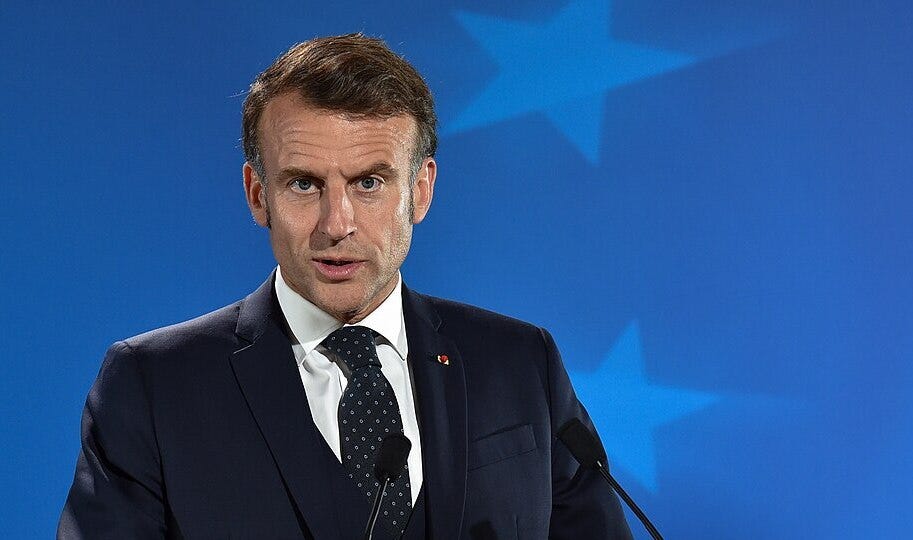
This image is used for illustrative purposes only.
One clear message, one carefully blank response
The call took place Sunday, at France’s initiative. The Élysée, the French presidential palace, was explicit about its purpose: Macron warned Lukashenko of the risks Belarus would face by allowing itself to be pulled into Russia’s war of aggression against Ukraine, and urged him to take concrete steps toward improving relations with Europe.
Minsk’s readout was conspicuously sparse. The Belarusian presidency said only that the two leaders had discussed regional issues and bilateral relations between Belarus, the EU, and France. No mention of Ukraine. No acknowledgment of any warning.
That silence is not incidental. It suggests Minsk chose not to publicly validate the French message — which could indicate the warning was received without being accepted.
The context: a night of maximum escalation
The call did not happen in a vacuum. In the hours before the two leaders spoke, Russia launched what Ukrainian air force officials described as an exceptionally large aerial assault: 690 airborne attack systems in total, including 600 drones and 90 missiles of various types. Among them was an Oreshnik intermediate-range ballistic missile — a system designed to carry nuclear warheads — which struck Bila Tserkva, a city roughly 50 miles south of Kyiv.
Russia’s Defense Ministry claimed all strikes had targeted military infrastructure. Ukrainian President Volodymyr Zelensky directly contradicted that account, documenting hits on residential buildings, an elementary school, a marketplace, and water supply facilities.
The preliminary death toll stood at four killed and more than 100 wounded across Kyiv and its surrounding region. The World Health Organization’s Kyiv office sustained damage from debris. Kaja Kallas, the EU’s foreign policy chief — roughly equivalent to a Secretary of State for the 27-member bloc — called it a reckless form of nuclear blackmail, describing the Oreshnik deployment as a deliberate political intimidation tactic. On X, Macron described Moscow’s posture as a headlong rush into the dead end of its own making [translated from French].
Analysis
Europe’s response, and why it matters beyond Ukraine
Sunday’s assault drew immediate condemnation from across the EU. Italian Prime Minister Giorgia Meloni condemned what she called “a progressive escalation in the weapons being used.” Kallas called the Oreshnik deployment a deliberate intimidation tactic.
For a non-European reader, the significance of that multilateral response is worth spelling out: unlike NATO, where the United States effectively sets the security agenda, the EU has no unified military command. Its collective condemnations carry political weight precisely because they are harder to engineer — they require consensus among 27 member states with deeply different historical relationships with Russia. When Brussels and Rome and Paris speak in unison, it is not automatic.
Belarus caught between two pressures
Belarus has hosted Russian troops and military equipment on its soil since before the February 2022 invasion. According to accounts assembled from the conflict’s early weeks, Russian armored columns had, via Belarusian territory, attempted to advance on Kyiv from the north before being forced into retreat. For several weeks now, Ukraine has said it fears Russia may attempt another northern offensive and has announced reinforced defenses along its border with Belarus.
Macron’s call fits within that logic: applying diplomatic pressure before a deeper military entanglement makes the situation irreversible. It is consistent with France’s doctrine of keeping all communication channels open — even with adversaries — but its practical effect remains to be seen.
Lukashenko: an ally with limited room to maneuver
The degree of real autonomy Lukashenko retains vis-à-vis Moscow is a question that deserves careful handling. His political survival following the brutal crackdown on pro-democracy protests in 2020 would appear to have depended heavily on Russian support — though the precise nature of that dependency cannot be formally established from available sources. That structural constraint, if real, would leave him with little ability to resist Russian pressure for deeper military involvement.
Macron almost certainly knows this. His call may therefore serve a dual function: sending a public signal to Lukashenko, while also building a diplomatic record — documenting that Europe gave warning before events made that warning moot.
The Oreshnik as a deliberate signal
Russia’s use of the Oreshnik warrants separate attention. The missile, an intermediate-range ballistic system capable of carrying nuclear warheads, has reportedly been deployed against Ukraine on at least two prior occasions — against Dnipro in November 2024 and Lviv in January 2026 — making Sunday’s strike its third known use in the war. Its repeated deployment in overnight strikes, each time claimed to target only military sites, fits a pattern of gradual normalization: making a nuclear-capable weapon feel routine. Whether that strategy is shifting Western red lines remains to be seen.
The Bottom Line
A phone call does not stop a war. But it fixes positions on the record — and in the geopolitics of active crises, documented positions are often what matters later.
The real question is not whether Macron convinced Lukashenko on Sunday. It is whether Belarus still possesses enough sovereign space to choose a different course — or whether that choice has already been taken away from it.
Sources: AFP